

Sustaining change is the unglamorous half of every transformation. The launch gets the celebration, the all-staff email and the photo of the project team holding a cake. Then the steering committee moves on, the project team is reassigned, and the people who actually have to work this way every day are left to sort out the rough edges on their own. Six months later, the new system is live, but half the team still runs the old spreadsheet “just to be safe”.
That pattern has a name in this article: the change recovery gap. It’s the distance between the day a change goes live and the day it genuinely becomes normal. This guide explains why so many Australian organisations launch change programs but never fully stabilise them, what it costs, and how to close the gap by sustaining change with practical steps. It’s written for change managers, project leaders, HR professionals and any manager who has ever inherited a half-finished transformation.
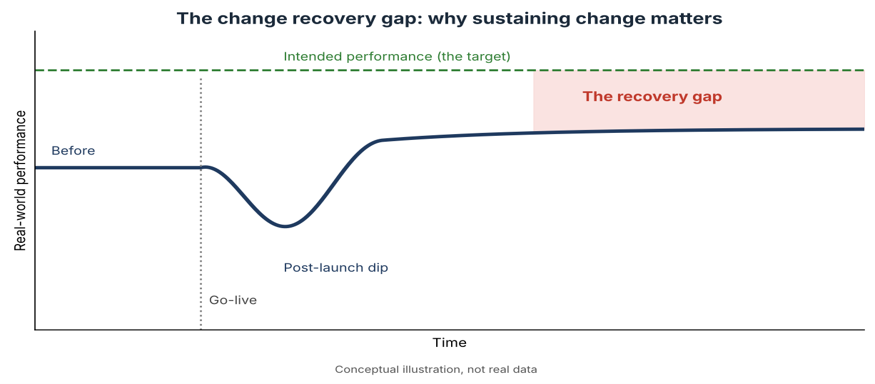
Image alt text: Sustaining change diagram showing the recovery gap between performance after go-live and the intended target
What Is the Change Recovery Gap?
Almost every significant change causes a dip. People are learning new tools, new processes or new reporting lines, so productivity and confidence drop for a while. In a healthy change, performance climbs back and eventually passes where it started. In an unstable one, it recovers only part of the way and then stalls, sitting below the level the business case promised.
The recovery gap is the space between where performance settles and where it was meant to be. It rarely shows up as a dramatic failure. Instead, it appears as a collection of small compromises: workarounds, duplicate records, extra approvals and “temporary” fixes that quietly become permanent. The programme is officially complete, yet the organisation never fully lands.
This is why sustaining change deserves as much planning as the launch itself. A go-live date is an event. Stability is an outcome, and it has to be built.
Why Organisations Launch Change but Never Fully Stabilise It
Unstable change rarely comes from one big mistake. It tends to come from a handful of ordinary habits that add up.
1. Funding and attention end at go-live
Most change programs are funded to deliver, not to embed. When the budget closes at launch, the people best placed to support adoption are gone just when the questions start. Sustaining change then becomes an unfunded favour that nobody has time to do.
2. The sponsor and the team move on
Executives change roles, priorities shift and new leaders want their own agenda. When the original sponsor leaves, the change can lose direction overnight, a pattern we explore in our article on the sponsor reset problem.
3. Nobody owns the outcome after launch
Delivery has a clear owner. Stability often doesn’t. Everyone supports the change in principle, yet nobody is accountable for whether it actually sticks. We look at this in detail in our piece on the change accountability gap.
4. The next initiative arrives before the last one settles
Organisations rarely change one thing at a time. A new program lands on the same teams before the previous one has bedded in, so nothing is ever fully embedded. Read more about this in our articles on the initiative collision problem and the change capacity problem.
5. Success is measured by delivery, not adoption
“On time and on budget” is easy to report. “Used properly by the people it was built for” is harder, so it often goes unmeasured. A project can be declared a success while the real outcome is still unclear, which is why sustaining change often goes unmeasured.
6. Reinforcement is treated as optional
Training sessions and launch communications get planned. Ongoing reinforcement, such as leaders modelling the new behaviour, updated procedures and recognition for people who adopt the change, tends to be left off the plan. Without it, old habits quietly win.
7. Workarounds become the real process
When a new process is awkward, people invent a way around it. The workaround spreads informally, often through respected colleagues rather than managers, which is where informal influence shapes what really happens. Soon the workaround is the process, and the official one exists only on paper.
What the Change Models Say About Sustaining Change
The best-known change models all treat sustaining change as a distinct job, not an afterthought:
- Lewin’s model. Kurt Lewin described change as unfreezing, changing and then refreezing. The final stage is about making the new way of working stick.
- Kotter’s eight steps. John Kotter’s approach finishes by anchoring new approaches in the culture, after building on early wins rather than declaring victory too soon.
- The ADKAR model ends with reinforcement, the step that keeps people from slipping back into familiar habits.
- Bridges’ Transition Model. William Bridges separated the external change from the internal transition, a reminder that people need time to move through an ending and a neutral zone before a new beginning feels normal.
Different language, same message: launching a change and landing it are two separate pieces of work. You can read a broader overview of the field on the change management page.
The Hidden Cost of Change That Never Stabilises
Failing at sustaining change is expensive even when nobody is counting. The bill arrives in several quiet ways:
- Running two systems. Old and new processes continue side by side, doubling the effort.
- Lost benefits. The savings or improvements in the business case never fully appear.
- Change fatigue. Staff become weary of programs that start strongly and fade away. We cover this in our piece on the adaptation tax and the change hangover.
- Eroded credibility. Each half-finished change makes the next one harder to sell. Our articles on change credibility and organisational trust explain why people stop believing.
- Higher risk. Inconsistent processes create errors, compliance gaps and customer frustration.
It’s worth remembering that the popular claim that most change programs fail is itself debated. A 2011 paper in the Journal of Change Management questioned where the commonly quoted failure figure came from. The better question isn’t how many fail, but how many stabilise fully, and most organisations can’t answer that.
Warning Signs Your Change Has Not Fully Stabilised
You don’t need a formal review to see that sustaining change has slipped. Watch for these signals:
- People still keep the old spreadsheet, form or system “just in case”.
- Different teams follow different versions of the new process.
- Support requests stay high months after go-live.
- Leaders talk about the change in the past tense, even though behaviour hasn’t shifted.
- Nobody can say who is responsible for the benefits.
- The same questions and complaints keep returning after each training session.
How to Close the Change Recovery Gap: A Practical Plan
Sustaining change is a discipline you can plan, resource and measure. Here is a step-by-step approach that works for most organisations:
- Plan for sustainment from day one. Include stabilisation in the original plan, budget and timeline, not as a vague phase that follows “later”.
- Define what “stable” means. Agree measurable signs of success, such as adoption levels, proficiency and benefits realised, so everyone knows when the work is truly done.
- Name a business owner for the outcome. One accountable leader should own results after the project team disbands, with authority and time to act.
- Run hypercare, then hand over properly. Hypercare is a short period of extra support after go-live. Follow it with a structured transition to business as usual, with clear contacts and documented procedures.
- Track adoption, not just delivery. Measure how many people use the new approach, how well they use it and whether results match the plan.
- Reinforce through leaders and systems. Have managers model the new behaviour, update KPIs and procedures, and recognise people who adopt it.
- Close the escape hatches. Retire old systems, forms and reports once the new way is ready, so there’s no easy route back.
- Listen to the frontline. Create simple feedback channels and act on what you hear. Our article on the change translation gap shows how strategy gets lost on the way to the front line.
- Protect capacity. Sequence initiatives so teams can absorb one change before the next one arrives, and review progress at regular intervals after launch.
How to Measure Whether Change Has Stabilised
If you can’t measure stability, sustaining change becomes guesswork. These indicators give a practical picture:
- Adoption rate. The share of intended users actually working the new way.
- How confidently and correctly people use the new process or tool.
- Workaround count. How many unofficial alternatives are still in use.
- Benefits realised versus plan. Whether the promised savings or improvements are showing up.
- Support demand. Whether help requests are falling over time.
- Sentiment and credibility. What employees say when they’re asked directly.
Combine the numbers with conversations. Data shows what is happening, and a few honest discussions explain why.
Change Management Training That Builds Sustainment Skills
Sustaining change takes skills in stakeholder engagement, communication, leadership and measurement. Structured training gives managers and practitioners a shared language and a proven framework for sustaining change. Our courses include:
- Change Management Foundation, covering organisational context and approach, people and change, change leadership and teams, stakeholders and communication, and the work of the change manager.
- Change Management Practitioner, which builds a structured understanding of how to plan, implement and support organisational change.
- The full range of change management courses, including leadership-focused options for managers and team leaders.
The Foundation and Practitioner courses align with qualifications offered through APMG International. You can also read more practical advice on the change management blog, or see the FAQs for answers about who should attend.
Change Management Courses Across Australia: Online and In Person
Sustaining change works best when leaders, project teams and frontline managers share the same approach. Training is available live online from anywhere in Australia, and in person in selected cities. Find your city below:
- Change management course in Melbourne, with a training location in West Melbourne.
- Change management course in Sydney, with a training location in Surry Hills.
- Change management course in Brisbane, with a training location in Brisbane City.
- Change management course in Perth, available live online or in-house.
- Change management course in Adelaide, available live online or in-house.
- Change management course in Canberra, available live online or in-house.
You can also see the full locations page, learn more about us, or contact our team on 1800 159 151 to talk about the right course for you or your organisation.
Frequently Asked Questions About Sustaining Change
What is sustaining change?
Sustaining change means making sure a new way of working becomes the normal way of working, and stays that way. It covers reinforcement, support, measurement and ownership after go-live, so improvements don’t fade once the project team moves on.
Why do change programs fail to stabilise?
Common reasons include funding that ends at launch, a sponsor who moves on, unclear ownership of the outcome, new initiatives that arrive too soon, weak reinforcement and a focus on delivery rather than adoption.
What is the change recovery gap?
It is the gap between where performance settles after a change and where it was meant to be. Instead of a full recovery, the organisation stalls partway, often propped up by workarounds and extra effort.
How long does it take for change to stabilise?
There is no fixed timeframe. It depends on the size of the change, how many people it affects and how much support they get. A better approach to sustaining change is to agree measurable signs of stability up front and review progress at regular intervals.
What is hypercare in change management?
Hypercare is a period of heightened support immediately after go-live, when users need quick help and problems must be fixed fast. It should lead into a planned handover to business as usual rather than simply stopping.
Who is responsible for sustaining change?
A named business leader should own the outcome after the project ends, supported by line managers who reinforce the new behaviour day to day. Change practitioners help, but they can’t sustain change on their own.
Final Thoughts on Sustaining Change
Launching a change is a project. Sustaining change is a leadership habit. Organisations that close the recovery gap plan for stability from the start, fund the work beyond go-live, give someone real ownership and keep measuring what people actually do. They also give teams enough breathing space to let one change settle before starting the next.
If you’d like to build the skills to lead change that sticks, explore our change management courses in Australia or speak with a course advisor today.