

The change capacity problem is what happens when an organisation keeps saying yes to new initiatives, while the people who must deliver them are already stretched to their limit. A new system lands in March, a restructure follows in June, and a culture programme is announced in September. Meanwhile, everyone still has a day job.
If you work in an Australian business, government agency or not-for-profit, you have probably felt this. Each project looks sensible on its own, yet together they leave staff tired, sceptical and unable to absorb anything more. Let us look at why the change capacity problem happens, what it costs, and how to fix it with better planning and practical change management training.
What Is the Change Capacity Problem?
Change capacity is the amount of change that people and teams can realistically absorb while still doing their normal work. It depends on time, energy, skills, support and trust. Every organisation has a limit, even if nobody has measured it.
The change capacity problem appears when the demand for change grows faster than that limit. Leaders keep approving projects because each one has a good business case. But nobody adds up the total load on the same teams, so the organisation runs past its capacity without noticing.
Why Organisations Keep Launching New Initiatives Anyway
It is rarely careless. The change capacity problem builds from understandable pressures.
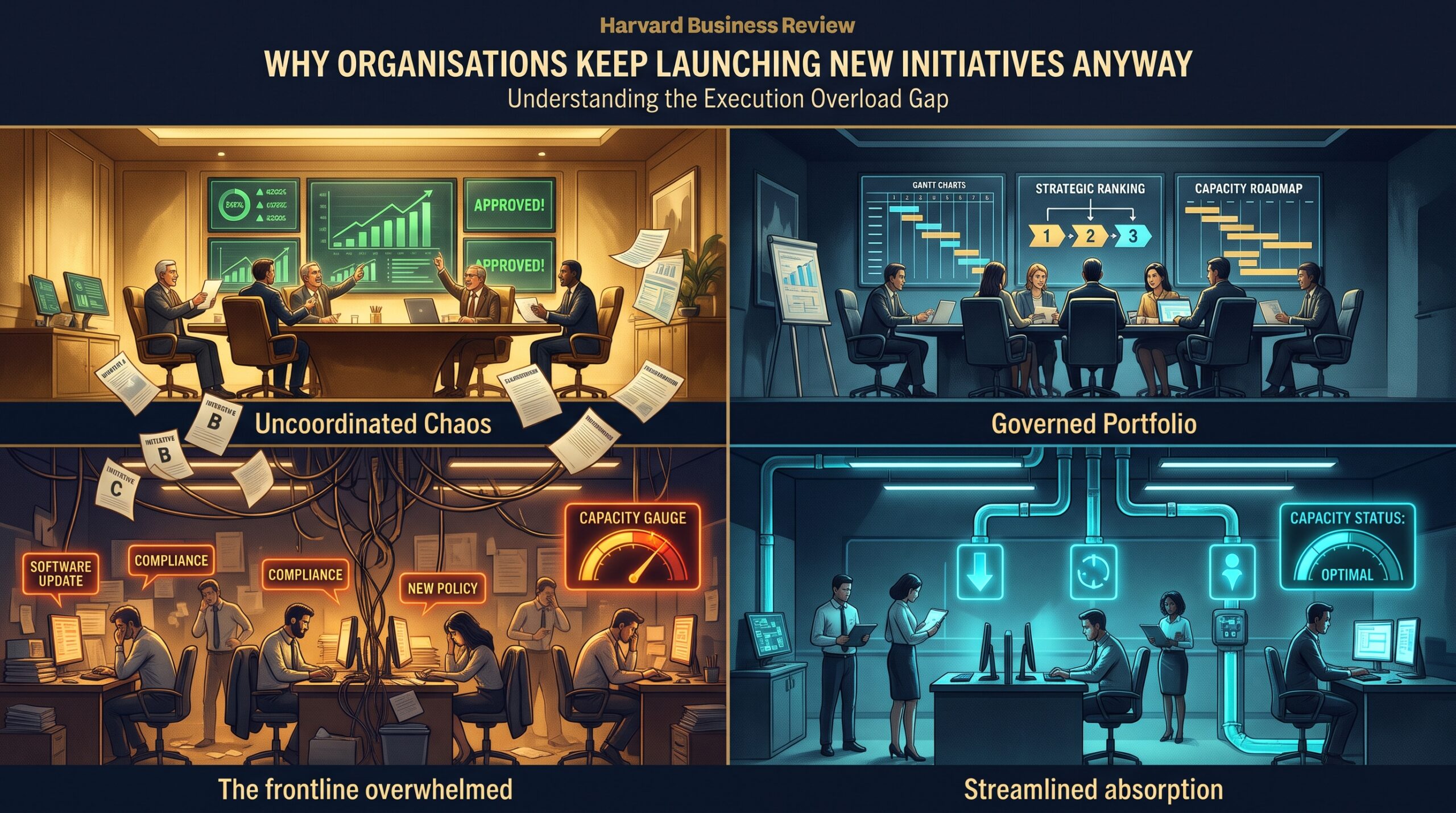
1. Every initiative is judged on its own
Business cases measure benefits and costs for one project. They rarely ask what else the affected teams are already dealing with. The sum of reasonable decisions becomes an unreasonable workload.
2. Sponsors compete for attention
Each executive wants their priority to succeed, and each assumes staff will find the time. Without a shared view, the same frontline teams are pulled in several directions at once.
3. Business as usual is invisible
Plans count project tasks, not the daily work that keeps the organisation running. Staff are expected to attend training, test systems and learn new processes on top of a full workload.
4. Saying no feels risky
Pausing or delaying an initiative can look like a lack of ambition. It feels safer to keep adding and hope people cope.
5. Launch is celebrated, adoption is not
Success is declared when a project goes live. The real work of changing habits continues for months, and it demands capacity that was never planned. Our article on the change hangover explores what the morning after a transformation really looks like.
6. Nobody owns the total picture
Project offices track projects. HR tracks engagement. Operations track performance. Few organisations track the combined change load on each team.
7. Past change has used up goodwill
When earlier initiatives were poorly handled, people become cautious about the next one. This is part of what we call the trust budget: every change spends it.
The Real Cost of the Change Capacity Problem
- Change fatigue and burnout. Constant disruption drains energy and goodwill. Safe Work Australia identifies poorly managed organisational change as a psychosocial hazard, so it is a wellbeing issue as well as a performance one. You can find guidance on Safe Work Australia.
- Low adoption. People who are overloaded comply on the surface but never truly change how they work.
- Delivery delays. Projects slip because the same people are needed on several at once.
- Quality and safety risks. Tired, distracted staff make more mistakes in their everyday work.
- Lost talent. Capable people leave rather than face another round of disruption.
- Hidden ongoing costs. Each change takes effort to learn and absorb, a cost we describe in the adaptation tax.
Warning Signs of the Change Capacity Problem
Check how many of these sound familiar:
- Staff say “another change?” before they hear the details.
- Training attendance and engagement with new tools keep falling.
- The same teams appear in the impact list of several projects.
- Projects launch on time but adoption stays low.
- Managers cannot say how many changes their team is currently absorbing.
- Initiatives are added to the portfolio without anything being paused or stopped.
If several apply, your organisation may already have a change capacity problem.
How to Fix the Change Capacity Problem
You do not need to stop all change. You need to see the total load and manage it deliberately.
Step 1: Build a single view of all change
List every current and planned initiative, including small ones, and who they affect. Put them in one place that leaders can see, not just inside separate project plans.
Step 2: Assess the impact on each group
For every initiative, estimate how much it will change daily work for each team, and when. A simple change impact assessment is enough to start.
Step 3: Create a change heatmap
Map teams against months and shade the periods of heavy change. The hot spots show where capacity is most at risk, and they are often a surprise to leadership.
Step 4: Measure capacity, not just demand
Ask teams how much time they genuinely have for change after normal work, and track signs of strain such as overtime, absenteeism and survey feedback. Capacity is a limit to plan around, not an assumption.
Step 5: Sequence and trade off
Use the heatmap to decide what goes first, what can wait and what can be combined. If something new is added, something else moves, shrinks or stops. A portfolio view, often supported by a PMO, makes these trade-offs visible.
Step 6: Protect people during critical periods
Avoid stacking go-lives on the same teams, and keep quiet windows around peak business periods such as end of financial year, retail seasons or audits.
Step 7: Plan adoption as carefully as delivery
Allow time and resources for coaching, practice and reinforcement after launch. Frameworks like ADKAR from Prosci and the approach taught by APMG International treat awareness, desire, knowledge, ability and reinforcement as real work that takes capacity.
Step 8: Be honest about the cost of delay too
Capacity management is not an excuse to avoid change forever. Delaying necessary change also has a price, as explained in our look at the cost of delaying change. The goal is smart pacing, not paralysis.
Step 9: Review quarterly
Revisit the change portfolio every quarter. Update the heatmap, ask teams how they are coping and adjust the plan before fatigue becomes resistance.
Skills That Help Leaders Solve the Change Capacity Problem
Managing capacity takes more than a spreadsheet. Leaders and change practitioners need to understand how people experience change, how to assess impact, how to communicate honestly and how to challenge unrealistic plans. Professional communities such as the Change Management Institute and the Australian Institute of Project Management offer standards, events and guidance for practitioners.
Our Change Management Foundation course introduces the core principles, including organisational context, people and change, leadership, stakeholders and communication. For deeper, practical application, the Change Management Practitioner course shows you how to plan, implement and support change in real organisations. You can also explore all options on our change management courses page.
Study in your city or online across Australia:
- Change management course in Melbourne
- Change management course in Sydney
- Change management course in Brisbane
- Change management course in Perth
- Change management course in Adelaide
- Change management course in Canberra
See all course locations, learn more about us, read the FAQs, or browse more articles on our change management blogs.
Frequently Asked Questions About the Change Capacity Problem
What is the change capacity problem?
It is when an organisation launches more change than its people can realistically absorb alongside their normal work, leading to fatigue, low adoption and delays.
What is change capacity?
Change capacity is the amount of change a team can handle at one time while still delivering day-to-day work, based on their time, energy, skills and support.
How do I know if my team has a change capacity problem?
Common signs include rising fatigue, falling engagement, missed deadlines, low adoption of new tools and frequent comments like “not another project”.
How can I measure change load?
Use change impact assessments for each initiative and combine them in a heatmap showing which teams are affected, when and how much. Pair this with feedback from the teams.
Does managing capacity mean slowing down change?
Not necessarily. It means sequencing and pacing change so it can actually be adopted. Well-paced change often delivers benefits faster than overloaded change that never sticks.
Final Thoughts: Respect the Limits of the People Doing the Work
The change capacity problem is not a sign that employees resist progress. It is a sign that organisations have not counted the human cost of their ambition. Build one view of all change, measure the impact on each team, sequence initiatives deliberately and plan for adoption. When leaders respect capacity, change stops feeling like a constant wave and starts becoming something people can actually absorb.
Ready to build your change skills? Call 1300 649 299 or contact our team to find the right change management course in Melbourne, Sydney, Brisbane, Perth, Adelaide, Canberra or online.