

The change accountability gap is the reason so many well-supported transformations still fail to deliver. The executive team backs the program. The project team hits the go-live date. Managers say all the right things in the town hall. Six months later, people are still working the old way, the promised benefits have not appeared, and when someone asks who is responsible for the result, the room goes quiet. This guide explains what the change accountability gap is, why it opens up in Australian organisations, what it costs, and how to close it with clear ownership, better measures and practical change management courses.
What Is the Change Accountability Gap?
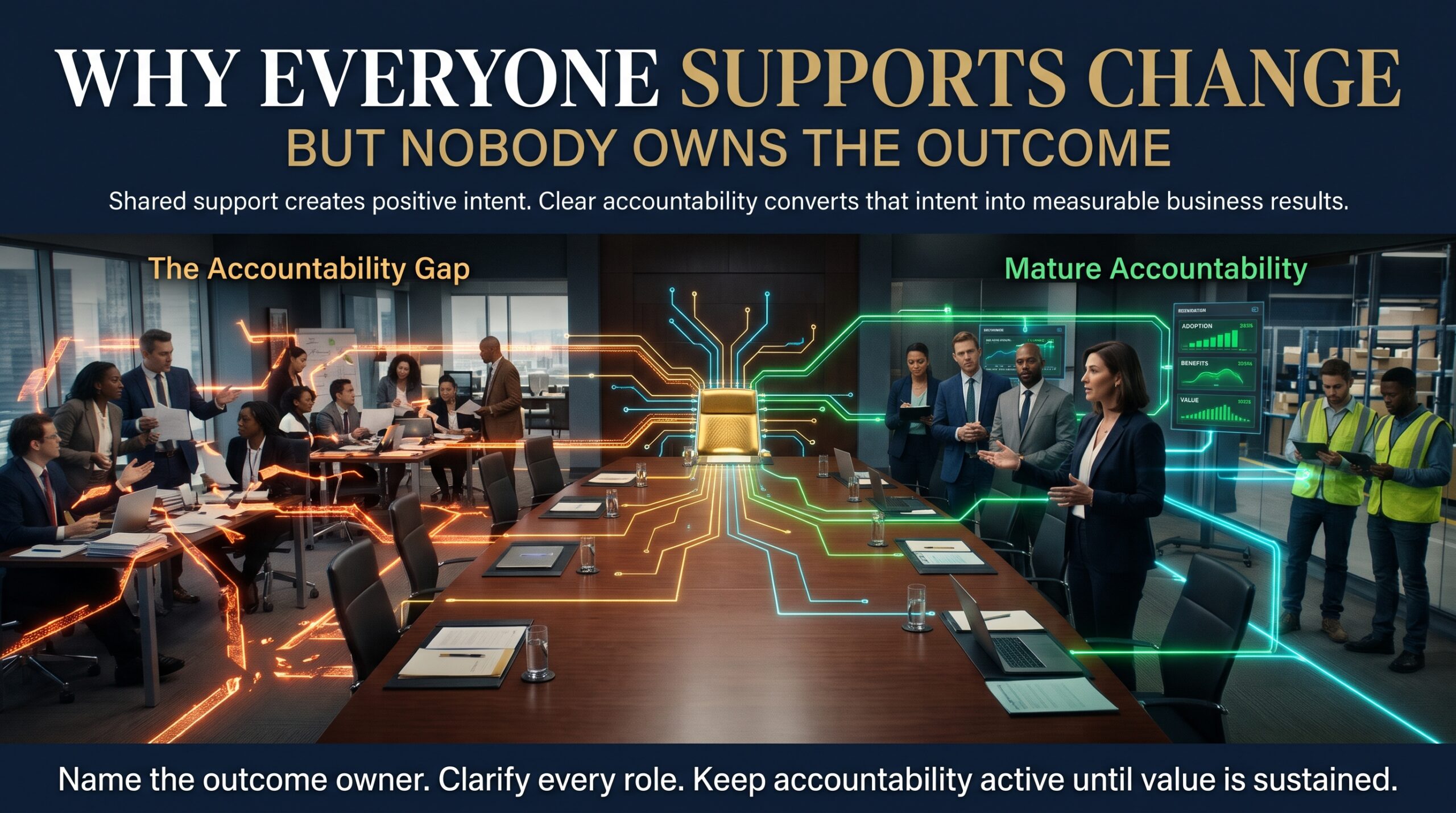
The change accountability gap is the space between supporting a change and being answerable for its outcome. Support is easy to give. People can agree with the vision, attend the briefing, sign the business case and sponsor the launch. Accountability is harder, because it means being the person who is held to account when adoption stalls or the benefits fail to arrive.
It helps to separate two ideas that are often confused. Responsibility is doing the work. Accountability is owning the result. Many people can be responsible for parts of a change, but one named person needs to be accountable for the outcome. When that name is missing, the change accountability gap appears.
It is closely connected to the issues we explore in our articles on the buy-in illusion and the employee buy-in gap. Both describe how agreement does not equal adoption, and the change accountability gap explains why nobody notices.
Why Everyone Supports Change but Nobody Owns the Outcome
Nobody sets out to leave a change unowned. The change accountability gap grows from how organisations plan and run projects.
1. Projects end, outcomes do not
A project has a start and an end date. The outcome, such as people using a new system properly or a new process producing real savings, lives long after the team has disbanded. If ownership is attached to the project, it vanishes at go-live.
2. Output is confused with outcome
Delivering the system, the training session or the communication pack is an output. Staff actually changing how they work is an outcome. Teams are often measured on outputs, so they are accountable for the wrong thing.
3. Sponsors are named but not active
An executive sponsor may be on the project charter without being clear about what they must do. When priorities shift, or a new executive arrives, direction can be lost, a pattern we describe in our article on the sponsor reset problem.
4. Change is treated as communication
Many organisations assume change management means sending announcements. Communication matters, but accountability for adoption needs decisions, resources and consequences, not only messages.
5. Line managers are asked to deliver without being equipped
The people closest to daily work shape whether a change sticks. If line managers are not briefed, trained or measured on adoption, nobody is steering behaviour where it counts.
6. Consensus culture
In organisations that value harmony, naming a single accountable person can feel uncomfortable. Shared ownership sounds fair, but in practice it often means nobody acts.
The Real Cost of the Change Accountability Gap
- Low adoption. The new system is installed, but people keep using workarounds and old spreadsheets.
- Benefits that never arrive. The business case promised savings or growth, but no one is tracking or pursuing them after launch.
- Rework and duplicate programs. Because the first change did not stick, a second program is launched to fix it, adding cost and fatigue.
- Change fatigue. Staff who see changes started and abandoned pay a cost every time, which we call the adaptation tax.
- Loss of credibility. Each unowned change reduces belief that the next one will be taken seriously. Our articles on change credibility and organisational trust explain how that trust gets spent.
- Growing change debt. Problems that are left unresolved accumulate, which is the theme of our article on the cost of delaying change.
- The morning-after effect. After the launch celebration, the organisation faces what we call the change hangover, with nobody owning the clean-up.
Put simply, the change accountability gap turns well-funded programs into expensive activity with no lasting result.
Warning Signs of the Change Accountability Gap
Be honest about how many of these apply to your organisation. Several ticks mean the change accountability gap is already at work.
- Everyone says they support the change, but nobody can say who is accountable for adoption.
- The project closes at go-live and the team moves on to the next initiative.
- Success is described as “delivered on time and on budget”, not “being used and delivering value”.
- There are no agreed measures for adoption, proficiency or benefits.
- The sponsor attends the kick-off and the launch, but not the weeks in between.
- Line managers learn about the change at the same time as their teams.
- When results disappoint, the discussion is about who is to blame, not what to do next.
- Several people say “I thought that was someone else’s job”.
How to Close the Change Accountability Gap: A Practical Plan
You do not need a large program to close the change accountability gap. You need clear decisions, made early and kept visible. Work through these steps in order.
- Name one accountable executive for the outcome. Choose a senior leader with the authority to remove barriers, secure resources and make trade-offs. A committee cannot be accountable.
- Define the outcome in measurable terms. Describe what will be different, such as percentage of staff using the new process, time saved or customer results, and set a date for review.
- Separate outputs from outcomes. Track both, but make leaders answer for outcomes.
- Write a simple accountability map. For each key activity, record who is responsible, who is accountable, who must be consulted and who is informed. A common RACI chart does this well.
- Give line managers a defined role. Brief them early, equip them with talking points and tools, and include adoption in their performance conversations.
- Keep the sponsor active. Agree what the sponsor will do each month, such as visible communication, removing blockers and reviewing adoption data.
- Assign a benefits owner for after go-live. Do not close the project until someone is named to own the benefits and the adoption results.
- Measure adoption, not attendance. Look at behaviour, system usage, error rates and feedback from the people affected.
- Plan for sponsor changes. If the sponsor leaves, hand over the outcome formally to the next leader, so direction does not reset.
- Review and learn. Hold a post-implementation review at a fixed point after launch and publish what was learned.
Many organisations close most of the change accountability gap by doing only the first four steps well. The remaining steps protect the result over time.
Legal and Workplace Considerations in Australian Change
Accountability also includes treating people fairly. Many modern awards and enterprise agreements require employers to consult employees about major workplace changes, and the Fair Work Ombudsman provides guidance on workplace obligations. Build consultation into your plan, record who is accountable for it, and take advice where a change affects roles, hours or locations.
Skills That Help Close the Change Accountability Gap
Naming an owner is only the first step. Owners, sponsors, managers and project teams need shared language and practical tools. Training the people involved in change together is one of the fastest ways to close the change accountability gap. Here is how our courses help.
A shared foundation. The Change Management Foundation course covers organisational context and approach, people and change, change leadership and teams, stakeholders and communication, and the work of the change manager. It gives sponsors, project managers, HR teams and managers a common starting point.
Applying change in practice. The Change Management Practitioner course builds on the foundation for professionals who plan, implement and support organisational change. You can read more about the qualification body at APMG International.
Frameworks you may meet. Many organisations use established models such as Kotter’s eight steps or the ADKAR model from Prosci. Whatever model you choose, the change accountability gap is solved by naming owners and measuring outcomes. The Australian Institute of Project Management is another useful reference point for project and program professionals.
You can also browse all of our change management courses or read our latest articles on the blog. For example, the change translation gap explains how strategy gets lost between leadership and frontline teams.
Change Accountability Gap Across Australian Cities
The change accountability gap appears in every industry and city. Here is where we often see it, and where you can train.
Sydney. Finance, technology and government organisations run frequent, complex programs, so ownership is often spread thinly. See our change management course in Sydney, available at our Surry Hills location or live online.
Melbourne. Healthcare, education, manufacturing and retail teams face constant transformation, from new systems to restructures. Explore our change management course in Melbourne, available in West Melbourne or live online.
Brisbane. Growing infrastructure, resources and services businesses need change that sticks after the launch. View our change management course in Brisbane, available in Brisbane City or live online.
Perth. Mining, energy and resources organisations run complex operational change across remote sites. Learn about our change management course in Perth, delivered live online or in-house.
Adelaide. Health, defence and education employers can benefit from clear ownership of change outcomes. Read about our change management course in Adelaide.
Canberra. Government agencies and suppliers deliver large reform programs where accountability must be explicit. See our change management course in Canberra, delivered live online or in-house.
We can also tailor in-house programs for your team. Browse every option on our locations page.
Change Accountability Gap: Frequently Asked Questions
What is the change accountability gap?
It is the gap between supporting a change and being answerable for its outcome. Many people back the change, but no single person is accountable for adoption and results.
Who is accountable for the outcome of organisational change?
Ideally one named senior leader, usually the executive sponsor or business owner of the area being changed. The project team and change manager support delivery, but accountability for the business outcome sits with the business.
What is the difference between responsibility and accountability in change?
Responsibility is doing the work, and many people can share it. Accountability is owning the result, and it should rest with one person.
How do you measure whether a change has been adopted?
Look at behaviour and results, such as system usage, process compliance, proficiency, error rates, customer outcomes and feedback, not just training attendance or communication reach.
Which change management course should I start with?
The Change Management Foundation course is a good starting point for sponsors, managers and project professionals. The Practitioner course suits people who will plan and implement change.
Close the Gap Before Your Next Change
The change accountability gap is not a sign that people do not care. It is a sign that care has not been turned into ownership. Name an accountable leader, define the outcome, give managers a role, measure adoption and keep the sponsor active, and your next change has a far better chance of lasting.
If you want your leaders and teams to share the same tools, review our change management courses, read the FAQs or contact our team to choose the right course. Start closing the change accountability gap today.