
Change translation is the work of turning a leadership strategy into something a frontline team can understand, believe and actually do on Monday morning. When it is missing, even a brilliant strategy arrives at the front line as noise.
Picture a familiar scene. The executive team spends months shaping a transformation. The strategy is sharp, the slides are polished and the all-hands presentation goes well. Three weeks later, a team leader in a warehouse, a contact centre or a clinic is asked, “So what does this mean for us?” and the honest answer is, “I am not sure, but I think it means more work.” Nobody failed to communicate. The message simply never got translated.
This is the change translation gap, and it is one of the quietest reasons strategies stall. In this guide we look at why it opens, what it costs, how to close it with practical steps and which skills help you become the translator your organisation needs. We also point to training for teams in Sydney, Melbourne, Brisbane, Perth, Adelaide and Canberra.
What Is Change Translation, and Why Does It Matter?
Leaders talk about direction: growth, efficiency, customer experience, digital capability. Frontline teams live in details: this system, this shift, this customer, this target. Change translation sits between the two. It answers the question every employee quietly asks, “What does this change mean for my work, and what do I need to do differently?”
It is not the same as communication. A message can be sent clearly and still not be translated. Translation means adapting the message to each role, in language people use, with specific actions attached. It is the difference between announcing a change and making it usable.
The reason it matters is simple. Strategy only creates value when people change how they work. That change happens at the front line, not in the boardroom, so the quality of change translation largely decides the quality of the outcome.
Why Strategy Gets Lost Between Leadership and Frontline Teams
The gap rarely comes from one big mistake. It builds through several ordinary habits.
- Strategy is written in leadership language. Phrases like “operating model”, “value streams” and “digital-first” mean a lot in a workshop and almost nothing at a service counter.
- Messages pass through too many hands. Each level of the cascade softens, trims or reinterprets the message, a bit like the old game of telephone.
- Nobody maps the impact by role. Leaders describe the destination but not what changes for a payroll officer, a site supervisor or a nurse unit manager.
- Middle managers are squeezed. They are expected to translate and sell the change, often without early briefings, preparation or time.
- Communication is mostly one-way. Frontline questions and concerns never travel back up, so leaders cannot see where the message broke.
- The timing is off. Leaders have lived with the idea for months. Frontline teams hear it for the first time and are expected to adopt it within weeks.
- Day-to-day priorities compete. If targets and rosters stay the same, employees quietly choose the old way, because that is what they are measured on.
What Leadership Says vs What the Frontline Hears
One of the simplest ways to see the gap is to compare what is said with what is heard, then with what a translated message looks like.
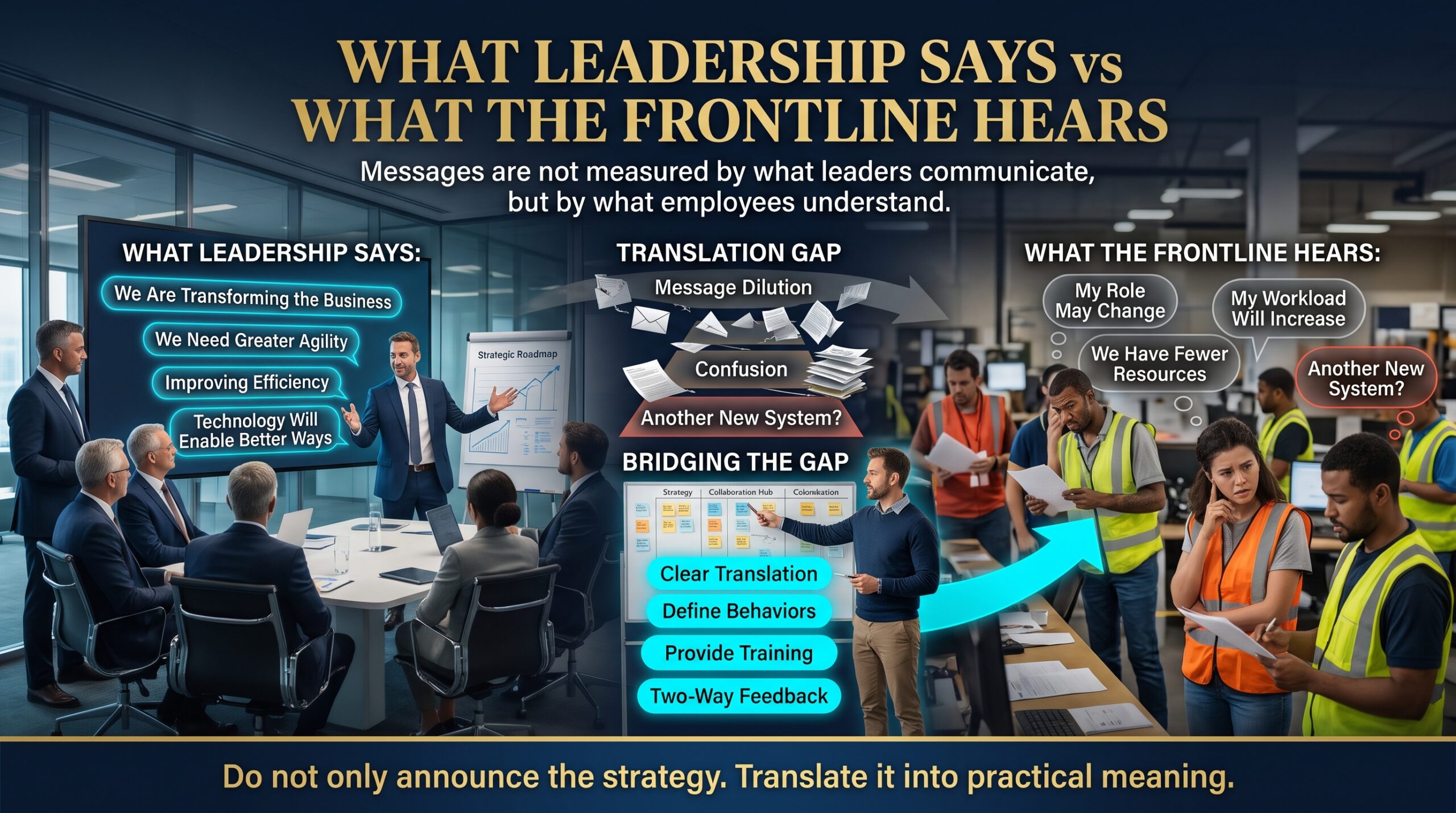
| Leadership says | Frontline often hears | A translated version |
| “We are moving to a digital-first customer experience.” | “We are being replaced by a chatbot.” | “From March, most simple requests will be handled online, so your time moves to complex cases. Here is the training you will get first.” |
| “We are streamlining our operating model.” | “Jobs are going.” | “Three approval steps become one. Here is what that means for your team’s daily process and who to ask.” |
| “We are adopting a single enterprise platform.” | “More logins and more data entry.” | “The new platform replaces four systems. In the first month you will use it for X only, with a coach on site.” |
| “We need to become more agile.” | “Even more meetings.” | “Teams will plan in two-week cycles. Here is what you stop doing, what you start and how decisions get made.” |
Notice that the translated version is specific, time-bound and honest about what changes. Good change translation does not hide the difficult parts. It makes them understandable, which is what builds trust. If you want to explore that link, read our article on organisational trust and change.
The Real Cost of the Change Translation Gap
When translation fails, the business rarely sees one dramatic failure. It sees a slow leak.
- Adoption that looks fine on launch day, then fades as people drift back to the old way of working.
- Rumours filling the vacuum, with the least helpful version of the story spreading fastest.
- Frontline workarounds that quietly undermine the benefits the business case promised.
- Frustrated middle managers who feel responsible for something they were never equipped to explain.
- Leaders who conclude that “people resist change” when the real problem was that people never got a usable message.
- Lower credibility for the next change, because employees remember how the last one landed.
This links closely to the pattern we describe in the buy-in illusion, where employees agree with the change but never adopt it, and in why employees go back to the old way after training.
How ADKAR Shows Where Change Translation Breaks
The ADKAR model from Prosci describes individual change in five steps: Awareness, Desire, Knowledge, Ability and Reinforcement. It is a handy map for spotting where change translation has failed, because each step needs a different kind of message.
| ADKAR step | The question the employee asks | What good translation provides |
| Awareness | Why is this happening? | A plain-language reason connected to their work |
| Desire | What is in it for me, and what is at risk? | Honest answers about impact, support and opportunity |
| Knowledge | What exactly do I need to do? | Role-specific steps, examples and timing |
| Ability | Can I actually do it? | Practice, coaching and time to learn |
| Reinforcement | Will this stick, and does anyone notice? | Recognition, aligned targets and visible follow-through |
Most strategies do a reasonable job at Awareness and then stop. Frontline teams are left to work out Desire, Knowledge and Ability on their own. That is where the gap widens.
A Practical Plan to Close the Change Translation Gap
You do not need a large program to improve change translation. These steps work for a small team initiative and for a major transformation.
- Write the change in one plain sentence. If you cannot explain the change without jargon, the frontline never will. Test it on someone outside the project.
- Complete a role-based impact assessment. For each group, list what stops, what starts and what stays the same. Be specific about tools, tasks, timing and decisions.
- Brief and equip middle managers first. Give managers the story, the answers to likely questions and time to ask their own questions before they face their teams.
- Build a network of change champions. Pick respected people from the front line who can explain the change in their own words and surface concerns early.
- Translate it into “what changes on Monday”. Create simple, role-specific guides that describe the first week, not the five-year vision.
- Close the loop with two-way checks. Use short pulse surveys, team huddles and teach-back, where people explain the change in their own words so you can spot gaps in understanding.
- Reinforce and measure. Align targets, recognise early adopters and track adoption, not just attendance at briefings.
Each step is small. Together they turn a one-way announcement into a conversation, which is what change translation really is. For more on why trust and credibility make the difference, see our piece on the change credibility score.
How to Tell Whether Your Translation Is Working
You can check the health of change translation without a complex dashboard. Ask a handful of frontline employees, in their own words, three questions: What is changing? Why is it changing? What does it mean for my job? If the answers differ widely or sound like slogans, the message has not been translated.
| Signal | What it tells you | How to gather it |
| Teach-back accuracy | Whether people understand the change in their own words | Short conversations in team huddles |
| Questions reaching managers | Whether people feel safe raising concerns | Manager notes and champion feedback |
| Workaround rate | Whether people are quietly avoiding the new way | Process observation and system data |
| Time to first correct use | How quickly people can apply the change | Adoption data and coaching logs |
| Pulse survey clarity score | How clear the change feels to each team | Two or three question pulse surveys |
Where the Change Manager Fits
A strong change manager is a translator by trade. They move between the boardroom and the front line, listening in both directions, and they make sure each audience gets what it needs. In practice that means analysing stakeholders, shaping role-specific messages, coaching sponsors and managers, and tracking how well the change is landing.
Change translation skills can be learned. The Change Management Foundation course covers organisational context, people and change, change leadership and teams, stakeholders and communication, and the work of the change manager. The Change Management Practitioner course builds on that by focusing on how to plan, implement and support change in practice. Both are aligned with APMG International certification pathways.
Change Translation Across Australian Cities
The translation challenge looks a little different in every city, depending on who sits at the front line.
- Sydney: large head offices in finance and professional services often push strategy across many sites and teams, so role-level translation is essential.
- Melbourne: health, education, retail and state government organisations deal with large, varied frontline workforces.
- Brisbane: infrastructure, resources and public sector programs rely on managers translating change across projects and regional sites.
- Perth: mining and energy businesses often have remote sites and rostered shifts, which makes timing and consistency of messages a real test.
- Adelaide: defence, health and manufacturing teams need practical, safety-aware translation for operational roles.
- Canberra: federal agencies must carry policy and program change through to service delivery staff, often under close public scrutiny.
Wherever you work, you can study with live online instructors, and in-person options are available in major cities. See every option on our locations page.
Change Management Courses That Build Translation Skills
If you want to become the person who closes this gap, start with a structured course:
- Change Management Foundation: a strong starting point for managers, team leaders, project professionals and HR staff who want a shared language for change.
- Change Management Practitioner: ideal when you are ready to plan, deliver and support change in real initiatives.
Not sure which fits? Browse all change management courses, read the FAQs or call 1300 649 299 to speak with a course advisor. You can also explore more articles in our change management blog.
Frequently Asked Questions About Change Translation
What is change translation in change management?
It is the process of turning a leadership strategy into role-specific messages, actions and support that frontline teams can understand and apply in their daily work.
Why does strategy get lost between leadership and the front line?
Usually because messages are written in leadership language, pass through many levels, are not adapted to each role and are rarely checked for understanding. Middle managers also often lack the time and preparation to translate them.
Who is responsible for translating change to frontline teams?
Everyone has a part. Sponsors set the direction, change managers design the translation, middle managers carry it to their teams and champions help make it real. The key is that someone clearly owns the job.
How is change translation different from change communication?
Communication focuses on sending information. Translation focuses on whether people understand what it means for their role and know what to do. Good change translation includes feedback and checks for understanding.
What tools help close the change translation gap?
Role-based change impact assessments, stakeholder analysis, manager briefings, change champion networks, teach-back conversations and pulse surveys are all practical tools. Frameworks such as ADKAR help you see where understanding breaks down.
Which course should I take to learn change management?
Most professionals begin with Change Management Foundation and move on to Practitioner when they are ready to apply the approach in real initiatives.
Be the Translator Your Strategy Needs
Strategies rarely fail because leaders lacked vision. They stall because the vision never became something a frontline team could use. Closing the change translation gap does not require a bigger announcement. It requires clearer language, better support for managers and a habit of listening back.
If you want the skills to lead that work with confidence, explore our change management courses. Call 1300 649 299 or contact our team and we will help you choose the right pathway.