

Organisational trust is the budget nobody writes down, yet every change initiative spends it. Before a single process is redesigned or a new system goes live, employees have already decided how much belief they’re willing to lend the programme. That belief comes from past experience: the last restructure, the last “temporary” workaround that became permanent, the last promise that quietly disappeared. Spend it wisely and change moves quickly. Overspend it and even a brilliant plan stalls.
This guide explains the trust budget, how changes draw it down, how leaders accidentally go into deficit, and practical ways to protect it. You’ll also see which change management skills and APMG-aligned courses help, with options in Melbourne, Sydney, Brisbane, Perth, Adelaide and Canberra.
What Is the Trust Budget in Change Management?
The trust budget is a simple way to think about the goodwill, credibility and patience that employees extend to leaders during change. Like money, it has a balance. Honest communication, kept promises and visible support make deposits. Surprises, broken commitments and unexplained reversals make withdrawals.
Every change asks people to accept something uncertain: new tools, new reporting lines, new ways of working. They only do that when they believe leaders are competent, honest and acting with their interests in mind. Annual research such as the Edelman Trust Barometer shows how central trust has become to how people view institutions, including their employers. Inside an organisation, that same dynamic decides whether a change sticks.
How Every Change Initiative Spends Organisational Trust
Change initiatives don’t just consume time and money. They consume organisational trust at predictable moments. The table below shows where the balance usually moves.
| Change moment | Trust is spent when… | Trust is earned when… |
| Announcement | People hear about it second-hand or late | Leaders explain the why before the what |
| Consultation | Feedback is requested but visibly ignored | Input changes the plan and people are told how |
| Timelines | Dates slip without explanation | Delays are announced early with reasons |
| Training | Sessions are generic and arrive after go-live | Training is role-specific and practical |
| Extra effort | Teams carry the load while leaders appear untouched | Leaders share the load and remove other work |
| Reversals | Decisions change with no explanation | Course corrections are owned openly |
| After go-live | Support disappears once the project closes | Support continues until new habits form |
Notice that none of these withdrawals are dramatic. Trust rarely collapses in one event. It leaks through dozens of small moments, which is why leaders often don’t notice until adoption stalls.
Why Change Fatigue Is Really a Trust Deficit
When people talk about change fatigue, they usually mean “we’ve done this before and it didn’t end well”. Employees who have lived through unfinished or poorly explained programmes approach the next one with a smaller trust balance. The new project inherits the old project’s debts.
That’s why a technically sound plan can still meet quiet resistance. The problem isn’t the content of the change. It’s the account it’s drawing from. We explore the behavioural side in Why Employees Support Change but Don’t Change Their Behaviour and The Buy-In Illusion.
Five Ways Leaders Overspend Organisational Trust
- Announcing before they’re ready. A vague announcement invites rumours, and rumours fill every gap with worst-case stories.
- Promising what they can’t control. “Nobody will lose their job” or “this will be painless” are commitments that rarely survive contact with reality.
- Ignoring change history. Teams remember what happened last time. Leaders who skip that conversation look either naive or dismissive.
- Using generic messaging. Corporate language that says nothing about what changes for a nurse, a claims officer or a warehouse supervisor signals that nobody has thought it through.
- Rewarding speed over honesty. If bad news is punished, only good news reaches the sponsor, and the programme loses its early-warning system.
Picture a regional healthcare provider rolling out a new rostering system. Leadership announces the go-live date at an all-staff briefing but can’t yet explain how shift swaps will work. Staff hear the gap as “they haven’t thought about us”. Two months later the date slips quietly. By the time training starts, much of the trust has already been spent. Nothing about the software was wrong.
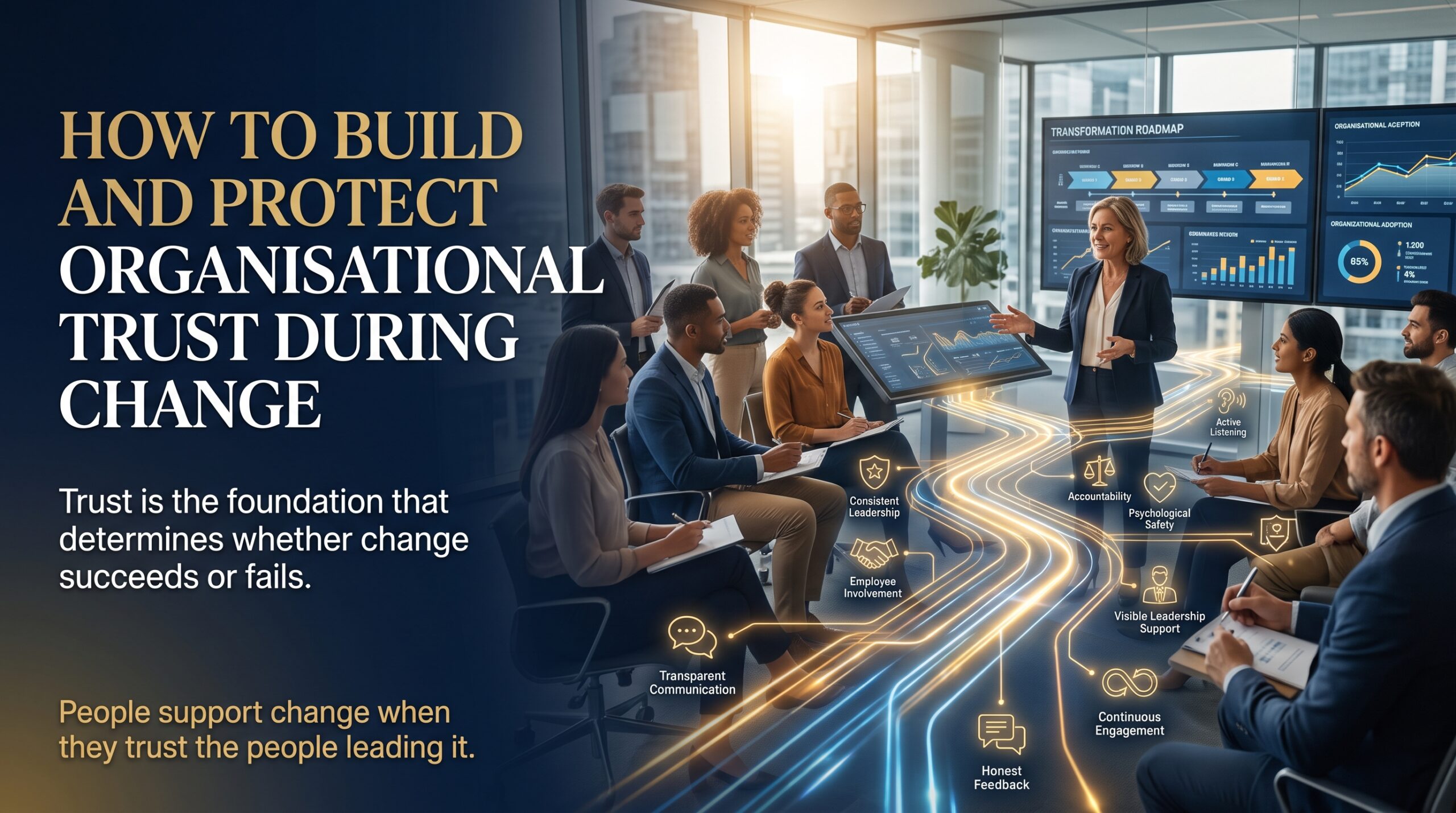
How to Build and Protect Organisational Trust During Change
Trust isn’t mysterious. David Maister’s well-known trust equation breaks it into credibility, reliability and closeness, reduced by self-interest. Change leaders can use the same four ideas as a practical checklist.
| Trust driver | What it means in change | What leaders can do |
| Credibility | People believe you understand the work | Involve frontline staff early and use their language |
| Reliability | You do what you said you would | Make fewer promises and keep every one |
| Closeness | People feel safe being honest with you | Hold open Q&A sessions and listen without defending |
| Low self-interest | The change isn’t just about leader credit | Show who benefits and share the credit widely |
Frameworks such as ADKAR from Prosci and the approach taught in the APMG International Change Management qualifications both put people, stakeholders and communication at the centre. Trust is the thread that connects them.
How to Measure and Track Your Trust Budget
You can’t manage what you never check. Treat organisational trust as an indicator, not a feeling, and review it before and during every initiative.
- Pulse questions. Ask short, regular questions such as “Do you understand why this is happening?” and “Do you believe leaders will do what they said?”
- Behavioural signals. Track attendance at optional sessions, volume of honest questions and use of feedback channels.
- Manager escalations. Rising informal complaints often appear before survey scores move.
- Adoption data. Low usage of new tools or processes is frequently a trust signal in disguise. See Why Employees Go Back to the Old Way of Working After Training.
- Promises kept. Keep a simple log of commitments made and delivered. It’s the most direct trust metric a project team can own.
Skills Change Leaders Need to Manage Organisational Trust
Protecting trust is a skill, and it can be learned. Practitioners need stakeholder analysis, honest communication planning, impact assessment, resistance management and the ability to coach sponsors. Our courses are built around those capabilities.
| Capability | Why it protects trust | Where to build it |
| Change foundations | Shared language and structured approach | Change Management Foundation |
| Applying change in practice | Planning, resistance and sustaining change | Change Management Practitioner |
| Stakeholder and communication skills | Honest, role-specific messaging | All change management courses |
| Career pathways | Moving into dedicated change roles | How to become a change manager |
For a deeper look at roles and credentials, read Change Manager Skills and Certifications. For the organisational view, see The Change Management Skills Gap and The Change Debt Problem, which show how delay and weak capability make trust harder to rebuild. You can also explore the official APMG International site for qualification details.
Organisational Trust and Change Management Training Across Australian Cities
Every city has its own change pressures: government reform in Canberra, finance and technology programmes in Sydney, health and education transformation in Melbourne, infrastructure in Brisbane, resources in Perth and defence and manufacturing in Adelaide. Choose the page closest to you.
| City | Typical change focus | Course page and delivery |
| Melbourne | Health, education, finance and state government | Change management course Melbourne: in-person or live online |
| Sydney | Finance, technology and professional services | Change management course Sydney: in-person or live online |
| Brisbane | Infrastructure, energy and public sector | Change management course Brisbane: in-person or live online |
| Perth | Resources, energy and operations | Change management course Perth: live online or in-house |
| Adelaide | Defence, manufacturing and health | Change management course Adelaide: live online or in-house |
| Canberra | Federal government and policy reform | Change management course Canberra: live online or in-house |
Prefer a wider IT and business classroom? Logitrain lists options for IT courses in Sydney, Melbourne, Brisbane, Perth, Adelaide and Canberra. See the full list on our locations page.
A Pre-Launch Trust Check for Change Sponsors
Before approving any launch date, sponsors can ask these questions.
- What happened the last time we did something like this, and have we said so out loud?
- Can we explain in one sentence why this change is happening and what it means for each affected group?
- Which commitments are we about to make, and can we genuinely keep them?
- Who will support people after go-live, and for how long?
- How will we find out early if trust is falling?
If you can’t answer three or more of these confidently, the trust budget is probably thinner than the project plan assumes. Teams that want a facilitated approach can arrange corporate or in-house training through our contact page.
Frequently Asked Questions About Organisational Trust and Change
What is organisational trust?
Organisational trust is the confidence employees have in their leaders, colleagues and processes. It covers belief in competence, honesty and good intent, and it strongly influences how people respond to change.
Why does change spend organisational trust?
Change asks people to accept uncertainty and give up familiar ways of working. They do this based on belief in leaders. Each unexplained decision, missed date or broken promise reduces that belief.
How can leaders rebuild trust after a failed change?
Acknowledge what went wrong, explain what will be different, make small commitments and keep them visibly. Consistent follow-through over months matters more than a single big speech.
Is trust more important than the change plan?
They work together. A strong plan needs trust to be adopted, and trust needs a credible plan to be earned. Neglecting either one puts the programme at risk.
Which course is best for learning to manage trust during change?
Most professionals start with Change Management Foundation and progress to Practitioner. Both cover stakeholders, communication and the role of the change manager.
Can I study change management online?
Yes. Courses run live online across Australia, with in-person options in major cities. Visit our FAQs for more detail.
Spend Organisational Trust Deliberately
Every change spends organisational trust. The leaders who succeed are the ones who know the balance, make deposits before they need withdrawals and treat credibility as a resource to protect. It isn’t soft. It’s the reason some programmes accelerate while others grind to a halt.
Ready to lead change people actually believe in? Explore our change management courses, compare the Foundation and Practitioner pathways, or speak to a course advisor on 1300 649 299 about live online, city-based or in-house training.