

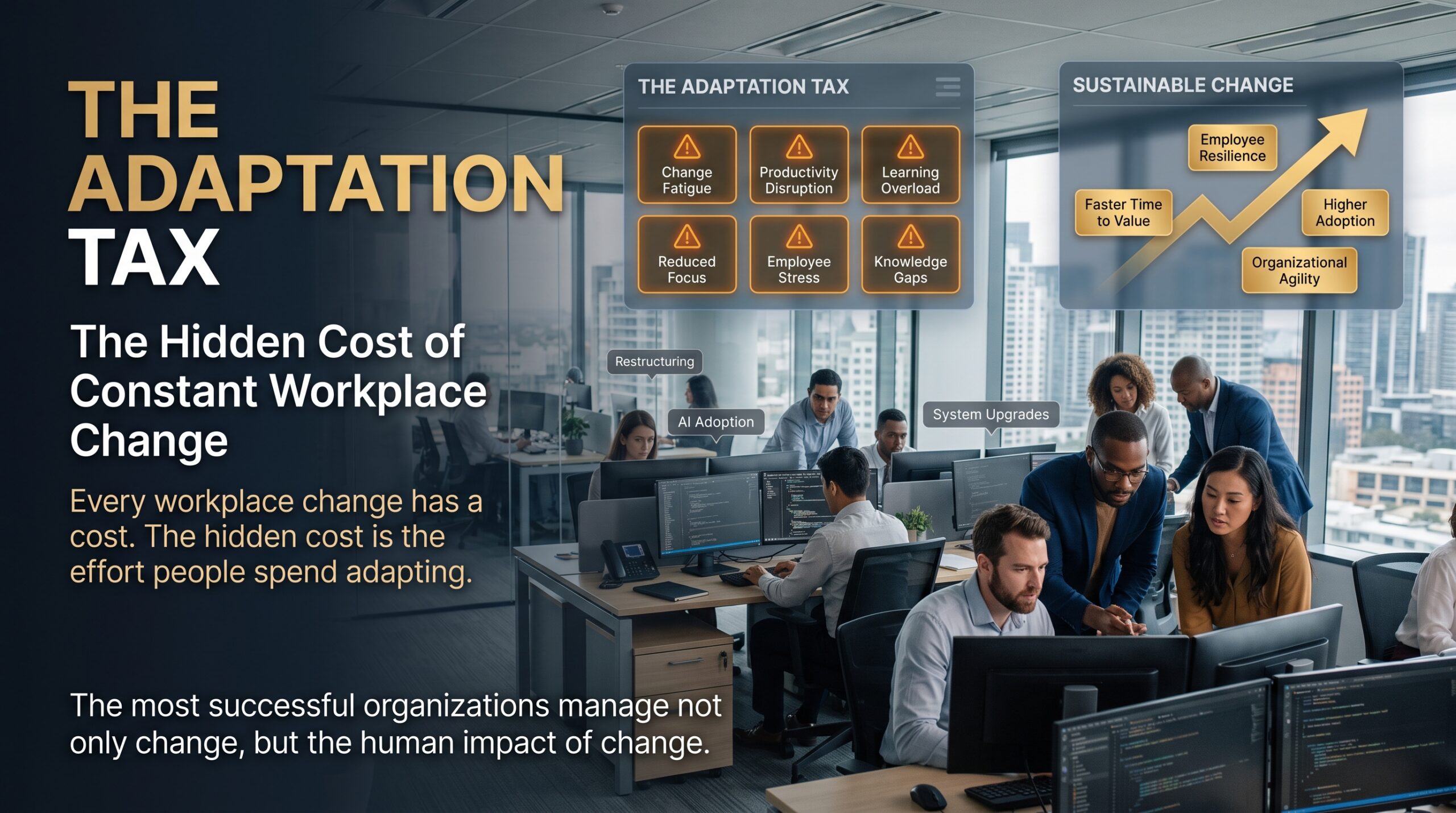
The adaptation tax is the hidden cost every employee pays each time their workplace changes the way they work. It never appears on a budget line or a project dashboard, yet it is paid daily in lost focus, extra effort, quiet frustration and slower decisions. When change arrives once a year, the tax is manageable. When it arrives every few weeks, it can quietly swallow a team’s capacity.
Think about the last twelve months at your organisation. A new system, a restructure, a revised process, a different reporting line, a fresh set of values. Each one made sense on its own. Together, they asked people to unlearn, relearn and reorient again and again, usually while still hitting the same targets.
This guide explains what the adaptation tax is, why constant change creates it, what it really costs, and how to bring it down. You will also see how change management courses give leaders the tools to plan change that people can actually absorb.
What Is the Adaptation Tax?
Picture an employee who has just mastered a new expense system. Mastery took effort. They learned the steps, made mistakes, asked colleagues for help and slowly built new habits. That effort is real work, yet nobody counts it. The adaptation tax is the sum of that invisible effort, multiplied across every person and every change.
The term is a metaphor rather than a formal accounting measure, but it is useful because it makes the invisible visible. Like any tax, it is paid whether or not anyone approved it. And like any tax, it can be small and fair or large and corrosive.
It is also different from resistance. Resistance is a reaction. The tax is a cost. A person who welcomes a change enthusiastically still pays it, which is why change programs with willing staff can still stall.
What Makes Up the Adaptation Tax?
The bill is made of several smaller charges. Most leaders see one or two of them and miss the rest.
- Cognitive load. People must hold the old way and the new way in their heads at once, which slows even simple tasks.
- The productivity dip. Output usually drops while people learn, and the dip lasts longer when support is thin.
- Emotional energy. Uncertainty about roles, status and job security uses up energy that would otherwise go into the work.
- Relationship disruption. New teams and new managers mean rebuilding trust, shared shorthand and working rhythms.
- Attention fragmentation. Change emails, town halls and training sessions compete with the day job for the same hours.
Why Constant Change Creates an Adaptation Tax
Change itself is not the villain. Organisations have to adapt to stay relevant. The trouble starts when the way change is planned ignores the people who have to live with it.
1. No Recovery Time Between Initiatives
Learning needs space. When the next change lands before the last one has settled, people never reach the “new normal”. They stay permanently in transition, and the tax compounds.
2. Overlapping Change Programs
Different teams launch different programs, each with its own timeline and champion. Nobody looks at the total load on a single person. A frontline employee may be affected by five projects that never spoke to each other.
3. Change Announced, Support Not Funded
Budgets pay for the system, the consultants and the launch. Time to practise, coaching and floor support rarely get a line. People are expected to absorb the change in the margins of their week.
4. Leaders Measure the Launch, Not the Landing
“Go-live” gets celebrated. The slow weeks afterwards, when people work out how to make the change stick, receive far less attention. We explore this pattern in The Change Hangover.
5. Unclear Reasons and Shifting Messages
When people cannot see why a change is happening, or hear a different story each quarter, they spend extra effort guessing. That guesswork is part of the bill.
Warning Signs You Are Paying a High Adaptation Tax
You do not need a survey to spot the early signals. Look for these:
- People say “here we go again” when a new initiative is announced.
- Training attendance drops, or people attend but disengage.
- Old spreadsheets and workarounds quietly reappear after go-live.
- Errors and rework rise in the weeks after every change.
- Experienced staff leave soon after a major restructure or system change.
- Managers report that teams are “too busy to change”.
- Adoption numbers look fine in week one and fade by week eight.
If several of these are familiar, your people are probably paying more than they can afford.
The Real Cost of the Adaptation Tax
Because the tax is spread thinly across many people, its total is easy to underestimate. These are the costs that tend to show up first:
- Lost productivity. Time spent relearning, double handling and asking for help is time not spent on customers or core work.
- Change fatigue and cynicism. People stop believing that the next change will be different from the last. Our article on the Change Credibility Score looks at why that belief matters.
- Higher turnover. Skilled people with options often leave rather than start over again.
- Errors and rework. Tired, divided attention leads to mistakes, especially in the first weeks of a new process.
- Stalled adoption. People agree with the change but do not use it. This is the buy-in illusion in action.
- Spent trust. Every poorly supported change draws down goodwill, a point we cover in The Trust Budget.
- Wellbeing risk. In Australia, poorly managed organisational change is recognised as a psychosocial hazard, so Safe Work Australia guidance is worth reading alongside your change plans.
None of this means you should avoid change. Standing still has its own price, which we unpack in The Change Debt Problem. The goal is to change well, not to change less.
A Simple Example of the Adaptation Tax at Work
Here is an illustrative scenario. A Sydney professional services firm introduces a new client database in March, restructures two departments in May, rolls out a new performance framework in August and refreshes its brand in October. Each change gets a launch email and a single training session.
By the final quarter, data quality in the new database is poor, several teams quietly keep their old spreadsheets, and two experienced managers resign. Leadership reads the pattern as resistance. In reality, staff were simply paying a tax nobody had budgeted for, and they ran out of capacity.
How to Measure Your Adaptation Tax
You cannot manage what you cannot see. A rough estimate is enough to start the conversation:
- Build a change inventory. List every change that touched a team in the last twelve months, including small ones.
- Estimate effort per person. For each change, ask how many hours people spent learning, adjusting and fixing problems.
- Run short pulse checks. Ask three questions: how many changes are you dealing with, how well supported do you feel, and how much capacity do you have left?
- Track the dip. Record how long productivity or quality stays below normal after each go-live.
- Compare load to capacity. If the total effort exceeds what people can spare, you have found your tax rate.
How to Reduce the Adaptation Tax: 7 Practical Steps
The good news is that this is a planning problem, so better planning can reduce it. Work through these steps in order.
- Create one change calendar. Put every initiative that affects a team on a single view so leaders can see the combined load before approving another.
- Set a change load limit. Agree how much change any team can absorb each quarter, and treat the limit as seriously as a budget cap.
- Sequence and bundle. Group related changes into one release and space unrelated ones apart so people can settle in between.
- Fund the landing. Budget for coaching, floor support, practice time and reduced targets during the learning period.
- Explain the why and what stays the same. Tell people what is changing, what is not, and the reason behind it. Certainty about the unchanged parts lowers the effort of the changed ones.
- Use local champions. Respected colleagues who explain and support the change reduce confusion faster than central emails.
- Retire the old and measure adoption. Switch off superseded systems, stop outdated processes, and check usage weeks after launch, not just on go-live day.
Change Frameworks That Help Lower the Adaptation Tax
You do not need to start from a blank page. Several well-known models give teams a shared way to plan the human side of change, and each helps reduce the tax in a different way.
| Framework | How it works | Best suited to |
| ADKAR | Moves individuals through Awareness, Desire, Knowledge, Ability and Reinforcement. | Supporting each person through a change |
| Kotter’s 8 steps | Builds urgency, a guiding coalition and short-term wins to carry change forward. | Large organisational transformations |
| Lewin’s model | Frames change as unfreezing, changing and refreezing established habits. | Explaining change simply to stakeholders |
| Bridges’ Transition Model | Separates the external change from the internal transition: endings, neutral zone, new beginnings. | Understanding the emotional side of change |
Prosci developed and promotes the ADKAR model, which is helpful when you want to find out exactly where an individual is stuck. Kotter publishes material on the eight-step approach for large-scale change. For a formal qualification pathway, APMG International is the body behind the Change Management Foundation and Practitioner certifications. Whichever you choose, the most useful question is the same: how much can our people realistically absorb?
How Change Management Courses Help You Lower the Adaptation Tax
Understanding the theory is one thing. Telling a director that a team has hit its change limit is another. Good training gives you the vocabulary, the tools and the confidence to plan change that people can carry.
At Change Management Courses, the options most relevant to this topic are:
- Change Management Foundation, which covers organisational context, people and change, change leadership and teams, stakeholders and communication, and the role of the change manager.
- Change Management Practitioner, which builds on the foundation to plan, implement and support change in real situations.
- The full course list, including live online and in-person options.
Not sure which course suits your role? Read more about us, check the FAQs, or get in touch and our team will point you in the right direction.
Change Management Training Across Australia
The adaptation tax is paid in every city. Change Management Courses offers training in Melbourne, Sydney, Brisbane, Perth, Canberra and Adelaide, with live online and in-house options for Hobart and other locations.
Melbourne and Sydney organisations in government, finance, health and technology often run several transformations at once, which makes change load planning even more valuable. Start with the Melbourne course page or the Sydney course page, or see every option on our locations page.
Training a whole leadership team together is often the quickest way to build a shared language for change. You can enquire about group or in-house training or call 1300 649 299.
Adaptation Tax FAQs
What is the adaptation tax?
The adaptation tax is the hidden effort, energy and productivity employees spend adjusting to workplace change. It is not a formal cost on any budget, but it is paid every time a process, system, structure or role changes.
Is it the same as change fatigue?
They are related but not identical. Change fatigue is how people feel when change never stops. The tax is the underlying cost that produces that feeling. Reducing the cost is the best way to reduce the fatigue.
How do you measure the adaptation tax?
Build an inventory of the changes a team has faced, estimate the hours of learning and adjustment each one required, run short pulse checks, and compare the total with the team’s real capacity.
How can leaders reduce the adaptation tax?
Plan a single change calendar, set a limit on how much change each team absorbs, sequence initiatives, fund coaching and practice time, and measure adoption after go-live. Our blog has more practical articles.
Which course helps with managing constant change?
The Change Management Foundation course is a strong starting point, and the Practitioner course goes deeper into planning and supporting change in practice.
Keep Reading
- The Change Hangover: Why Yesterday’s Transformation Affects Tomorrow’s Success
- Why Employees Go Back to the Old Way of Working After Training
- The Employee Buy-In Gap
- The Change Management Skills Gap
Conclusion: Make Change Affordable Again
The adaptation tax is not a sign that your people are weak or resistant. It is a sign that the organisation is asking for more change than it has planned to support. Once you can see the cost, you can budget for it, space it out and reduce it.
If you want structured help, explore our change management courses, read more on the blog, or contact the team to find the right fit for you and your organisation.