

Change credibility is the level of belief employees have that a change will actually happen, will be handled fairly and will be supported by the people announcing it. Most organisations track project milestones, budgets and training attendance. Very few track change credibility, even though it quietly decides whether everything else works. A plan can be perfect on paper and still stall because people simply do not believe it will stick.
This article introduces a practical way to measure it, which we call the change credibility score. You will learn what it is, why it predicts adoption better than most dashboards, how to calculate it with a simple pulse survey, and what to do when the number comes back lower than you hoped. If you lead or support change in Australia, it is a metric worth adding to your next steering committee pack.
What Is Change Credibility?
Change credibility answers a plain question: when this organisation says something is changing, do people believe it? It is built on history. Every earlier restructure, system rollout or “culture program” leaves a mark. Promises that were kept add to it. Promises that quietly disappeared take away from it.
It is related to trust, but it is not the same thing. Our article on the trust budget looks at how every initiative spends goodwill. Change credibility is narrower and easier to measure. It focuses on belief in the specific change and the people leading it. An organisation can have decent general trust and still have low credibility because the last three programs fizzled out.
Why Most Organisations Never Measure Change Credibility
- It feels soft. Leaders are comfortable with cost and schedule. Belief seems harder to put a number on.
- It is uncomfortable. A low score is feedback about leadership behaviour, and that is not always welcome.
- It is easy to confuse with sentiment. A positive town hall does not mean people believe the change will happen. We explore that gap in The Buy-In Illusion.
- Nobody owns it. Project managers own delivery. HR owns engagement. Change credibility sits between them, so nobody tracks it.
The result is a blind spot. Teams find out the change had no credibility only after adoption stalls, and by then the cost of recovery is much higher. That pattern is closely linked to the cost of delaying change and to why transformation projects fail even when everyone agrees.
The Five Parts of a Change Credibility Score
There is no single industry standard for this metric, so the framework below is a practical model you can adapt rather than an official formula. It breaks credibility into five parts that each have a clear owner and a clear fix.
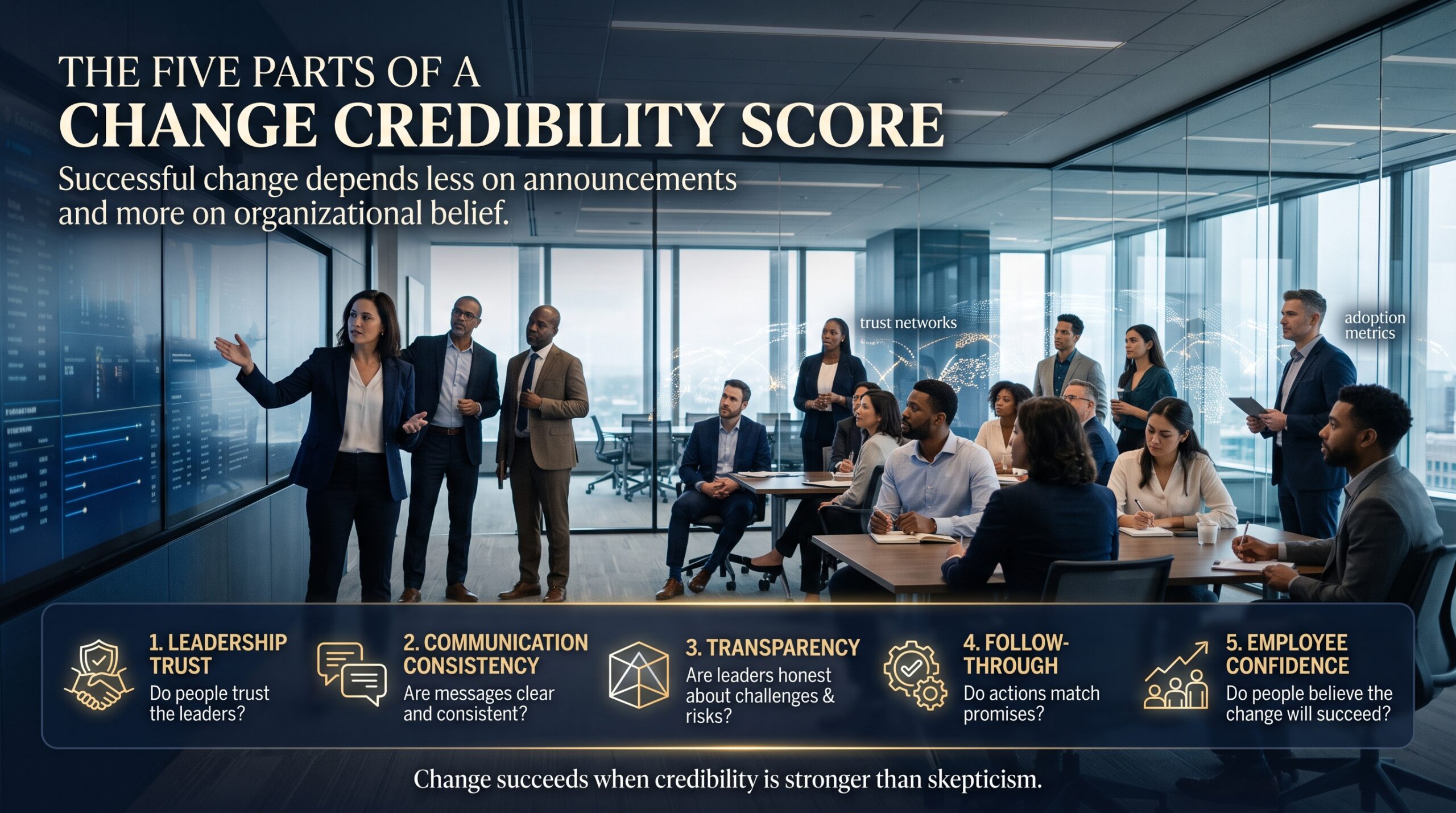
1. Promise delivery
Do people see commitments kept? If leaders said the new system would have training before go-live, was there training? Small promises kept build change credibility quickly. Small promises broken destroy it just as fast.
2. Leadership consistency
Do leaders act in line with what they announce? A sponsor who endorses new ways of working and then asks for the old report is sending a stronger message than any email.
3. Clarity
Can people explain, in their own words, what is changing, why and what it means for their role? Vague messages reduce credibility because people fill the gaps with worst-case assumptions.
4. Responsiveness
When people raise concerns, do they hear back and see something change? Closing the loop on feedback is one of the cheapest ways to lift change credibility.
5. Track record
Did previous changes land, or were they abandoned? Track record is the part you cannot fix quickly, but you can acknowledge it honestly and show how this time is different.
How to Calculate Your Change Credibility Score
You do not need expensive software. A five-question pulse survey, sent to the people affected by the change, is enough to get started. Ask each person to rate the statements below from 1 (strongly disagree) to 5 (strongly agree).
| Part | Sample survey statement |
| Promise delivery | Commitments made about this change have been kept so far. |
| Leadership consistency | Leaders’ actions match what they say about this change. |
| Clarity | I can explain what is changing and why. |
| Responsiveness | When people raise concerns about this change, something is done about them. |
| Track record | Past changes here have been followed through. |
Take the average of all five answers across respondents, then multiply by 20. That gives you a credibility score out of 100. For example, an average of 3.4 becomes a score of 68. Track it by team, location and role, because the overall average can hide pockets of very low belief.
| Score | What it usually means | Suggested response |
| 80 to 100 | Strong belief in the change | Keep delivering and share early wins |
| 60 to 79 | Cautious support | Fix the lowest-scoring part and communicate progress |
| 40 to 59 | Real doubt | Pause new announcements, close open feedback and reset expectations |
| Below 40 | Low belief | Escalate to the sponsor and rebuild with visible, small commitments |
Using the Change Credibility Score in Practice
Imagine a state government agency in Canberra rolling out a new case management system. The project is on time and on budget. The pulse survey shows a change credibility score of 52, with the lowest result on responsiveness. Staff have raised concerns about workload during the transition, and nobody has replied.
The change lead does three things. She publishes a short “you said, we did” update, adjusts the training schedule for two teams, and asks the sponsor to attend one team meeting to listen rather than present. Six weeks later the score reaches 66. The system, the budget and the timeline are exactly the same. What changed is the belief that the organisation will follow through.
Measured over time, credibility also helps explain results that otherwise look puzzling. If adoption lags while the score is low, you have a lead indicator you can act on. That connects directly to the behaviour gap we describe in Why Employees Support Change but Don’t Change Their Behaviour.
Seven Ways to Raise Change Credibility
- Make fewer, smaller promises and keep every one of them.
- Name past failures openly. Acknowledging what went wrong before earns more belief than pretending it did not happen.
- Show the sponsor’s behaviour. Ask leaders to use the new process themselves, visibly.
- Close the feedback loop within two weeks, even if the answer is “not yet”.
- Tell people what will not change so they can stop guessing.
- Share evidence early. Short, honest progress updates beat a big launch.
- Reinforce after go-live. Credibility is lost most often after the training ends, as we explain in Why Employees Go Back to the Old Way of Working After Training.
Change Credibility Across Australian Cities
The same score can mean different things depending on the sector and the local change landscape. These city pages show training options for people who lead change in each location.
- Sydney: financial services and consulting teams run frequent transformation programs, so change fatigue lowers credibility quickly. See change management courses in Sydney.
- Melbourne: healthcare, education and state government programs depend on staff belief over long timelines. See change management courses in Melbourne.
- Brisbane: infrastructure and major project teams need credibility across contractors and permanent staff. See change management courses in Brisbane.
- Perth: resources and energy organisations manage change across remote sites where messages travel slowly. See change management courses in Perth.
- Adelaide: defence, health and manufacturing employers rely on steady, consistent leadership. See change management courses in Adelaide.
- Canberra: federal agencies face machinery-of-government changes where credibility with staff is essential. See change management courses in Canberra.
Courses are delivered live online across Australia, with in-person options in Melbourne, Sydney and Brisbane.
Build the Skills to Measure and Lift Change Credibility
Measuring change credibility is one thing. Knowing how to respond is another. Structured training gives you the models, language and tools to diagnose why belief is low and what to do about it. Two pathways are a good place to begin:
- Change Management Foundation covers organisational context, people and change, change leadership, stakeholders and communication, and the role of the change manager.
- Change Management Practitioner builds on that with practical application of the approach to real change situations. Both align with the APMG International change management framework.
You can compare options on the change management courses page or read how to become a change manager to plan your pathway.
Common Mistakes When Measuring Change Credibility
- Measuring once and filing it away. A single score is a snapshot. The trend matters more.
- Only surveying leaders. The people affected by the change are the ones whose belief counts.
- Ignoring the lowest-scoring group. The average hides the team most likely to resist.
- Collecting data without responding. A survey with no visible action lowers credibility further.
- Treating the score as a grade. It is a diagnostic tool, not a performance rating for individuals.
Frequently Asked Questions About Change Credibility
What is change credibility?
Change credibility is how strongly employees believe a change will be delivered, supported and followed through by the people leading it. It is shaped by past experience, leadership behaviour and clear communication.
How do you measure change credibility?
A short pulse survey is the simplest method. Ask five statements on a 1 to 5 scale covering promises kept, leadership consistency, clarity, responsiveness and track record. Average the results and multiply by 20 for a score out of 100.
What is a good change credibility score?
As a guide, 80 and above suggests strong belief, 60 to 79 suggests cautious support, and below 60 signals doubt that needs attention. Because the model is a practical framework rather than a formal standard, compare your score against your own baseline over time.
Who should own change credibility in an organisation?
The change lead or change manager usually owns the measurement, but the executive sponsor owns the behaviour that moves it. Both need to review the score together.
Start Measuring Change Credibility Today
Most organisations only discover a credibility problem when the damage is done. A five-question survey can show you the problem months earlier, while there is still time to fix it. Measure it once, act on what you see, then measure again.
To build the skills behind the numbers, explore our change management courses, call 1300 649 299, or contact the team to find the right pathway.