

The initiative collision problem is what happens when several change programs, each sensible on its own, all land on the same group of employees at the same time. A new system goes live in the same month as a restructure. A policy rewrite arrives the week a process redesign begins. Every project manager has a plan, a sponsor and a deadline, and every plan quietly assumes the same people are free.
This article explains how the initiative collision problem forms, how to spot it early, what it costs and how change leaders can sequence work so people can absorb it. If your teams keep saying they are “drowning in projects”, read on.
What Is the Initiative Collision Problem?
In change management, each initiative is usually planned as if it were the only one. The initiative collision problem appears when those plans are added together. Training sessions overlap, managers are pulled into multiple workshops, and the same subject-matter experts are asked to test, review and approve three different things in the same fortnight.
It is not about having too many ideas. It is about nobody seeing the combined load on people. Each project can be healthy on paper while the people at the receiving end are overwhelmed, which is why the problem is often invisible until adoption falls apart.
How the Initiative Collision Problem Happens
Collisions rarely come from carelessness. They grow out of how organisations plan and fund work:
- Planning happens in silos. Technology, HR, finance and operations each run their own roadmaps with their own governance.
- Approval is project by project. A business case is judged on its own merit, not on what else is already landing on the same teams.
- Calendars follow the financial year. Go-lives bunch up around quarter ends, budget deadlines and vendor release dates.
- The same people are always needed. Strong performers and experts get nominated for every programme, so they carry the heaviest load.
- Nobody owns the whole picture. Without a single view of change across the organisation, no one is positioned to say “not yet”.
Our article on the change capacity problem explains why organisations keep saying yes. The initiative collision problem is what that habit looks like on the ground.
Signs of the Initiative Collision Problem
Look for these patterns before the damage becomes obvious:
- Staff skip training or arrive without having read the material because they are already in other sessions.
- The same managers appear on every steering committee and workshop invite.
- Project teams compete over go-live dates and fight for the same testers.
- Messages about different changes contradict each other or arrive in the same week.
- Employees describe the workplace as “change after change” and stop engaging with new announcements.
- Early adoption looks good, then drops off as people revert to old habits.
The Real Cost of the Initiative Collision Problem
When the initiative collision problem goes unmanaged, the cost shows up in many places at once.
- Change fatigue. People disengage when they cannot tell which change matters or how long this one will last.
- Lower adoption. New processes and tools are only half learned, so benefits arrive late or never.
- Delivery delays. Projects wait for the same people, so one slip creates a chain reaction.
- Burnout and turnover. Key staff carry the combined load and eventually leave.
- Operational errors. Frontline teams make mistakes while learning several new ways of working at once.
- Erosion of trust. Every stalled initiative makes the next one harder to believe. See our post on the adaptation tax for the hidden price each employee pays.
Real-World Examples of Competing Change Programs
- The finance team. A new ERP release, a revised expense policy and a restructure all land before year-end close. Month-end errors rise and morale falls.
- The frontline operations team. A new rostering tool, a safety procedure update and a customer system change are all introduced in one quarter. Supervisors spend more time explaining systems than leading people.
- The HR function. A payroll upgrade, a performance review redesign and an enterprise agreement update arrive together. HR becomes the bottleneck for every other team.
In each case, no individual project was a bad idea. The trouble was the stacking.
How to Fix the Initiative Collision Problem
You do not need a huge programme office to start. A few practical habits make a big difference.
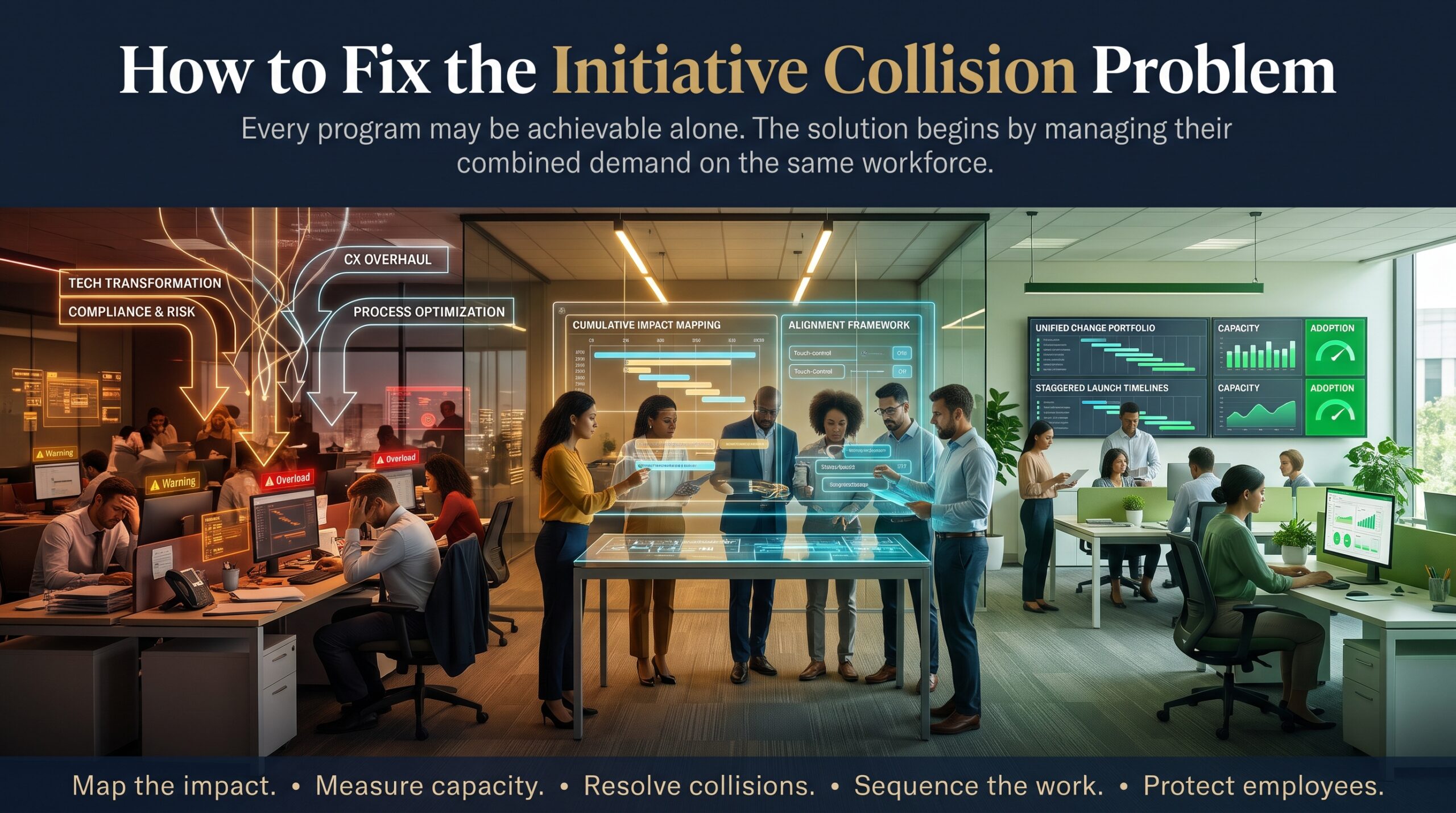
- Build a single change inventory. List every current and planned initiative, with start dates, end dates, sponsors and the groups affected.
- Assess impact by team, not by project. For each team, estimate how much each initiative asks of them in training, testing, communication and new ways of working.
- Create one change calendar. Show all go-lives, training windows and major communications on a shared timeline visible to every project and sponsor.
- Set a capacity threshold. Agree on a limit for how much change any one team can absorb in a quarter, then test new initiatives against it.
- Sequence, bundle or pause. Move go-lives apart, combine related training, or delay lower-priority work. Treat this as a normal part of project portfolio management.
- Protect blackout periods. Keep busy times such as year-end close, peak trading or audit season free from non-essential change.
- Run a regular change forum. Bring programme leads and sponsors together monthly to resolve clashes before they reach employees.
- Listen to the people affected. Short pulse surveys and manager check-ins reveal overload long before adoption metrics do.
This links closely with capacity planning, applied to people rather than machines, and with the wider discipline of managing organisational change.
A Simple Change Impact Heatmap
A heatmap is one of the quickest ways to make the initiative collision problem visible. Rate each team’s load from each initiative by month, then look for red cells:
| Team | March | April | May |
| Finance | Medium | High | High |
| Operations | Low | High | Medium |
| HR | Medium | Medium | High |
| Customer service | Low | Medium | Low |
In this example, Finance and HR face heavy loads in May, while Customer service has room. A sponsor can now ask a practical question: can any go-live move, or can the work be shared differently? This is a much better conversation than “why is everyone resisting?”
Mistakes That Keep the Initiative Collision Problem Alive
- Judging each project only on its own business case and ignoring the combined load.
- Assuming employees can “just adapt” because they did before.
- Relying on the same champions and experts for every project.
- Treating resistance as a communication issue when the real cause is overload.
- Letting sponsor ambition override a clear view of team capacity. Our article on the sponsor reset problem shows how fast priorities can shift.
Change Management Skills That Help
Spotting and sequencing competing change takes structured skills: assessing impact, engaging stakeholders, planning communication and leading through resistance. Our courses cover these in a practical way:
- Change Management Foundation covers organisational context, people and change, change leadership, stakeholders and communication.
- Change Management Practitioner builds the skills to plan, apply and support change in real situations.
Compare all options on our change management courses page, read the FAQs or explore more ideas on the change management blog. You may also like our posts on the change accountability gap and the change hangover.
Learn Change Management in Your City
Whether your organisation is in the middle of the initiative collision problem or preparing for the next wave of change, training is available in person and live online:
- Change management course in Melbourne
- Change management course in Sydney
- Change management course in Brisbane
- Change management course in Adelaide
- Change management course in Perth
- Change management course in Canberra
Want training for a whole team? Contact us and we will help you choose the right option.
Frequently Asked Questions About the Initiative Collision Problem
What is the initiative collision problem?
It is the situation where several change programs land on the same employees at the same time, creating overload even though each program looks reasonable on its own.
How do you know if your organisation has too many change initiatives?
Common signs include low training attendance, the same managers in every workshop, clashing go-live dates, and employees who stop engaging with new announcements.
How do you manage competing change initiatives?
Create one change inventory and calendar, assess impact by team, set a capacity limit, and sequence or pause work when teams are overloaded.
What is change fatigue?
Change fatigue is the exhaustion and disengagement people feel when they face continuous or poorly coordinated change. It is a common result of the initiative collision problem.
Which course helps with managing multiple change programs?
The Change Management Foundation course gives a solid base in people, stakeholders and communication, and the Practitioner course helps you apply those skills to real change work.
Final Thoughts
The initiative collision problem is a visibility problem. Each project can look healthy while the same people are carrying all of them. When leaders see the combined load, sequence work with care and protect the capacity of their teams, change becomes easier to absorb and far more likely to stick.
Ready to lead change that people can actually absorb? Explore our change management courses and build the skills to coordinate change across your organisation.