

The change hangover is what an organisation feels the morning after a big transformation. The launch celebration is over, the project team has moved on, and what remains is a quiet mix of tiredness, scepticism and half-finished work. The trouble is that this feeling doesn’t stay in the past. It follows the organisation into the next project, and it quietly decides whether that project succeeds.
Most leaders plan carefully for the change in front of them. Far fewer ask what the last change left behind. Yet employees remember every previous rollout, every promise that wasn’t kept and every system that was meant to make life easier and didn’t. That memory shapes how they respond to whatever comes next.
This guide explains what a change hangover is, how to recognise it, why it affects tomorrow’s success and how structured change management training helps leaders prevent it across Australian workplaces.
What Is a Change Hangover?
A change hangover is the lingering aftereffect of a past transformation that reduces an organisation’s ability to absorb the next one. It includes emotional effects, such as exhaustion and cynicism, and practical ones, such as unfinished processes, parallel systems and benefits that were never delivered.
It is closely related to change fatigue, but the two aren’t identical. Change fatigue describes how people feel: worn out by constant change. The change hangover is wider. It covers the leftover feelings and the leftover mess, including the workarounds, the abandoned initiatives and the broken trust that a previous programme left on the ground.
It also differs from ordinary resistance. Resistance is a reaction to a change people haven’t yet experienced. A change hangover is a reaction to changes they already have.
Why Yesterday’s Transformation Affects Tomorrow’s Success
Every change an organisation delivers leaves behind a reputation. If the last programme was well run, finished properly and honestly reported, people approach the next one with reasonable trust. If it was rushed, quietly dropped or declared a success without evidence, people approach the next one with their guard up.
Three things carry the effect forward:
- Employees compare each new initiative with the last one, and the comparison is rarely generous.
- People who are still absorbing a previous change have less energy for the next. Attention is a finite resource.
- Each unfulfilled promise lowers the credibility of the next announcement. We explore this idea in the change credibility score.
That is why it can sink a well-designed project. The strategy may be sound, but the starting conditions are poor.
Seven Warning Signs to Watch For
You don’t need a survey to spot it. Watch for these signals:
- Town halls get polite nods, but nobody asks questions.
- “Here we go again” becomes a common phrase in corridors and chat channels.
- Old and new processes run side by side months after go-live.
- Training attendance is high, yet daily behaviour hasn’t changed. See why employees go back to the old way of working.
- Project team members are burnt out, or they leave once the programme closes.
- Stakeholders quietly ask whether this initiative will be cancelled like the last one.
- Benefits promised in the business case are never reported back.
If three or more of these are familiar, the next change will probably start behind. This pattern overlaps with the buy-in illusion, where agreement on paper doesn’t turn into adoption in practice.
What Causes a Change Hangover?
These effects rarely come from one bad decision. They build from patterns that repeat across industries, including government, healthcare, finance, IT, retail and education.
- Go-live is treated as the finish line. The project closes, the team disbands and nobody owns reinforcement. Adoption is left to chance.
- Changes pile up. Several initiatives land on the same teams in the same quarter, with nobody tracking the combined load.
- Promises go unreported. Benefits are announced at the start and never measured at the end. That erodes organisational trust.
- Lessons aren’t learned. Review sessions are skipped or filed away, so the same mistakes return in the next programme.
- Recovery time is ignored. Teams move straight from one change into the next with no pause to consolidate, celebrate or fix what’s broken.
The Real Cost of Ignoring the Aftereffects
It rarely appears as a line in the budget, which is why it is so easy to ignore. The costs show up elsewhere: slower adoption, lower productivity, rising turnover and a growing reluctance to engage with new initiatives.
It also feeds a second problem. When organisations avoid change because the last one went badly, they fall behind, and catching up later costs more. That is the dynamic described in the change debt problem. Too much poorly managed change and too little change both end up expensive.
Change Hangover vs Healthy Change Recovery

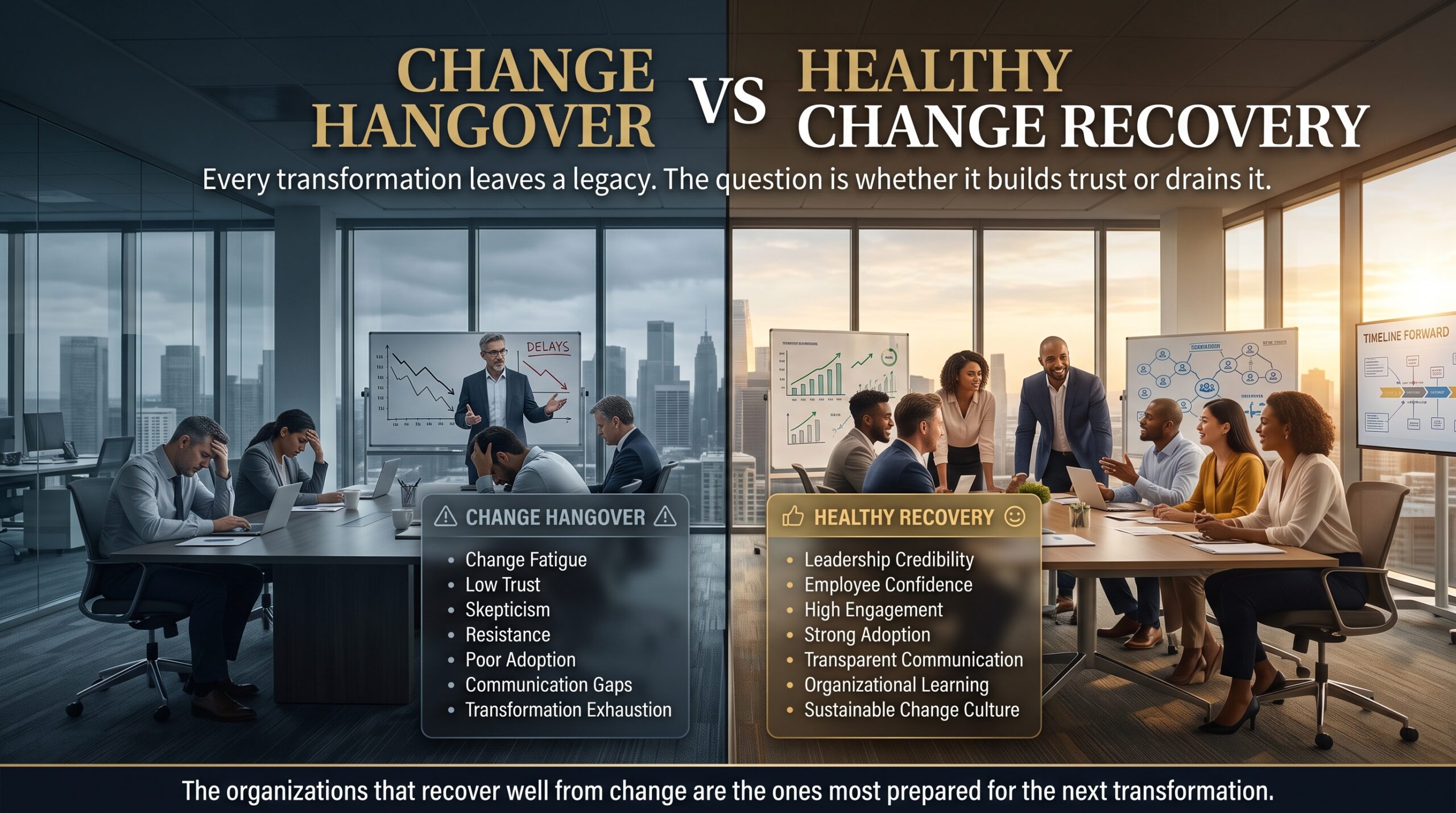
| Area | With a Change Hangover | With Healthy Change Recovery |
| After go-live | Project closes, team moves on, nobody owns reinforcement | Named owner tracks adoption and fixes issues |
| Employee attitude | Cynical, tired, “here we go again” | Cautiously open, because past promises were kept |
| Next change | Starts with doubt and low engagement | Starts with a realistic picture of capacity |
| Leadership behaviour | Announces new priorities before closing old ones | Closes, reports and then launches |
| Measurement | Success declared at launch | Benefits and adoption measured and shared |
The difference isn’t the size of the change. It is how deliberately the organisation closes one change before starting another.
How to Prevent and Treat a Change Hangover
The good news is that a change hangover is manageable. These six practices help leaders prevent it and recover from it:
- Close the last change properly. List what was delivered, what was dropped and what is still open. Tell people honestly where things stand.
- Run an honest lessons-learned session. Include frontline staff, not just the project team, and share the findings.
- Measure sentiment and adoption before starting something new. Treat it like a readiness check. If adoption of the last change is still low, fix that first.
- Map the change load. Build a simple calendar of every initiative hitting each team and avoid stacking them.
- Keep your promises visible. Report benefits against the original business case, including the disappointing ones.
- Build recovery time into the plan. Recognise effort, fix pain points and let teams consolidate before the next wave.
Managers play a particularly important role here. Our article on why employees support change but don’t change their behaviour explains how line managers can model the new way of working.
Examples From Australian Workplaces
These are composite examples based on common patterns, not individual case studies:
- Finance in Sydney: a core system upgrade goes live on time. Six months later, staff still use spreadsheets alongside it. The next transformation faces open doubt from day one.
- Healthcare in Melbourne: a new patient record process is introduced during a busy period. Clinicians adapt by creating workarounds, and a later digital project struggles to earn their attention.
- Local government in Brisbane: three service changes land within one financial year. Staff stop distinguishing between them and disengage from all three.
- Resources in Perth: a safety reporting system is rolled out and then replaced within two years. Crews are reluctant to learn the replacement.
- Education in Adelaide: a restructure is announced but its outcomes are never communicated. Rumours fill the gap and affect the next initiative.
- Government in Canberra: repeated machinery-of-government changes leave teams uncertain about priorities. New directions meet scepticism even when they are well designed.
Change Management Skills That Reduce the Change Hangover
Preventing a change hangover is a skill, not a matter of goodwill. People who understand structured change management spot the early warning signs and plan reinforcement from the beginning. Here is how our courses map to that capability:
| Capability | What It Builds | Course |
| Change foundations | Organisational context, people and change, stakeholders and communication | Change Management Foundation |
| Planning and sustaining change | Structured methods to plan, implement and support organisational change | Change Management Practitioner |
| Strategic change leadership | Leading teams and sponsors through change with confidence | Leading Change (see courses page) |
Not sure where to start? Read about the change management skills gap and why transformation projects fail even when everyone agrees, then compare the Foundation and Practitioner courses.
Where the Change Hangover Hits Hardest Across Australia
Large, frequent change programmes appear in every state and territory. This is a broad picture rather than a forecast, but these are the pressure points we hear about most:
- Sydney: finance, professional services and technology businesses running overlapping system upgrades. See change management courses in Sydney.
- Melbourne: healthcare, education and retail organisations changing quickly. See change management courses in Melbourne.
- Brisbane: infrastructure, local government and growing service businesses. See change management courses in Brisbane.
- Perth: resources and energy operators balancing safety, technology and workforce changes. See change management courses in Perth.
- Adelaide: health, education and manufacturing organisations managing restructures. See change management courses in Adelaide.
- Canberra: federal agencies facing frequent shifts in priorities and structure. See change management courses in Canberra.
Training is available in Melbourne, Sydney and Brisbane, with live online and in-house options for Perth, Adelaide and Canberra. See all change management training locations.
For Leaders: Questions to Ask Before the Next Change
Before approving another initiative, ask a few honest questions. Did the last change reach its intended outcome? Do we know how people feel about it? Which teams are carrying the heaviest change load right now? What did we promise last time, and did we deliver it?
Recognised frameworks can help you answer them consistently. The certification body APMG International publishes the change management qualifications that our Foundation and Practitioner courses align with. Add that structure to your planning and the next change is far less likely to inherit the last one’s problems.
Frequently Asked Questions
What is a change hangover?
A change hangover is the lingering emotional and practical aftereffect of a previous transformation. It reduces an organisation’s ability to absorb future change because of fatigue, scepticism, unfinished work and lost trust.
How is a change hangover different from change fatigue?
Change fatigue is how people feel when they are worn out by constant change. A change hangover is broader. It includes that fatigue plus the unfinished processes, unmet promises and reduced credibility left behind by earlier programmes.
How long does a change hangover last?
There is no fixed timeline. It lasts until the previous change is properly closed, adoption is confirmed and trust is rebuilt. In many organisations that takes months, and longer if the next change starts too early.
How can managers prevent it?
Close each change properly, report real outcomes, avoid stacking initiatives and give teams time to consolidate. Structured training in change management gives managers the tools to do this consistently.
Which change management course should I start with?
Most people begin with the Change Management Foundation course and move to the Practitioner course once they are leading or supporting real change work. Browse the full courses page to compare.
Are change management courses available in Sydney, Melbourne, Brisbane, Perth, Adelaide and Canberra?
Yes. Training is available across Australia, with in-person options in Melbourne, Sydney and Brisbane and live online or in-house delivery elsewhere. See the FAQ page or contact our team.
Final Thoughts: Close One Change Before Starting the Next
Transformation doesn’t end at go-live. What an organisation does in the weeks and months afterwards decides how the next change is received. Leaders who recognise the change hangover and deal with it honestly give every future initiative a better start.
Ready to build practical skills for leading change that sticks? Explore our change management courses, or call 1300 649 299 and speak to a course advisor about the right pathway for you.