

The sponsor reset is the quiet moment a healthy change program stops being healthy. A new executive arrives, the previous sponsor moves on, and within weeks the vision that took a year to build is being questioned from first principles. Nobody announces it. Nobody cancels anything. The program simply loses its sense of direction.
If you have ever watched a steering committee go silent when a newly appointed executive asked, “Remind me why we’re doing this?”, you have seen a sponsor reset first-hand. This guide explains why it happens, what it costs your people and your budget, and how change leaders in Melbourne, Sydney, Brisbane, Adelaide, Canberra and Perth can keep momentum when leadership changes.
What Is the Sponsor Reset Problem in Change Management?
The sponsor reset problem describes what happens to an organisational change initiative when its executive sponsor is replaced, or when a new executive inherits it as part of a wider restructure. Direction, priorities and authority all go back on the table at once. It is not a formal methodology, and you will not find it as a chapter in a textbook. It is a practical label for a pattern that change practitioners see again and again.
The pattern matters because of how much weight sponsorship carries. Prosci’s research on the primary sponsor’s role shows active and visible sponsorship has topped the list of success contributors in every one of its benchmarking reports since 1998. A sponsor reset therefore removes the single biggest success factor in the middle of the journey, often without anyone noticing it has gone.
A typical reset shifts four things at once:
- The mandate: who actually has the authority to make decisions about the change.
- The narrative: the story employees have been told about why the change is happening.
- The priorities: what gets funded, what gets paused and what quietly disappears.
- The relationships: the web of trust the previous sponsor built with leaders, unions, vendors and frontline teams.
Why a New Executive Changes the Direction of Organisational Change
New executives are rarely careless with other people’s programs. Most reset direction for understandable reasons, and knowing those reasons is the first step to working with them rather than against them.
They inherit the program, not the reasoning
Your business case tells a new executive what you are doing. It rarely explains why you chose this option over three others, which compromises were agreed, or which stakeholder was won over after six difficult conversations. Without that history, every earlier decision looks open to challenge.
They need a win that is visibly theirs
Most new executives are judged on what they change in their first ninety days. An inherited program belongs to someone else’s story. Unless the new sponsor can see a place for their own thinking in it, the pull to start something fresh is strong.
The knowledge lives in people’s heads
Much of the context behind a change sits in conversations rather than documents. When the previous sponsor leaves, that context walks out the door with them. The change team is left holding a plan that nobody senior can fully explain.
The coalition was built around the old sponsor
Support for a change is usually personal before it is organisational. Peers backed the program because they trusted the person leading it. A new sponsor has to earn that trust from scratch, and the people who were quietly supportive may now sit back and wait.
Governance gets reshuffled at the same time
Leadership changes rarely arrive alone. Reporting lines move, steering committee membership shifts and budgets are re-baselined. Each of these can reset direction, even when the name on the project charter has not changed.
Warning Signs That a Sponsor Reset Is Already Under Way
You will rarely get a formal announcement. Watch for these signals instead:
- Steering committee meetings are postponed or shortened without a clear reason.
- The phrase “pause and review” starts appearing in emails and agendas.
- You are asked to rebuild the full picture of the program in a fresh presentation.
- New terms replace the vocabulary employees have only just learned.
- Middle managers stop cascading messages because they are unsure the message still stands.
- Budget lines for training, communications or change resources are marked “under review”.
One of these on its own is normal. Three or more together almost always mean a sponsor reset is happening, whether anyone has named it or not.
The Real Cost of a Sponsor Reset for People and Performance
The financial cost of a sponsor reset is easy to see: duplicated work, delayed benefits and contractors on stand-by. The human cost is larger and harder to measure.
Employees watch leaders closely. When direction changes with a new face in the room, they draw a simple conclusion: this one will pass too. That belief erodes change credibility and drains the organisational trust that every change initiative quietly spends. People who were starting to adopt new ways of working slip back, and the sceptics feel proved right.
A stop-start approach also adds to change debt. Every month spent re-arguing a settled decision is a month the original problem keeps getting more expensive. And because the frontline feels the confusion first, it is one of the hidden reasons transformation projects fail even when everyone agrees on paper.
How to Manage a Sponsor Reset: A Five-Step Protocol
You cannot prevent every leadership change. You can decide how well your program survives one. This five-step protocol works for change managers, project leads and PMO teams alike.
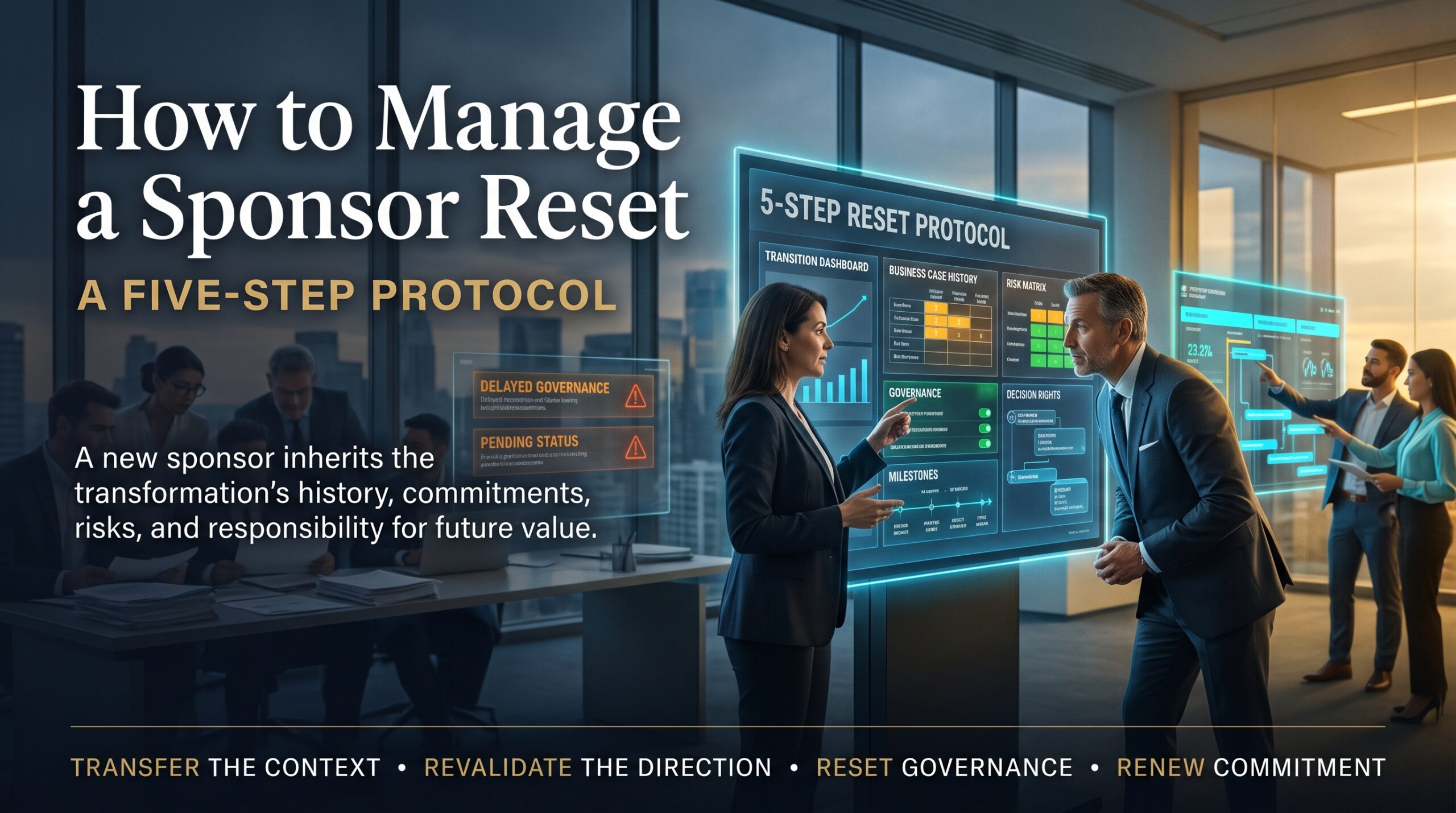
Step 1: Deliver a sponsor handover brief within 14 days
Write a single page in plain language. Cover the problem the change solves, the decisions already made and why, the stakeholders who matter most, the main risks, and the next three decisions that need the sponsor’s attention. Keep it short enough to read on a train.
Step 2: Reframe the change around the new executive’s priorities
Do not defend the program. Translate it. Ask what the new executive has been asked to deliver and show where the change supports those goals. If it genuinely does not, you need to know now. Coaching a senior leader on what active and visible sponsorship looks like is also one of the most common tactics practitioners report, as Prosci’s research on why executives fail at sponsorship explains.
Step 3: Separate what is fixed from what is flexible
Be honest about which elements are locked in by regulation, contracts or sunk investment, and which are genuinely open. Offering the new sponsor real choices on the flexible parts gives them ownership without unravelling the whole plan.
Step 4: Rebuild the coalition of sponsorship
One executive is a fragile foundation. Prosci encourages building a coalition of sponsorship, with several leaders visibly backing the change. Identify business heads, a deputy sponsor and respected managers who can carry the message while the new sponsor settles in.
Step 5: Re-communicate once, clearly and together
Employees need one consistent message about what is staying, what is changing and why. Where possible, have the new sponsor and the outgoing sponsor deliver it together. A joint appearance is one of the fastest ways to show continuity after a leadership change.
A 30-60-90 Day Sponsor Reset Plan
Use this simple timeline to keep the reset short and structured instead of letting it drift for a whole quarter.
| Window | Focus | Key outputs |
| Days 1 to 30 | Listen and align | Sponsor handover brief
One-to-one stakeholder briefings List of fixed versus flexible decisions |
| Days 31 to 60 | Re-anchor and rebuild | Benefits case tied to the new executive’s priorities
Refreshed stakeholder map Coalition of sponsors confirmed |
| Days 61 to 90 | Re-launch and embed | Joint message to all staff
Revised governance and reporting Sponsor activity plan for the next quarter |
How to Make Your Change Program Sponsor Reset-Proof
The best time to handle a leadership change is before it happens. Build these habits into every major change:
- Write down the why. Keep a living change charter and decision log so the reasoning survives any one person’s departure.
- Name a deputy sponsor from day one. Choose someone senior enough to step up if the primary sponsor moves.
- Spread the visibility. Have several leaders front the change so no single face carries it.
- Plan for succession in governance. Add “sponsor transition” to the risk register as a standing item.
- Check sponsor health every quarter. Prosci’s sponsor checklist is a practical starting point.
These habits also help with related problems. If teams slide backwards after launch, read why employees go back to the old way of working after training. If people nod in meetings but never change behaviour, see the buy-in illusion and the employee buy-in gap.
The Sponsor Reset in Australian Workplaces
Leadership change looks different across sectors, but the pattern is the same. In Canberra, machinery-of-government changes can move whole programs between departments and sponsors almost overnight. In Sydney and Melbourne, restructures across banking, insurance, technology and professional services regularly bring in new executives mid-transformation. Brisbane and Adelaide see similar moves in health, education and state government programs, while in Perth large resources and infrastructure projects often span several leadership terms.
Whatever your industry or city, the sponsor reset deserves a place on your risk register and a plan in your change toolkit.
Skills Every Change Leader Needs to Handle a Sponsor Reset
Handling a sponsor reset is a skill, not a talent. It draws on stakeholder analysis, upward coaching, communication planning and benefits management, along with the confidence to have a candid conversation with a senior person. Established frameworks such as the Prosci ADKAR model and Kotter’s eight-step process help, but they only work when you know how to adapt them to a leadership change. Prosci’s own best practices in change management put executive sponsorship at the very top of the list.
If you are new to the discipline, the Change Management Foundation course gives you the language, models and stakeholder tools to get started. If you already lead change and want a structured approach for complex programs, the Change Management Practitioner course is the natural next step. Compare both on our change management courses page, or choose your city: Melbourne, Sydney, Brisbane, Adelaide, Canberra or Perth. You can also see every in-person and live online option on our locations page.
Sponsor Reset FAQs
What is a sponsor reset in change management?
A sponsor reset is the loss of direction, authority and momentum that follows when the executive sponsor of a change initiative is replaced, or a new executive takes ownership of it. Priorities, funding and messaging are reopened, often informally.
What happens to a change project when the executive sponsor leaves?
Without a plan, the project usually slows down. Decisions are deferred, middle managers hesitate to cascade messages and employees begin to doubt the change will last. With a handover brief, a deputy sponsor and a joint message, most projects recover quickly.
How do you onboard a new executive sponsor?
Give them a one-page brief within two weeks, hold short one-to-one briefings with key stakeholders, explain what is fixed and what is flexible, and agree the specific visible actions they will take over the next quarter.
Can a change manager coach a senior executive?
Yes, and good practitioners do it regularly. The approach is to frame coaching around the executive’s own goals, keep it practical and offer ready-to-use talking points, rather than lecturing them on their role.
Which course helps with sponsor and stakeholder management?
Both the Change Management Foundation course and the Change Management Practitioner course cover stakeholders, leadership and communication. Check our FAQs page for details on formats and certificates.
Final Thoughts: Protect Direction When Leadership Changes
A sponsor reset is not proof that your change program has failed. It is a predictable test of whether it was built to last. Programs that pass tend to share three traits: a written why, more than one visible sponsor, and a change leader willing to guide a new executive rather than wait for them.
Ready to build those skills? Contact our team to talk through your goals, or browse more articles on our change management blog.