

A change collision happens when several change initiatives, each sensible and well managed on its own, land on the same people at the same time. Every project has a sponsor, a plan, a communications calendar and a green status report. Yet the employees who must absorb all of them at once are left confused, exhausted and quietly disengaged. The initiatives do not fail because they were badly run. They fail because they arrived together.
This is one of the most common and least visible reasons organisational change underdelivers. It hides inside the gap between project-level reporting and the real experience of the people on the receiving end. This guide explains what a change collision is, why it happens even in mature organisations, how to spot and map one, and what leaders in Sydney, Melbourne, Brisbane, Perth, Adelaide and Canberra can do to prevent it.
What Is a Change Collision?
A change collision is the overlap of multiple initiatives on a shared group of people, in a shared window of time, beyond what those people can reasonably absorb. The key word is shared. Each initiative may be small, modest and well justified. The problem appears only when you add them together and look at one team’s calendar.
It helps to separate this idea from two close neighbours. Change fatigue describes how people feel after too much change. Change overload describes the volume itself. A change collision is the structural cause behind both: it is the specific moment where separate plans meet on the same group of employees. Unlike fatigue, which is a symptom, a collision is something you can see on a chart and do something about.
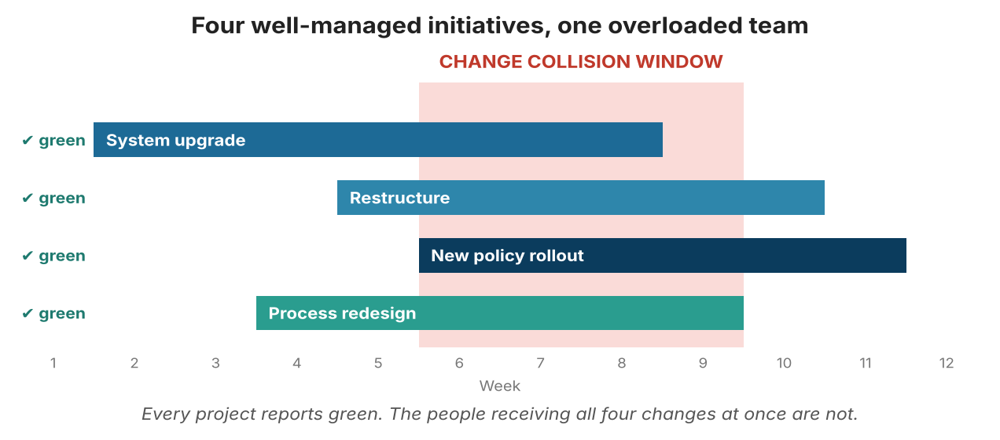
Picture a frontline operations team in the same quarter as a new system upgrade, a restructure, a revised policy and a redesigned process. Four project managers are each doing a good job. Nobody is looking at the team that has to learn, adapt and keep serving customers throughout.
Why Well-Managed Initiatives Still Fail Together
It is tempting to blame poor project management, but in a change collision the individual projects are often exemplary. Several structural reasons explain why good work still produces poor outcomes.
- Reporting happens project by project. Each initiative reports its own status, so every dashboard stays green while the combined load on one team goes unmeasured.
- Nobody owns the employee’s whole experience. Sponsors are accountable for their initiative, not for the total change a team receives. This is a close cousin of the change accountability gap.
- Planning is done in silos. Each programme builds its own timeline, training plan and communications, usually without seeing the others.
- Capacity is assumed to be unlimited. Plans quietly assume that people can find the time for training, new habits and adjustment on top of their day jobs. We explore this in the change capacity problem.
- Sponsors compete for attention. Each executive wants their launch to succeed, and without a portfolio view, the loudest initiative wins the best dates.
- Dates are fixed by external pressure. Regulatory deadlines, financial year-end and vendor contracts push go-lives into the same window.
The Hidden Arithmetic of a Change Collision
Consider a simple, illustrative example. Suppose four initiatives each ask a team for just two hours a week of learning, meetings and adjustment. Individually, that sounds trivial. Together it is eight hours, which is a full working day, and that is before anyone has done their actual job. Most project plans never add these numbers up because each plan only sees its own two hours.
Real life is harsher than the arithmetic. People do not simply add up demands; they pay a switching cost each time they move between different changes, different systems and different messages. A change collision therefore costs more than the sum of its parts, which is why a team can look fine on paper and still struggle in practice.
Warning Signs of a Change Collision
You rarely need new software to spot a change collision. The evidence usually shows up in ordinary conversations and calendars.
- Go-live dates cluster. Several launches, trainings or policy changes fall in the same few weeks.
- Managers ask “which change is this?” When even leaders cannot tell initiatives apart, frontline staff certainly cannot.
- Training attendance and completion drop. People skip sessions because they cannot fit another one in.
- Workarounds multiply. Staff return to old methods or build informal shortcuts because the new ways keep changing.
- The same names appear everywhere. A small group of people sits on every stakeholder list, reference group and test team.
- Communications are ignored. Open rates fall and the same questions keep returning.
- Benefits slip across the board. Individual projects report green, yet the expected outcomes arrive late or not at all.
What a Change Collision Costs Organisations
The price of a change collision rarely shows up as one clean figure. It spreads across adoption, productivity, wellbeing and trust.
- Lower adoption. People use new tools and processes partially or not at all, so projected benefits shrink.
- Productivity dips. Teams spend more time learning and recovering than delivering.
- Rising resistance. Pushback grows when people feel nobody is looking at the total load.
- Burnout and turnover risk. Constant adaptation wears people down, a theme we cover in the adaptation tax.
- Lost credibility. When change after change is launched and then abandoned, employees stop believing the next one, as discussed in the change credibility score.
- Unfinished stabilisation. Teams never fully settle into one change before the next arrives, an issue explored in sustaining change and the change hangover.
There is a workplace health dimension as well. Safe Work Australia includes poorly managed organisational change among the psychosocial hazards that employers should consider. A collision of initiatives is exactly the kind of situation that can turn a normal business transformation into a wellbeing risk.
How to Map a Change Collision
Mapping is the fastest way to turn a vague feeling of overload into a clear picture. You can do it in a workshop with a whiteboard or a spreadsheet.
- List every active and planned initiative. Include small projects, policy updates and system changes, not just the headline programmes.
- List the groups affected. Break the organisation into teams, roles or locations that experience change differently.
- Build a heat map. Put groups on one axis and weeks or months on the other, then mark which initiatives touch each group in each period.
- Rate the intensity. Score each impact as low, medium or high based on how much the group must learn, stop or start doing.
- Add business rhythm. Overlay financial year-end, peak trading, audits, leave periods and other fixed pressures.
- Find the peaks. Look for groups and periods where several high-impact changes stack up. Those are your collision points.
- Decide what to do. For each collision point, choose to sequence, bundle, delay or stop an initiative.
How to Prevent a Change Collision
Prevention is mostly about seeing the whole picture early and giving someone the authority to act on it. These practices work in large enterprises and small teams alike.
- Keep one change calendar. Maintain a single, visible view of all initiatives affecting each group, and review it on a regular schedule.
- Run a change impact assessment for every initiative. Capture who is affected, how much and when, before dates are locked.
- Set capacity thresholds. Agree how much change a team can absorb at one time and treat it as a real constraint.
- Sequence and bundle. Move launches apart where possible, and combine related changes into one coherent message and one training experience.
- Create portfolio-level governance. Give a person or group authority to resolve conflicts between initiatives, not just between tasks.
- Align sponsors. Make sure executives agree on priorities, especially when leadership changes, a risk covered in the sponsor reset problem.
- Protect recovery time. Build gaps into the calendar so people can stabilise before the next wave.
- Translate for the frontline. Explain how the changes connect to each other and to daily work, a challenge described in the change translation gap.
- Measure adoption, not just delivery. Track whether people are actually using the change, not only whether it went live on time.
- Build change skills across the organisation. Train managers and project staff in change management so collisions are spotted early.
If you want a deeper look at the closely related theme, read our article on the initiative collision problem, which explores how multiple programmes compete for the same employees.
Change Collision Examples in Australian Workplaces
The pattern appears in every sector. A few common versions are below.
- Finance and professional services: a new core system, a reporting change and a regulatory update all go live around the end of the financial year.
- Healthcare: a new rostering tool, a clinical record update and revised compliance procedures arrive in the same quarter.
- Government and councils: a restructure, a new service channel and a policy reform hit the same teams together.
- Retail and logistics: a new inventory system and a store layout change land just before the busy season.
- Education: a curriculum update, a learning platform change and a timetable redesign start in the same term.
Change Collision Across Australian Cities
The pressure points look slightly different from city to city. You can compare delivery options for each location on our locations page.
Sydney
Sydney’s banks, insurers, consultancies and technology firms often run several large programmes at once, so portfolio-level visibility matters. See our change management course in Sydney.
Melbourne
Melbourne’s healthcare, education, retail and government organisations frequently stack reforms across large workforces. Explore our change management course in Melbourne.
Brisbane
Infrastructure, resources and public sector projects in Queensland can overlap on the same delivery teams. Browse our change management course in Brisbane.
Perth
Mining, energy and resources businesses in Western Australia juggle operational change across remote and metropolitan sites. Check out our change management course in Perth.
Adelaide
Manufacturing, health and defence-related organisations in South Australia need steady, well-sequenced change. Learn more about our change management course in Adelaide.
Canberra
Federal agencies in Canberra often face policy-driven change that arrives in waves, which makes sequencing and sponsor alignment essential. View our change management course in Canberra.
Change Management Skills That Reduce Change Collision
Mapping and sequencing are skills, and they improve with training. Our change management courses in Australia give managers, project professionals and HR teams a common language for planning change across the whole organisation.
- Change Management Foundation: covers organisational context, people and change, change leadership, stakeholders and communication, and the role of the change manager.
- Change Management Practitioner: a structured approach to planning, implementing and supporting organisational change, aligned with APMG International
- Leading Change: an instructor-led course on strategic change leadership principles.
Professionals who manage projects may also want to explore the resources of the Australian Institute of Project Management. If you are unsure which course suits you, our FAQ page covers who should attend and what you will learn, and the blog has further articles on change leadership.
Frequently Asked Questions About Change Collision
What is a change collision?
It is the overlap of several change initiatives on the same group of people at the same time, to a degree those people cannot reasonably absorb.
How is a change collision different from change fatigue?
Change fatigue is how people feel after too much change. A collision is the structural cause, the point where separate initiatives meet on one team. You can map and manage a collision, which makes fatigue easier to prevent.
Who is responsible for preventing it?
Ideally a portfolio-level group or leader who can see all initiatives and resolve conflicts between them. Individual project managers cannot solve it alone because each only sees their own plan.
Can small organisations experience it?
Yes. In a small business, a few simultaneous changes can overwhelm a small team quickly. The fix is simpler, usually a shared calendar and an honest conversation about what can wait.
Which course helps manage change at portfolio level?
The Change Management Foundation course builds the core concepts, and the Practitioner course goes further into planning and implementing change in practice.
Final Thoughts: Look at the People, Not Just the Projects
A change collision is a failure of perspective, not of effort. The projects are fine; the view is too narrow. Put every initiative on one calendar, map the impact on each group, protect people’s capacity and give someone the authority to say “not yet”. Do that, and good initiatives stop competing with one another and start working together.
Ready to build these skills? Visit Change Management Courses Australia, explore the full course list, or contact our team or call 1300 649 299 to speak with a course advisor.