

The cost of delaying change almost never shows up as a line on a budget, and that is exactly why it keeps growing. A legacy system limps on for another year. A restructure is postponed until after the next quarter. A process everyone admits is broken gets one more workaround. Each delay feels cheap on the day it is made. But the bill arrives later, with interest, and it is usually far larger than the cost of acting would have been.
This guide explains what I call the change debt problem, why the cost of delaying change compounds year after year, and how to spot it in your own organisation. We will look at the warning signs, the skills and courses that help, how it plays out in Sydney, Melbourne, Brisbane, Perth, Adelaide and Canberra, and a practical 90-day plan to start paying the debt down. If you want a structured route into the discipline, our change management courses are a good place to begin.
What Is Change Debt?
Change debt is the accumulated cost of changes an organisation knows it needs to make but keeps postponing. The idea borrows from technical debt in software: every shortcut you take today is a loan you will repay later, and the longer you wait, the more interest you pay.
The “interest” in change debt isn’t only money. It shows up as workarounds nobody documented, staff who quietly leave because the same problems never get fixed, customers who drift to faster competitors, and a growing sense across the team that “nothing ever really changes here”. That last one is the most expensive of all, because it makes every future change harder to land.
Why the Cost of Delaying Change Compounds Every Year
1. Workarounds Pile Up and Become the Process
When a broken process isn’t fixed, people invent workarounds. Within a couple of years those workarounds are the process, complete with private spreadsheets and unwritten rules. Changing it now means unpicking habits as well as systems, which is a bigger job than it was at the start.
2. Systems Age and Options Shrink
Old platforms lose vendor support, integrations break and specialist knowledge walks out the door. Waiting can turn a planned, staged upgrade into an emergency replacement with no time for preparation, training or proper communication.
3. The Skills Gap Widens
While the organisation stands still, the market moves. New tools, regulations and customer expectations arrive, and the distance between what your people can do and what the business needs grows. Closing a two-year gap costs far more than closing a six-month one.
4. Credibility Erodes With Every Announcement That Goes Nowhere
If leaders announce a change and then shelve it, employees learn to wait it out. The next initiative starts with a credibility deficit. This is one reason the cost of delaying change rises faster than the calendar alone would suggest.
5. The Change Itself Gets Bigger
A small, well-timed adjustment becomes a large transformation when it is left alone. More systems depend on it, more teams are affected and more people have a stake in the status quo. What could have been a pilot becomes a program.
6. Competitors and Regulators Don’t Wait
Rivals modernise, customers expect faster service, and compliance requirements tighten. Organisations that change late often do it under pressure, which limits their choices and raises the price.
Change Now vs Change Later: A Simple Comparison
The cost of delaying change is easiest to see when the two paths sit side by side.
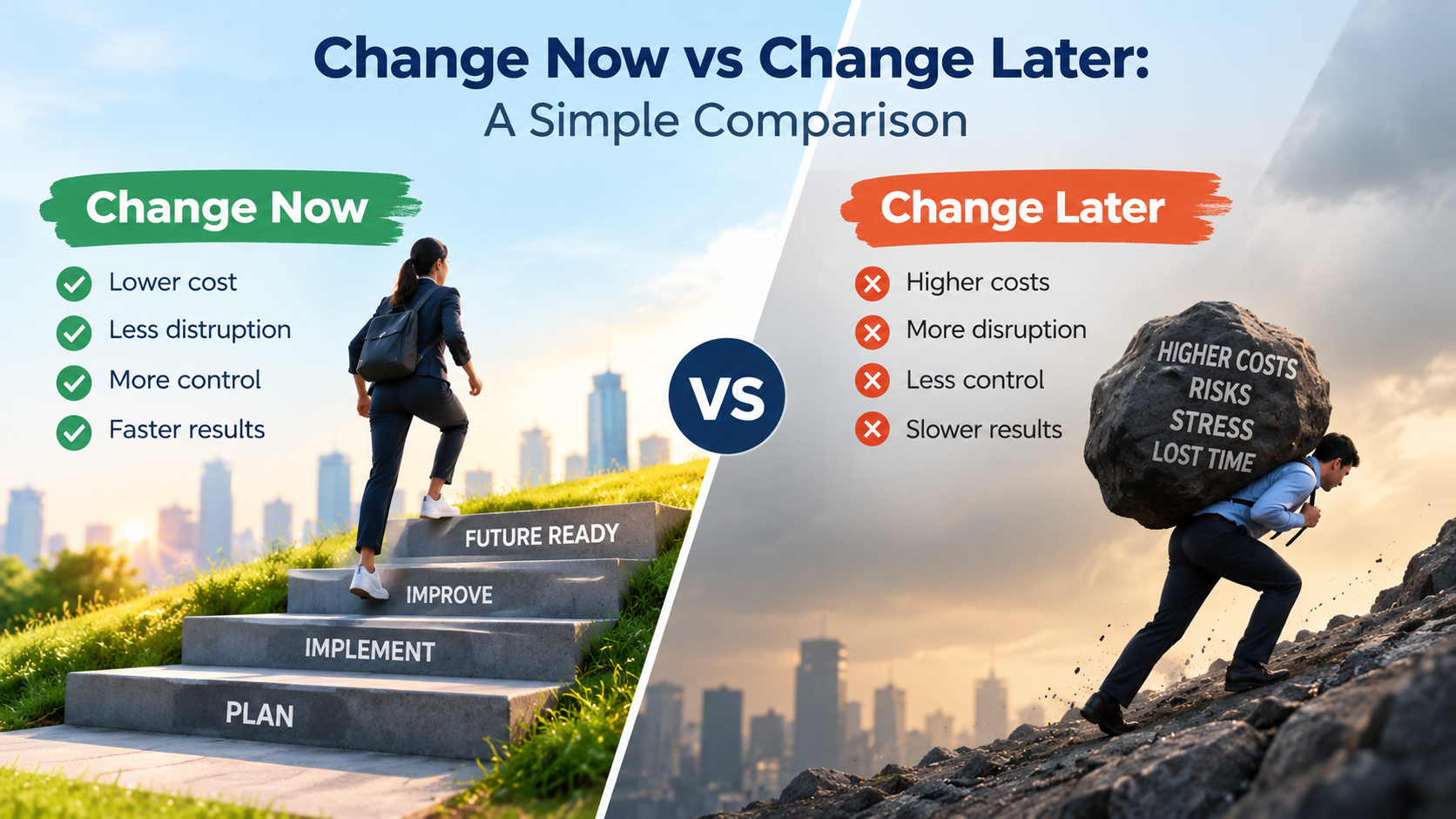
| Factor | Change Now | Change Later |
| Scale of change | Small, staged and testable | Large, urgent and interconnected |
| Employee readiness | Time to prepare and train | Rushed communication and resistance |
| Cost profile | Planned budget and phased spend | Emergency spend and higher premiums |
| Risk | Managed through pilots | Concentrated in one high-stakes go-live |
| Credibility | Leaders follow through | Trust already damaged by past delays |
| Options | Several paths to choose from | Few choices left |
An Illustrative Example
Consider a mid-sized Australian services firm that knows its client onboarding process is slow and manual. Fixing it in year one would mean mapping the process, trialling a small automation, and training a handful of staff. A few years later the same process touches billing, compliance and three separate systems, half the team relies on private workarounds, and the people who understood the original design have moved on. The problem is identical. The cost of delaying change turned a small project into a major program. (This is a hypothetical example to show the pattern, not a statistic.)
Why Organisations Keep Delaying Change
- “It isn’t the right time.” There is never a perfect time, so the delay becomes permanent.
- Fear of disruption. Leaders focus on the visible short-term pain and overlook the hidden long-term cost.
- No clear sponsor. Without someone accountable, change drifts between departments.
- Past failures. A previous change that went badly makes everyone cautious about starting another.
- Budget cycles. Spending is judged annually, while the cost of delaying change accumulates across years.
- Limited capacity. Teams are stretched running today’s operations and can’t imagine adding change on top.
Signs Your Organisation Is Carrying Change Debt
Change debt hides in plain sight. If several of these sound familiar, the cost of delaying change is probably already rising.
- People say “we’ve always done it this way” or “that project never went anywhere”.
- Critical knowledge sits with one or two individuals.
- Employees keep private spreadsheets to work around official systems.
- Change announcements are met with shrugs rather than questions.
- The same issues appear in every engagement survey and post-project review.
- New projects are delayed because “the last one isn’t bedded in yet”.
- Leaders talk about change often but rarely fund the people side of it.
How to Reduce the Cost of Delaying Change
You don’t have to fix everything at once. The goal is to stop the debt growing and then pay it down deliberately.
- Make the cost visible. Estimate what the delay costs each month in rework, lost time, turnover and missed opportunity. Numbers get attention where opinions don’t.
- Assess readiness first. A structured change readiness assessment shows where people, processes and leadership are strong or weak before you commit.
- Break the change into stages. Smaller steps are easier to fund, test and learn from.
- Secure a real sponsor. Someone senior must own the outcome and model the new behaviour.
- Plan for people, not just systems. Communication, training and reinforcement deserve a budget line. Our post on why employees go back to the old way after training shows what happens without them.
- Measure adoption. Use employee adoption metrics to prove the change stuck, not just that it went live.
Skills That Help You Tackle the Cost of Delaying Change
Recognising change debt is one skill; reducing it is another. Structured training gives you the frameworks, language and tools to make the case and lead the work.
- [Change Management Foundation](https://changemanagementcourses.au/change-mangement-foundation/) introduces the core principles: organisational context, people and change, leadership, stakeholders and communication.
- [Change Management Practitioner](https://changemanagementcourses.au/change-management-practitioner/) builds the practical ability to plan, run and sustain change, including how to handle resistance and measure results.
- Certification background. Both pathways are aligned to recognised industry frameworks, and APMG International publishes further information on the certification scheme.
If you are unsure which level fits, you can compare all options on our courses page, or read how a lack of capability can derail programs in our post on the change management skills gap.
The Cost of Delaying Change Across Australian Cities
Change debt exists everywhere, but the pressure points differ by city and industry.
Sydney. Financial services and professional services firms face constant regulatory and technology shifts, so postponed change quickly becomes compliance risk. See change management courses in Sydney.
Melbourne. Healthcare, education and government organisations carry heavy legacy processes, and delays hit frontline staff first. Explore change management courses in Melbourne.
Brisbane. Infrastructure and construction programs run on long timelines, where late decisions flow through the entire schedule. Check out change management courses in Brisbane.
Perth. Mining, energy and resources operations depend on safe, consistent processes, and slow change can carry real operational risk. Find change management courses in Perth.
Adelaide. Defence, health and advanced manufacturing organisations need careful, staged transitions that build trust. See change management courses in Adelaide.
Canberra. Federal agencies handle machinery-of-government shifts and policy changes that leave little time for late starts. Take a look at change management courses in Canberra.
For a wider view of workforce trends, Jobs and Skills Australia publishes labour market and skills research worth bookmarking.
Change Debt and AI Adoption
Technology adoption is where the cost of delaying change is often most visible. Organisations that put off preparing people for tools such as Copilot risk paying twice: once for licences nobody uses, and again for a rushed catch-up later. Our guide to a Copilot rollout strategy shows how early planning keeps that cost down.
A 90-Day Plan to Pay Down Change Debt
- Days 1 to 30: List the debts. Gather the postponed changes, group them by impact and pick the one with the highest cost and the lowest complexity.
- Days 31 to 60: Prove it in a pilot. Run a small, well-supported trial. Communicate clearly, train the people involved and capture what you learn.
- Days 61 to 90: Scale and reinforce. Extend to the next group, share the results and agree the adoption measures that will keep the change alive.
Repeat the cycle with the next item on the list. Each successful step also rebuilds credibility, which lowers the cost of every future change. If leaders agree with the plan but behaviour stays the same, our posts on why transformation projects fail even when everyone agrees and why employees support change but don’t change behaviour explain the gap.
Common Mistakes When Dealing With Change Debt
- Waiting for the perfect moment instead of starting small.
- Treating change as a technology project with no people plan.
- Announcing change without a sponsor or follow-through.
- Measuring go-live but not adoption.
- Trying to fix everything at once and burning out the team.
Frequently Asked Questions About the Cost of Delaying Change
What is change debt?
Change debt is the accumulated cost of changes an organisation knows it needs to make but keeps postponing. Like financial debt, it grows with interest the longer it is left.
Why does the cost of delaying change increase over time?
Because workarounds harden into habits, systems age, skills gaps widen, trust erodes and the change itself grows larger and more interconnected the longer it waits.
How can I measure the cost of delaying change?
Start by estimating monthly rework, lost productivity, staff turnover linked to the issue, and opportunities missed. Even rough figures help leaders see that doing nothing has a price.
Do I need a certification to lead change?
Not always, but structured training gives you proven frameworks and credibility. Many professionals begin with the Foundation course and progress to Practitioner.
Can I study change management online while working?
Yes. Live online classes let you learn from anywhere in Australia around your work commitments. See the FAQ page for delivery options.
Final Thoughts: Start Paying Down Change Debt Now
Delay feels safe because its costs are quiet. But the cost of delaying change compounds in the background until it forces a much bigger, faster and more expensive decision. Start small, make the cost visible, prepare your people and follow through, and each change you complete makes the next one easier.
Ready to build the skills to lead change with confidence? Explore our change management courses, or speak to a course advisor on 1300 649 299. For wider training options, see Logitrain.