

The town hall went well. Heads nodded, the leadership team got a round of applause, and the follow-up survey came back overwhelmingly positive. Three months later, the new system is live and most people are still doing the job exactly the way they did before, using the old spreadsheet they swore they would retire. This is the buy-in illusion, and it is one of the most common reasons change adoption stalls inside Australian organisations. Employees genuinely agree with the change. They just never act on it.
If you lead projects, run a team or work in HR or transformation, this gap probably looks familiar. In this guide we explain why agreement and behaviour drift apart, how to diagnose where people are stuck, and which change adoption strategies close the gap. We also point to practical training for learners in Melbourne, Sydney, Brisbane, Perth, Adelaide and Canberra.
Quick answer: Employees agree with change but do not adopt it because agreeing is easy and changing is hard. Real change adoption needs more than awareness. People also need the motivation, the know-how, the time to practise and a workplace that rewards the new way instead of the old one.
What is the buy-in illusion?
The buy-in illusion is the belief that visible agreement means the change is working. It happens when leaders measure what is easy to see (attendance, applause, positive survey scores) and assume it predicts what is hard to see, which is what people actually do on a Tuesday morning when nobody is watching.
The illusion is convincing because the agreement is sincere. Most employees are not resisting. They understand the reason for the change, they like the vision, and they would say so if asked. But opinion and behaviour are different things, and projects are judged on the second one. Closing that gap is the heart of change adoption.
Why employees agree with change but never adopt it
- Agreeing is cheap. Nodding in a meeting costs nothing. Learning a new process, slowing down while you are unfamiliar and risking mistakes costs a lot. People take the cheap option first.
- Nobody has time to learn. The old workload does not shrink when the new system arrives. If there is no protected time to practise, people fall back on what they can do quickly.
- Knowing is not the same as being able. A single training session can explain a tool without making anyone confident using it. Confidence comes from practice and support.
- The old way is still easier, or still rewarded. If targets, reports and recognition all still depend on the old process, people will rationally keep using it.
- Managers are not modelling the change. Employees watch what their direct manager does, not what the executive email says. If the manager keeps asking for the old report, the old report survives.
- Nobody checks. Without follow-up, the new way becomes optional. Silence is read as approval, and the project team has moved on to the next initiative.
Our own articles explore different parts of this problem, including why employees support change but do not change their behaviour, why transformation projects fail even when everyone agrees and why employees go back to the old way of working after training.
Change adoption vs buy-in: signals that tell them apart
Measuring change adoption starts with refusing to treat buy-in signals as proof. Compare what you may be tracking with what actually shows that the change has landed:
| Question | Buy-in signal (can mislead) | Adoption signal (harder to fake) |
| Communication | High attendance at the town hall | People can describe what they do differently now |
| Sentiment | Positive survey results | The new process is used for real work, every day |
| Old methods | Old tools are officially “retired” | Old spreadsheets and workarounds have stopped appearing |
| Quality | Training completion rates | Fewer errors, queries and help desk requests over time |
| Leadership | Visible executive support | Managers use the new reports in their own meetings |
If you want to track the right measures after go-live, read our guide to employee adoption metrics.
Diagnosing the gap with the ADKAR model
Prosci’s ADKAR model breaks individual change into five stages: Awareness, Desire, Knowledge, Ability and Reinforcement. Its value in this situation is that it tells you where a person is stuck, so you do not apply the wrong fix. Prosci’s own material notes that someone with strong Awareness, Desire and Knowledge can still fall back when they lack the Ability to succeed, which is exactly the pattern behind the buy-in illusion.
| Stage | What you hear | What is really happening | What helps |
| Awareness | “I get why we are doing this.” | The reason is understood. This is usually where the illusion starts. | Keep the message simple, but do not stop here. |
| Desire | “Sounds good, in theory.” | Support is verbal. Personal impact is unclear or feels risky. | Explain what changes for each role and involve people early. |
| Knowledge | “I attended the training.” | People know the steps, but not how to handle real situations. | Use job-specific examples and quick reference guides. |
| Ability | “I will get to it when things calm down.” | Skills are not yet built, and time to practise is missing. | Provide coaching, sandbox practice and protected time. |
| Reinforcement | “We went back to the old way.” | The new behaviour fades when nothing rewards it. | Align targets, recognise adopters and retire the old method. |
Notice that only the first row is solved by communication. Most adoption gaps sit in the last three, which are about skills, time and reward, not messaging.
7 change adoption strategies that work in practice
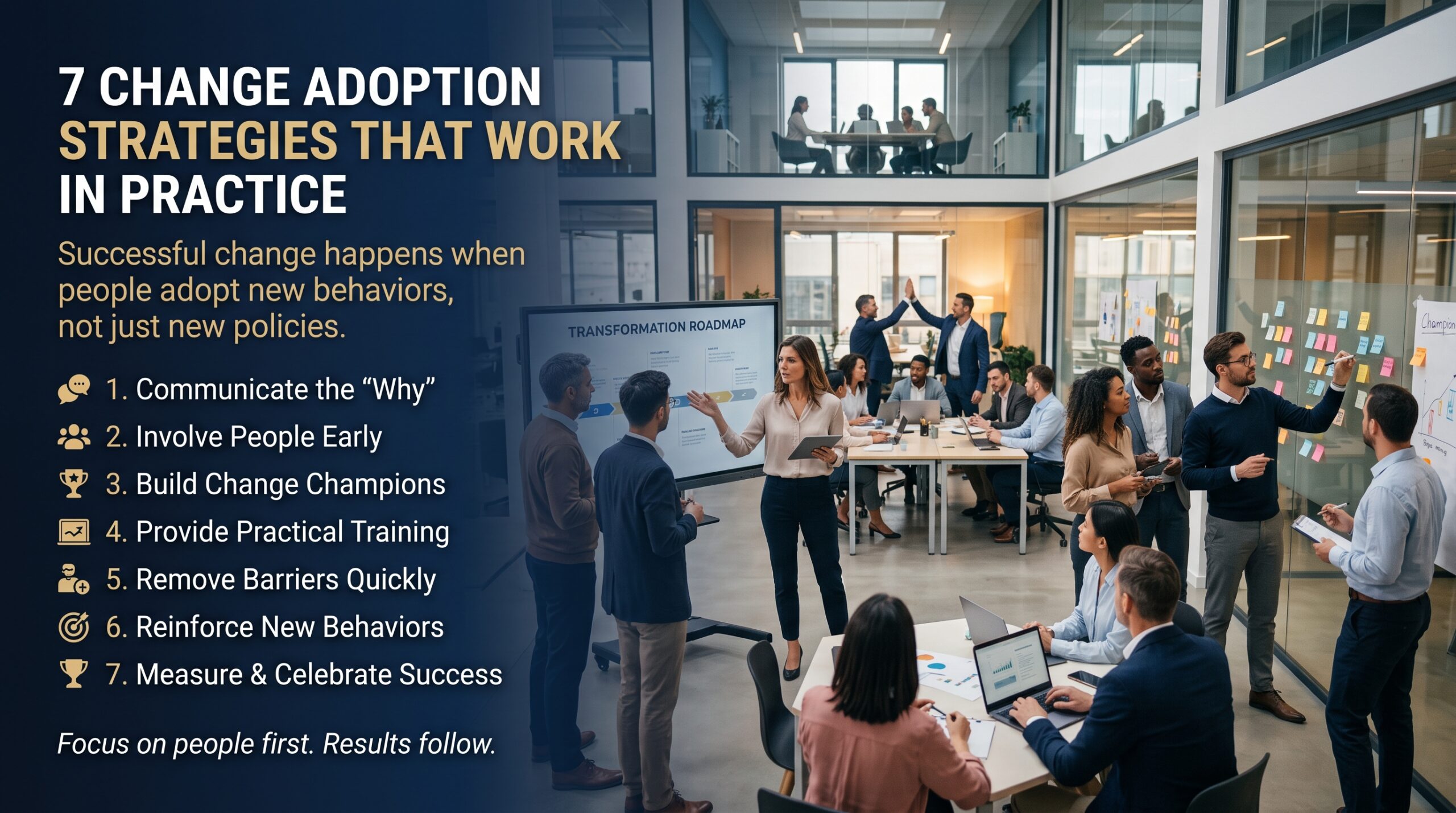
Good change adoption does not happen by accident. It is designed, in the same way you would design a training plan or a communication plan. These seven strategies work together:
- Define the behaviour, not just the system. Write down exactly what people should do differently, such as “submit requests through the new portal, not by email”. Vague goals produce vague results.
- Make the new way the easiest way. Remove steps, pre-fill forms and fix friction. If the new method is harder than the old one, adoption will lag no matter how good the message is.
- Train in the flow of work. Short, role-specific sessions close to go-live beat a single long workshop. Add quick guides and a place to ask questions.
- Equip managers first. Give frontline leaders talking points, a clear view of what to look for and permission to coach. They are the strongest influence on daily behaviour.
- Retire the old way on purpose. Set a date, communicate it and switch off or stop accepting the old method. Running two systems indefinitely sends the signal that the change is optional.
- Reinforce what you want repeated. Recognise early adopters, share small wins and align KPIs with the new process.
- Measure behaviour and follow up. Check usage data, listen to frontline feedback and act on what you find. Adoption is a process that continues after go-live.
Change adoption skills and courses that build them
Strong change adoption is a learnable skill, not a personality trait. It combines understanding people, planning communication, working with stakeholders and measuring results. Two courses at Change Management Courses are a natural place to start:
- Foundation level. The Change Management Foundation course covers organisational context and approach, people and change, change leadership and teams, stakeholders and communication, and the work of the change manager.
- Practitioner level. The Change Management Practitioner course suits people who want to apply change approaches to real initiatives. Check the course page for current details.
- All options. Compare formats and dates on our change management courses
If you are thinking about making change your career, our guides to how to become a change manager in Australia and change manager skills and certifications explain the pathways. Employers are looking for these abilities. The World Economic Forum’s Future of Jobs reporting continues to point to adaptability and working with people through change as skills in demand, and the Jobs and Skills Australia labour market insights portal helps you check demand in your own field.
Change adoption training by city
Adoption challenges show up in every sector, though the setting differs. Typical examples and local course pages include:
- Melbourne: health, education and state government programs. In-person classes run in West Melbourne, plus live online. See change management courses in Melbourne.
- Sydney: finance, professional services and large technology rollouts. In-person classes run in Surry Hills, plus live online. See change management courses in Sydney.
- Brisbane: infrastructure, resources and public sector projects. In-person classes run in the city, plus live online. See change management courses in Brisbane.
- Perth: resources and energy operations, where new safety and reporting systems must be used consistently. Live online or in-house. See change management courses in Perth.
- Adelaide: defence, health and manufacturing transformations. Live online or in-house. See change management courses in Adelaide.
- Canberra: federal agencies delivering policy and system change. Live online or in-house. See change management courses in Canberra.
You can compare every option on our change management course locations page.
A 30-day plan to close your own adoption gap
Use this plan to test your change adoption gap on a live initiative:
- Week 1: Look for evidence. Pick one recent change. List the buy-in signals you collected, then find the adoption signals that either confirm or contradict them.
- Week 2: Find the stage. Use the ADKAR table above to decide whether people are stuck at Desire, Knowledge, Ability or Reinforcement.
- Week 3: Fix one barrier. Choose a single action, such as protected practice time or a manager briefing, and put it in place.
- Week 4: Measure behaviour. Check usage and quality data, speak to three frontline employees, and decide what to adjust next.
Frequently asked questions
What is change adoption?
Change adoption is the point at which people actually use a new process, system or way of working in their daily jobs. It is different from awareness or agreement, because it is measured by behaviour, not opinion.
Why do employees agree with change but never adopt it?
Agreeing is easy, while changing takes time, skill and risk. If people lack practice, face competing priorities or see the old way still being rewarded, they keep doing what they did before even though they support the change.
How do you measure change adoption?
Look at behaviour: system usage, process compliance, error rates, support requests and whether old workarounds have disappeared. Combine the data with conversations with frontline staff and managers.
What is the difference between buy-in and adoption?
Buy-in is agreement with the change. Adoption is doing the new thing consistently. You need buy-in to start, but only change adoption delivers the business benefit.
Are change management courses available online in Australia?
Yes. Our courses are available through live online delivery across Australia, with in-person options in Melbourne, Sydney and Brisbane. Participants receive a certificate of completion.
Ready to turn agreement into action?
Closing the gap between agreement and behaviour is one of the most valuable skills in modern organisations. Explore our change management courses, or contact us on 1300 649 299 to speak with a course advisor. Start this week by choosing one change and asking a simple question: what are people doing differently on Tuesday morning?