

Employee buy-in for change is the one ingredient almost every transformation plan assumes and very few actually earn. The strategy is sound, the business case is solid, the timeline is approved and the sponsor is enthusiastic. Then launch day arrives and the people who have to live with the change quietly nod, comply on the surface and carry on exactly as before. The strategy did not fail during delivery. It failed months earlier, in the gap between what leaders decided and what employees were ever persuaded to believe.
This guide explains that gap, why it opens so early, and how to close it. You will find seven reasons employee buy-in for change collapses before a project starts, a practical pre-launch plan, a link to the ADKAR model, city-by-city insight for Sydney, Melbourne, Brisbane, Perth, Adelaide and Canberra, and the training pathways that help change leaders build real commitment instead of polite agreement.
What Is the Employee Buy-In Gap?
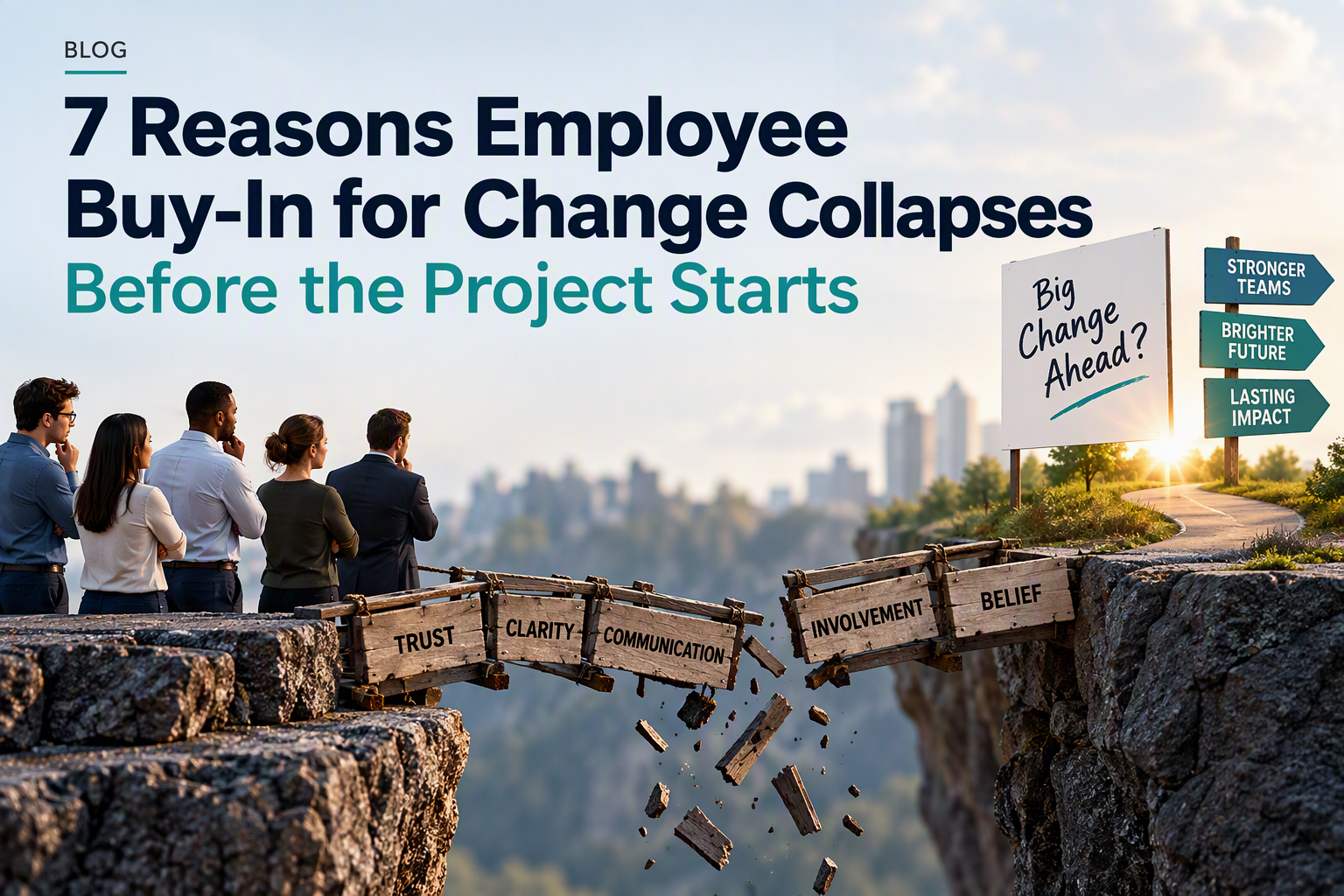
The employee buy-in gap is the distance between a change being announced and employees genuinely owning it. On one side sits the plan: objectives, milestones, governance and communication calendars. On the other sits human reality: doubts, habits, workload, past experiences and a quiet question that every employee asks, which is “what does this mean for me?”.
When that question goes unanswered, people do not usually protest. They wait. They wait to see whether this change is real, whether leaders will stay the course and whether it will make their working life better or worse. That waiting is the buy-in gap in action, and it is invisible on a project dashboard until adoption numbers disappoint.
The key point is timing. The gap is created before launch, by how the change was designed and introduced, which is why even brilliant delivery cannot rescue a change that never earned employee buy-in for change in the first place.
Why Employee Buy-In for Change Matters More Than the Strategy
A strong strategy increases the potential value of a change. Employee buy-in decides how much of that value you actually capture. A system that nobody uses properly, a process that people work around and a new structure that employees quietly resist all deliver a fraction of the promised benefit, no matter how well they were planned.
Put simply, strategy sets the ceiling and buy-in determines the floor. Organisations that invest heavily in the first and lightly in the second end up with expensive programs and modest results. Organisations that treat employee buy-in for change as a core workstream, planned and measured like any other, tend to see faster adoption and fewer surprises.
7 Reasons Employee Buy-In for Change Collapses Before the Project Starts

1. The strategy was designed in a boardroom and announced to everyone else
Many changes are shaped by a small group of executives and consultants, then communicated downwards as a finished decision. Employees can feel when they were not part of the thinking. Even a good plan lands badly when it arrives as a fait accompli, because people support what they help create.
2. The “why” is about the organisation, not the person
Leaders explain the change in terms of efficiency, growth and competitiveness. Employees hear workload, risk and uncertainty. A message such as “we are modernising our platform to improve performance” does not answer the question on every mind. Employee buy-in for change begins when the message includes what changes for the individual, what stays the same and what support they will get.
3. Employees were informed, not involved
A town hall, an email and an intranet page tell people what is happening. They do not give anyone a voice. Real involvement means asking for input early, using it visibly and showing where it changed the plan. A Melbourne operations team that helped redesign its own workflow will defend the new process. A team that was simply told about it will wait for it to fail. That is why employee buy-in for change grows from involvement, not announcements.
4. Middle managers were not equipped to lead the conversation
Employees trust their direct manager far more than a distant executive. Yet managers are often briefed late, given a slide deck and asked to “cascade the message”. If they have unanswered concerns themselves, they will pass on hesitation instead of confidence. Managers who are prepared, listened to and trained become the strongest builders of employee buy-in for change.
5. Past changes left a trail of broken promises
Change fatigue is real. If the last restructure promised stability and delivered redundancies, or the last system launch promised simplicity and delivered months of rework, employees carry that memory into every new announcement. Skipping this history is a mistake. Acknowledging it honestly is often the first step towards rebuilding trust.
6. Legitimate concerns are labelled as resistance
When employees raise questions, they are frequently treated as obstacles to be managed. Yet many concerns are valuable early warnings: unrealistic timelines, missing training, risks to customers. Dismissing them as resistance teaches people to stop speaking up, and silence is the most dangerous signal of all.
7. Sponsors announce the change but do not visibly own it
Employees watch what leaders do, not just what they say. If a sponsor kicks off the program and then disappears, or keeps working in old ways, the message is clear: this is optional. Visible, consistent sponsorship, including answering hard questions in the open, is one of the strongest drivers of employee buy-in for change.
Informed vs Bought In: Seeing the Gap Clearly
Use the table below as a quick diagnostic. If most of your current activity sits in the left column, you are communicating a change, not building commitment to it.
| Area | Informed employees | Bought-in employees |
| Understanding | Know what is changing | Understand why, and what it means for them |
| Voice | Hear announcements | Shape parts of the solution |
| Emotion | Comply or wait and see | Feel ownership and some enthusiasm |
| Manager role | Passes on the message | Leads the conversation with confidence |
| Concerns | Kept quiet or labelled as resistance | Raised early and acted on |
| Behaviour after launch | Revert to old ways under pressure | Adopt and reinforce new ways of working |
Closing the gap does not mean getting universal enthusiasm. It means moving enough people from passive awareness to active support that the change can survive its first difficult months.
How to Build Employee Buy-In for Change Before Launch
The work happens early, usually long before the first training session. These six practices form a reliable foundation.
- Involve employees in the design. Run listening sessions, co-design workshops and small working groups with people who do the work every day.
- Make the “why” personal. Build a message that covers the business reason, the individual impact and the support available. Test it on a small group before it goes out.
- Equip your managers first. Brief them early, give them talking points and a safe space to raise their own concerns before they face their teams.
- Address history openly. Name previous changes that went badly and explain what will be different this time.
- Treat concerns as data. Capture every question and concern, respond visibly and show what changed as a result.
- Show sponsor commitment. Have leaders attend sessions, answer questions in person and model the new behaviours themselves.
None of these require large budgets. They require planning time and genuine willingness to listen, which is exactly where trained change practitioners add value.
Using ADKAR to Close the Buy-In Gap
The widely used Prosci ADKAR model describes how individuals move through change: Awareness, Desire, Knowledge, Ability and Reinforcement. The buy-in gap sits mainly in the first two stages. Most programs invest heavily in awareness and then jump to knowledge, skipping desire entirely.
| ADKAR stage | What employees need | Buy-in action before launch |
| Awareness | To understand why change is needed | Share the business case honestly, including risks and trade-offs |
| Desire | A personal reason to support it | Explain individual impact, listen to concerns and involve people in design |
| Knowledge | To know how to change | Provide role-specific guidance and manager briefings |
| Ability | Practice and support to perform | Build safe practice time and floor support into the plan |
| Reinforcement | Reasons to keep going | Recognise early adopters and fix obstacles quickly |
Desire cannot be forced. It can only be earned through honesty, involvement and visible respect for the people affected. That is the heart of employee buy-in for change.
How to Tell Whether Employee Buy-In for Change Is Missing
You do not have to wait for adoption data to find out. Watch for these early warning signs.
- Meetings are quiet and questions come privately afterwards, not in the room.
- Attendance at briefings is high but engagement is low.
- Managers keep asking for “more information” before they will commit.
- Informal workarounds appear before the new process even launches.
- Pulse surveys show strong awareness but weak confidence or support.
Short pulse checks, manager feedback sessions and honest conversations with a cross-section of employees will tell you far more than a project status report. Measure buy-in the way you measure budget: regularly and openly.
A 90-Day Pre-Launch Plan to Build Employee Buy-In for Change
If a change is still in planning, this timeline gives you a practical way to build commitment before go-live.
| Phase | Focus | What to do |
| Days 1 to 30 | Listen and diagnose | Run listening sessions, map stakeholder groups and review past change experiences. Draft a personal “what is in it for me” message for each group. |
| Days 31 to 60 | Involve and equip | Set up co-design groups, brief and train managers and respond visibly to concerns. Adjust the plan where employee input is sound. |
| Days 61 to 90 | Commit and prepare | Confirm sponsor behaviours, run a pulse check, agree adoption measures and publish a “you said, we did” summary before launch. |
By day 90 you will have measurable evidence of employee buy-in for change, or clear warning signs that the launch date needs to move.
The Employee Buy-In Gap Across Australian Cities
Employee buy-in for change follows a universal principle, but the pressure points differ by location and industry.
- Sydney: large financial services and consulting programs often run on tight timelines. Rushed announcements are the biggest threat to employee buy-in for change.
- Melbourne: health, retail and technology organisations value consultation. Employees expect to be heard, and skipping that step is quickly noticed.
- Brisbane and the Gold Coast: growing public sector and infrastructure programs need strong middle-manager engagement across dispersed teams.
- Perth: resources and engineering workplaces rely on trust in frontline supervisors. Safety and operational impact must be addressed upfront.
- Adelaide: health, education and defence programs reward honest communication about workload and capacity.
- Canberra: public service transformation depends on clear explanation of policy intent and what it means for day-to-day roles.
Wherever you operate, the sequence is the same: listen first, explain personally, involve early and follow through visibly.
Change Management Courses That Build Buy-In Skills
Facilitating employee buy-in for change is a learnable skill, not a personality trait. Structured training gives you proven frameworks, practical tools and a recognised credential. These are the pathways Australian professionals ask about most.
- Change Management Foundation (APMG): introduces core concepts, stakeholder engagement and resistance management. Explore our change management courses.
- Change Management Practitioner (APMG): builds the skills to plan and lead change on real programs, including engagement and adoption planning. See the Practitioner pathway.
- Project management training: useful for project leaders who want to work more effectively with change teams. Visit project management courses.
- Wider IT and business training: browse the full catalogue at Logitrain.
Not sure which level suits you? Our team can help you match a pathway to your current role and experience.
Quick Self-Audit: Is Your Change Missing Employee Buy-In?
Answer honestly. Each “no” points to work to do before launch.
- Can every employee group explain why the change is happening and what it means for them?
- Were employees involved in shaping the solution, not just informed about it?
- Have managers been briefed and equipped before the wider announcement?
- Have you acknowledged past change experiences honestly?
- Are employee concerns being captured, answered and acted on visibly?
- Are sponsors modelling the change in their own behaviour?
If you answered no to three or more, there is likely a buy-in gap, and the 90-day plan above is the place to start.
Frequently Asked Questions
What is employee buy-in for change?
It is the level of understanding, belief and commitment employees have toward a change before and during implementation. Genuine buy-in goes beyond awareness. It means people see the reason for the change and feel willing to support it.
Why do change strategies fail before they start?
Because the groundwork with employees is skipped. Strategies are designed centrally, communicated late and delivered without listening. By launch, employees are already sceptical, and no amount of good project management repairs that.
How do you gain employee buy-in for a major change?
Involve employees early, make the personal impact clear, equip managers, treat concerns as useful feedback and keep sponsors visibly engaged. Build these into the plan well before launch.
Is resistance to change the same as lack of buy-in?
Not exactly. Resistance is often a visible reaction to a real concern, while missing employee buy-in for change can be silent. Treat both as information about what employees need to commit.
Do I need a certification to lead employee engagement in change?
Not strictly, but formal training in frameworks such as APMG and ADKAR gives you tested tools and credibility, and helps you structure engagement work more effectively.
Close the Gap Before You Launch
Great strategies do not fail because people are difficult. They fail because commitment was assumed instead of built. The encouraging news is that employee buy-in for change can be planned, practised and measured, and the best time to start is long before the first announcement.
Ready to build the skills? Explore our change management courses, consider project management training to work better with delivery teams, or browse the wider catalogue at Logitrain.