
A widely cited McKinsey analysis puts the failure rate of large-scale transformation programs at around 70 percent and the reasons rarely trace back to the technology itself. They trace back to the change management skills gap: the distance between what a transformation actually requires from its leaders and project teams, and what those people are actually equipped to deliver.
Most transformation programs don’t fail during implementation. They fail weeks or months earlier, in planning meetings where nobody in the room has the skills to plan for how people will actually respond to the change. By the time the system goes live or the new process rolls out, the outcome has often already been decided not by the technology, but by whether the change management skills gap was closed before the program ever reached implementation.
What Is the Change Management Skills Gap?
The change management skills gap describes the shortfall between the change capability a transformation program needs and the change capability actually present in the people running it. It shows up in a few consistent ways: a project manager asked to “handle the change side” with no formal training, a sponsor who signs off on a communications plan without understanding resistance patterns, or a steering committee that tracks budget and timeline in detail but has no visibility into adoption readiness at all.
This is different from simply not having a change manager on the team. Many organisations do have one the gap is broader than headcount. It is a gap in structured methodology, in leadership change-capability, and in the discipline to apply a framework like ADKAR or Prosci consistently rather than treating change as a communications task bolted on at the end.
Why Programs Fail Before Implementation Even Starts
The failure point is earlier than most teams assume. By the time a program reaches go-live, the change management skills gap has usually already shaped the outcome through decisions made during planning: who was consulted, how resistance was assessed, whether training was designed around actual workflows, and whether leaders were equipped to model the new behaviour themselves. Fixing change management after go-live is damage control. Closing the gap before implementation is what actually protects the program.
Programs With vs. Without Change Management Capability
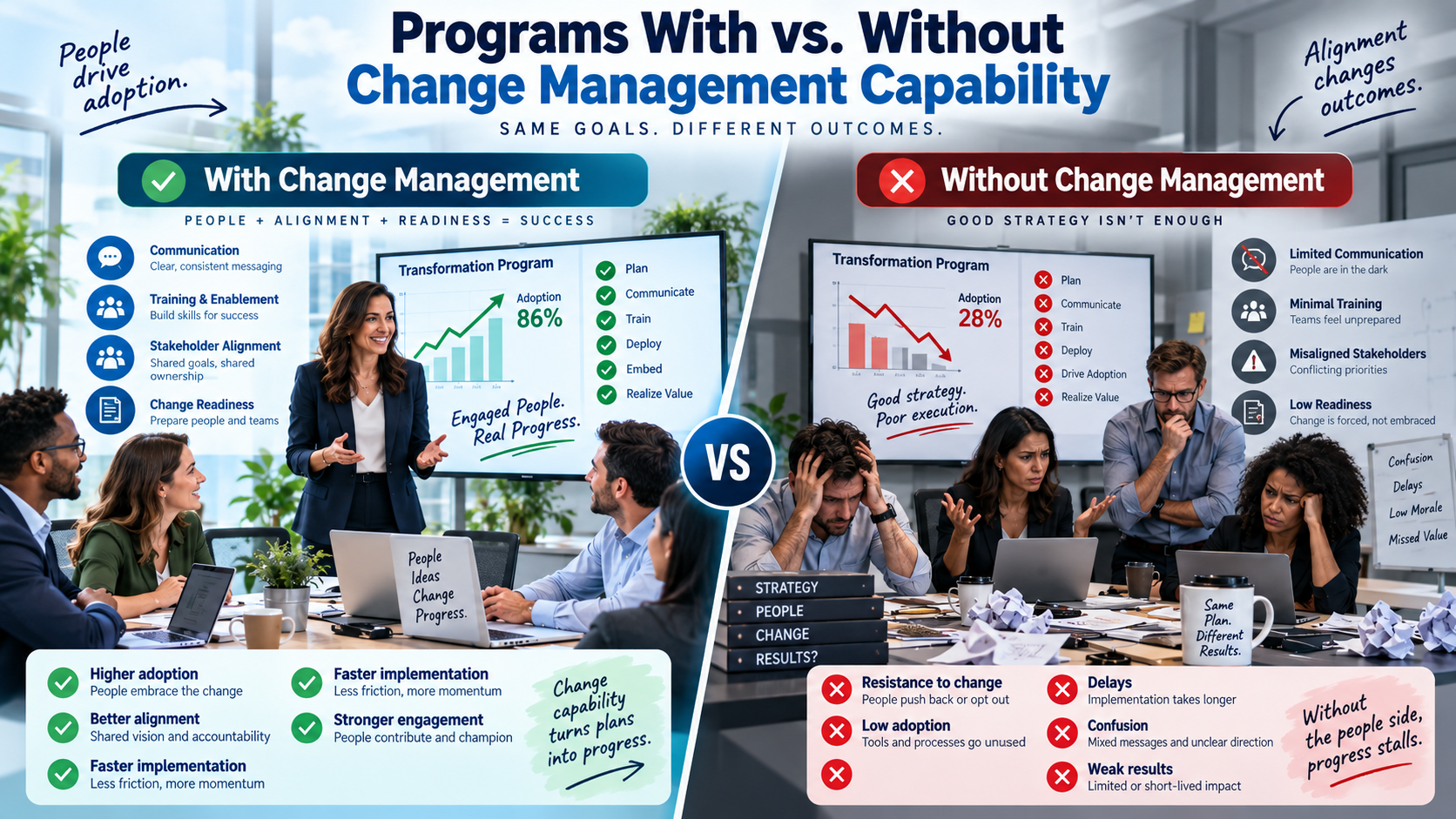
The table below shows how the same transformation program plays out differently depending on whether the change management skills gap has been addressed before implementation.
| Program Stage | Skills Gap Closed | Skills Gap Present |
| Planning | Structured impact and readiness assessment | Change treated as a communications afterthought |
| Sponsorship | Leaders trained to actively sponsor and model change | Sponsors sign off but stay disengaged |
| Resistance | Anticipated and managed with a framework | Discovered only after rollout, reactively |
| Training | Built around real workflows and role impact | Generic sessions disconnected from daily tasks |
| Adoption Tracking | Measured against clear adoption KPIs | Success assumed once the system goes live |
| Outcome | Higher chance of meeting program goals | High risk of stalling or reverting to old process |
6 Root Causes of the Change Management Skills Gap
The change management skills gap rarely comes from a single missing role. It usually comes from a combination of these six recurring causes:
- Change treated as a communications task, not a structured discipline with its own methodology.
- Project managers expected to “cover” change management without formal training in it.
- Sponsors who approve the program but are never trained to actively sponsor the change itself.
- No resistance assessment built into the planning phase, so pushback is discovered too late to manage well.
- Training designed around system features rather than the actual change in day-to-day work.
- No adoption metrics, so leadership has no early warning when a program is quietly failing.
How the Skills Gap Shows Up Across Australian Organisations
Program failures tied to the change management skills gap are not confined to any one industry or city. Organisations in Sydney, Melbourne, Brisbane, Perth, Adelaide, and Canberra report the same pattern across banking, government, resources, and retail transformation programs.
In Sydney, banking and financial services programs increasingly require accredited change managers before large system rollouts are approved. In Melbourne, retail and logistics transformations often stall when frontline resistance isn’t assessed early. In Brisbane, resources and infrastructure programs are investing in change capability uplift for project managers, not just dedicated change roles. In Perth, mining and utilities transformations increasingly build change readiness into governance from day one. In Adelaide, growing SME and public-sector-adjacent programs are building internal change capability rather than relying solely on external consultants. In Canberra, government transformation programs now list structured change management, ADKAR or Prosci methodology, as a formal capability requirement.
The lesson is consistent nationwide: the organisations closing the change management skills gap earliest are the ones seeing their transformation programs actually stick.
How to Close the Gap Before Your Next Program Kicks Off
Closing the change management skills gap is one of the highest-leverage moves a transformation program can make, because it is far cheaper to build capability before a program starts than to recover a stalled one after go-live.
- Build change management capability into project managers and team leads, not just a single dedicated role.
- Train sponsors specifically on active sponsorship, not just program approval.
- Run a structured resistance and readiness assessment before the plan is finalised.
- Apply a proven framework such as ADKAR or Prosci consistently across every phase, not only communications.
- Set adoption KPIs before go-live so success is measured by behaviour change, not just system deployment.
A structured change management course is the fastest way to build this capability across a project team, because it equips project managers, sponsors, and change leads with a shared, proven methodology instead of leaving change to be improvised program by program.
For teams weighing which certification path builds that capability fastest, our comparison of Prosci vs APMG change management certification breaks down the two most recognised frameworks in Australia.
If your transformation program involves a system rollout specifically, our guide on change management for ERP implementations covers the vendor-specific adoption challenges that often expose the skills gap first.
And if your program has already reached go-live and adoption is stalling, our post on why employees support change but don’t change their behaviour explains the reinforcement gap that usually follows a skills gap left unaddressed during planning.
All change management training is delivered as part of Logitrain’s Australia-wide IT and business skills training programs, with instructor-led options for professionals and project teams nationwide.
Frequently Asked Questions
What causes the change management skills gap in most organisations?
It typically comes from treating change as a communications task rather than a structured discipline, combined with untrained sponsors and no formal resistance planning before implementation.
Can project managers close the change management skills gap themselves?
Partially. Project managers can build meaningful change capability with structured training, but a program still benefits from a dedicated change lead applying a proven framework like ADKAR or Prosci.
When should change management planning start in a transformation program?
Ideally during initial planning, well before implementation resistance and readiness assessments are far more effective when built in early rather than added once rollout has already begun.
Final Word
The change management skills gap is rarely visible on a program’s risk register, but it is one of the most reliable predictors of whether a transformation will actually stick. Programs that close the gap before implementation through trained sponsors, structured resistance planning, and a consistent methodology give themselves a real chance of beating the odds that sink most large-scale change.