

If you’re responsible for helping your organisation sustain change, you already know the sinking feeling. The training went well, the feedback forms were glowing, and then a few weeks later you walk past a team’s desks and see the old spreadsheet open on every screen.
Here’s the uncomfortable truth: training isn’t the finish line. It’s the moment change becomes possible, not the moment it becomes real. People leave a workshop with good intentions and walk straight back into a workplace that’s still built around the old way.
We’ve looked at the psychology in why employees support change but don’t change their behaviour. This article picks up where that one stops. It’s about what happens after the training room, and the practical playbook successful change leaders use to sustain change for the long haul.
What Does “Going Back to the Old Way” Actually Look Like?
It rarely looks like rebellion. It looks like people being busy. Here are the signs most change leaders spot too late:
- Shadow spreadsheets. The new system is live, but somebody keeps a private copy of the old report “just in case”.
- “Just this once” exceptions. A deadline hits, the new process feels slow, and the old one quietly comes back for the month-end rush.
- Double handling. People enter data in the new tool and the old one, which doubles the work and kills goodwill.
- Old channels, new tools. Approvals still travel by email and phone even though a workflow exists.
- Logged in, not used. Login numbers look healthy, but the meaningful features sit untouched.
Because none of this makes noise, it often goes unnoticed until the benefits case starts to slip. That’s why you need to plan to sustain change from the start, not scramble once the project team has moved on.
Why Employees Go Back to the Old Way After Training
Most relapse isn’t about attitude. It’s about the environment people return to. These are the six causes we see most often after the training day ends. Understanding them is the first step to sustain change that lasts:
1. The forgetting curve starts the moment training ends
Research going back to Hermann Ebbinghaus suggests we forget a large share of new information quickly unless we use or review it. A single workshop, however good, fades fast. If the first real chance to practise arrives three weeks later, most of the detail has already gone.
2. The workplace hasn’t changed, only the people have
Training changes what people know. It doesn’t change the templates, forms, approval steps and reporting lines that were designed around the old process. You can’t train people out of a system that still rewards the old way, so the environment has to move too.
3. The old way is still open for business
If the legacy spreadsheet, report or shortcut is still available, the easier path wins, especially under pressure. Leaving both doors open feels kind. In practice it guarantees that some people will keep walking through the old one, so if you want to sustain change, you have to close it.
4. Nobody actually owns what happens next
The project team celebrates go-live and moves on to the next initiative. Managers assume the project handled it, and the project assumes managers will. With no named owner, nobody notices when usage drops. If you want to sustain change, somebody has to be accountable for it.
5. Real work arrives faster than practice
Training uses tidy examples. Real work arrives with messy data, exceptions and a deadline. The first time someone gets stuck on a live task and can’t find help, the old method is right there and the deadline is not negotiable.
6. Small failures go unsupported
Early stumbles are normal. If nobody’s on hand to help, people conclude the new way is slower or harder and quietly abandon it. One unanswered question can undo a week of good training.
How Successful Change Leaders Sustain Change After Training
Established frameworks agree on the principle. Prosci’s ADKAR model treats reinforcement as its own stage, and Kotter’s eight steps finish by anchoring new approaches in the culture. In practice, the leaders who consistently sustain change do eight things differently.
1. They plan to sustain change before training starts
Reinforcement is designed into the plan and the budget from day one, not added when problems appear. They also run a change readiness assessment early, so they know which teams will need the most support after go-live.
2. They retire the old way on purpose
Kurt Lewin described change as unfreezing, moving and refreezing, and refreezing is the step most programs skip. Successful leaders give a clear cut-off date, then archive the old spreadsheet, update templates and remove legacy access. They communicate this early so nobody’s surprised.
3. They space the learning
Instead of one big session, they schedule short refreshers at one, two and four weeks, backed by quick-reference guides and short how-to videos. Small, repeated practice beats one long day, and it’s the most direct way to sustain change against the forgetting curve.
4. They put help where the work happens
Super users and change champions sit with teams during the first weeks. Drop-in sessions and a fast-response channel mean nobody has to struggle alone. A two-minute answer at the right moment can save a whole workflow from reverting.
5. They equip managers to coach
Employees copy what their manager does. Leaders give managers a simple checklist, a few coaching questions for one-on-ones and the expectation that they’ll use the new way themselves. We cover this in more depth in our post on the support-behaviour gap.
6. They make the new way the easy way
They gather friction points in the first fortnight, then fix the top few quickly and visibly. When people see feedback turn into action, they trust the change. When the new process is genuinely easier, the old one loses its appeal and it becomes far simpler to sustain change.
7. They measure behaviour, not attendance
Attendance sheets and happy surveys tell you people showed up, not that anything changed. Leaders track real usage, error rates and turnaround times, and they compare those to sentiment. Our guide to employee adoption metrics shows what to measure after go-live.
8. They celebrate proof, not just launches
They share early wins with numbers and stories: “Invoices are now approved in a day, not five.” Visible results give hesitant colleagues a reason to switch, and they reward the people who moved first.
Training Day Thinking vs Change Leader Thinking
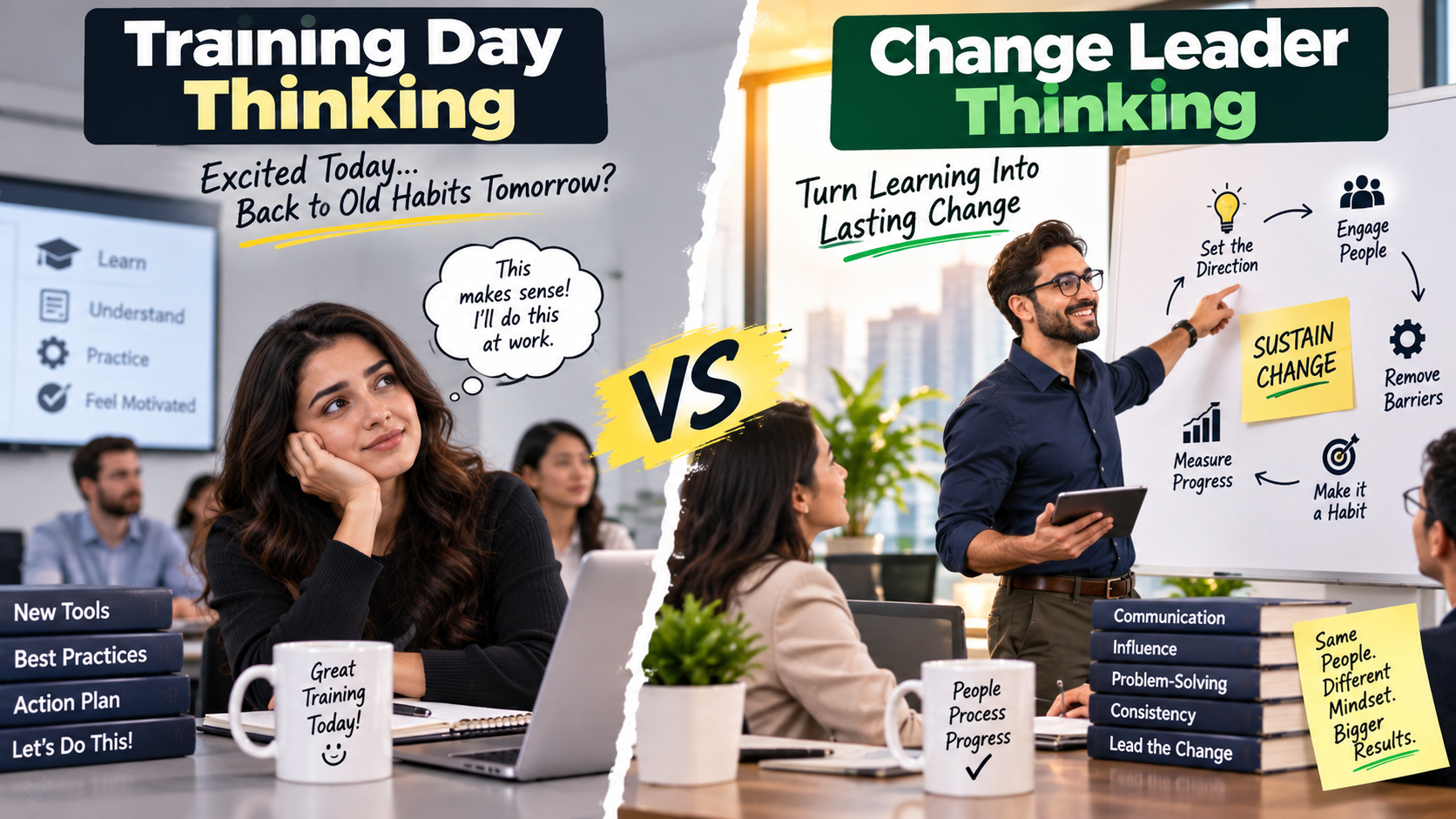
| What most programs do | What change leaders do |
| Treat training day as the finish line | Treat training as the start of the change |
| Run one big workshop | Space short refreshers over several weeks |
| Leave old tools and templates open | Set a cut-off date and retire them |
| Hand over to no one after go-live | Name an owner accountable for adoption |
| Measure attendance and satisfaction | Measure real usage and outcomes |
| Announce the launch | Share proof that the new way works |
Notice that every item on the right is a decision made by a leader, not by a training provider. That’s good news, because it means the outcome is far more in your hands than it feels on the day the old spreadsheet reappears.
A 90-Day Plan to Sustain Change After Training
You don’t need a giant program. You need a clear sequence and someone to run it:
- Before training: define the behaviour. Write one sentence describing exactly what people will do differently (for example, “Every purchase order is raised in the new system”) and choose the metric that proves it.
- Days 1 to 7: be visible. Put super users on the floor, hand out quick-reference guides and answer questions within hours.
- Weeks 2 to 4: refresh and fix. Run the first short refresher, collect friction points and fix the top three publicly.
- Weeks 4 to 8: retire the old way. Give notice, then switch off legacy tools and templates. Ask managers to reinforce the change in one-on-ones.
- Weeks 8 to 12: review the data. Check usage against your metric, share results and support any teams still reverting.
- Day 90: hand over. Pass ownership to a business-as-usual owner and diarise a six-month check.
Follow that rhythm and you give the new behaviour the best chance to stick. It’s also a practical way to sustain change without exhausting your project team.
Rolling out new technology? The same principles apply. See our guides to change management for ERP implementations and Microsoft Copilot rollout strategy, where reversion to old habits is especially common.
Learn to Sustain Change: Courses That Build the Skills
Knowing the theory helps, but applying it with real stakeholders is what builds confidence. Change Management Courses runs practical training for managers, team leaders, project professionals, HR staff and change practitioners:
- The Change Management Foundation course covers organisational context, people and change, change leadership and teams, stakeholders and communication, and the work of the change manager.
- The Change Management Practitioner course builds on that with structured planning for applying change in real organisations.
- Not sure which certification suits you? Read our comparison of Prosci vs APMG change management.
Participants receive a certificate of completion. For wider professional development, APMG International and the Association of Change Management Professionals are useful places to explore standards and community. Thinking about a career move? Read how to become a change manager in Australia.
Where to Learn to Sustain Change in Australia
You can train in person in three cities, or join live online from anywhere:
- Melbourne: Change management course in Melbourne, in-person at West Melbourne or live online.
- Sydney: Change management course in Sydney, in-person at Surry Hills or live online.
- Brisbane: Change management course in Brisbane, in-person in Brisbane City or live online.
- Perth: Change management course in Perth, live online or in-house.
- Adelaide: Change management course in Adelaide, live online or in-house.
- Canberra: Change management course in Canberra, live online or in-house.
Want to train a whole team so everyone uses the same approach? Ask about in-house delivery. You can see every option on the locations page, browse all change management courses, read the FAQs, or call 1300 649 299 to talk it through.
FAQs About How to Sustain Change After Training
Why do employees go back to the old way of working after training?
Usually because the workplace itself hasn’t changed. People forget quickly without practice, the old tools are still available, and nobody supports them when they hit their first problem. It’s rarely about attitude.
How long does it take for a new way of working to stick?
It varies by person, task and organisation, but expect months rather than days. Many successful programs plan active support for around 90 days after go-live, then keep monitoring beyond that.
How do you sustain change after go-live?
Name an owner, retire the old way, run short refreshers, put help close to the work and track real usage. Sustained change comes from ongoing reinforcement, not a single launch event.
What is the role of managers in sustaining change?
Managers model the new behaviour, coach their teams in one-on-ones and raise problems early. Employees watch their manager more closely than any announcement, so manager habits matter enormously.
How do you measure whether a change has stuck?
Track behaviour, not opinions. Look at system usage, error rates, turnaround times and how often the old process still appears. Compare those figures with survey results to spot any gap that threatens your effort to sustain change.
Which course helps me sustain change in my organisation?
The Change Management Foundation course is a strong starting point, and the Practitioner course goes deeper into planning and applying change. Both include practical tools you can use straight away.
Final Thoughts: Make the New Way the Only Way
Employees don’t go back to the old way because they’re difficult. They go back because the old way is familiar, available and easier in the moment. Change leaders who sustain change remove that safety net, support people through the awkward first weeks and prove the new way works.
Start with one behaviour, one owner and one 90-day plan to sustain change. Ready to build the skills? Explore our change management courses or send us an enquiry and we’ll help you choose the right course.