
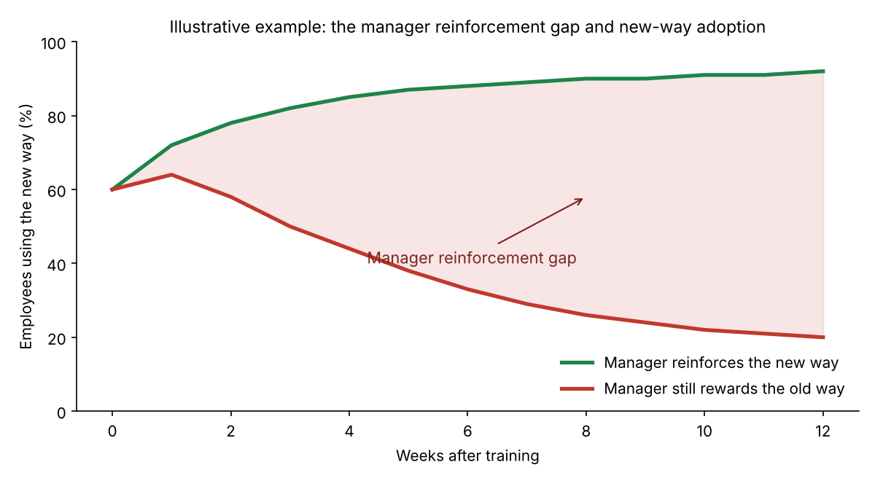
The manager reinforcement gap is what happens when employees leave a training session ready to work the new way, then return to a manager who still praises, measures and promotes the old way. Nobody planned it. It simply shows up the first time a deadline looms and the manager asks for the report in the format everyone used last year.
If you have ever delivered a change program, you have probably seen it. The workshop evaluations are glowing. The system goes live. Six weeks later, usage is patchy, people have quietly reverted to their old routines and everyone is puzzled, because nobody said they disagreed with the change.
This article explains why the manager reinforcement gap opens up, what it costs, how to spot it early and what to do about it. It is written for change managers, project leaders, HR professionals and any manager who has ever wondered why a well-run change program did not stick.
What Is the Manager Reinforcement Gap?
Employees learn what to do from training, communications and coaching. They learn what actually matters from their manager. The manager reinforcement gap is the distance between those two lessons. The first says “use the new process”. The second, delivered through what the manager asks for, notices and rewards every week, says “keep doing it the way that gets you noticed”.
When the two messages conflict, employees follow the one that affects their pay, their reputation and their daily working life. That is not resistance. It is ordinary, sensible behaviour. Researchers have been pointing to this for decades. Steven Kerr’s classic paper on the folly of rewarding A while hoping for B describes the same trap, and the broader field of change management now treats reinforcement as a stage of its own.
Put simply, training creates ability, but managers create habit. Without the second, the first fades.
Why Employees Learn the New Way but Their Manager Rewards the Old Way
There is rarely one culprit. In most organisations the manager reinforcement gap is produced by several pressures working together:
- Managers are trained last, or not at all. Change programs often cascade training from the top and then straight to frontline staff, skipping the middle. The people who must reinforce the change learn about it at the same time as everyone else.
- The scorecard has not changed. If targets, KPIs and performance reviews still measure the old behaviour, managers will reward it, however sincerely they support the new one.
- Managers fear the productivity dip. Learning something new is slower at first. A manager under delivery pressure can quietly steer people back to the faster, familiar method.
- The old way made them successful. Managers often built their careers on the previous process. Letting go of it can feel like devaluing their own expertise.
- “Support the change” is too vague. Nobody told managers which specific behaviours to look for, what to say or what to stop asking for.
- Mixed signals from above. When a sponsor announces a change but keeps using the old report in meetings, managers copy what leaders do, not what they say. We explore this in the sponsor reset problem.
- Peers matter too. Informal leaders on the team can swing opinion faster than any official message, as we describe in the informal influence gap.
- No capacity left. A manager juggling several programs at once rarely has time to coach, observe and recognise. See the change capacity problem.
What the Manager Reinforcement Gap Looks Like in Practice
Here is a deliberately simple, hypothetical example. A sales team is trained on a new customer system and is told to log every call there. In the weekly meeting, though, the sales manager still asks each person to send the usual spreadsheet by Friday, because that is what the regional director wants.
Within a month, the system is an extra chore. The spreadsheet is the real deliverable. Staff learned the new way and understood why it matters, yet every Friday they learn which one is rewarded. The project team, looking at login data, wonders why adoption has stalled.
The manager is not being difficult. They were never given a reason, a tool or permission to change what they ask for.
Warning Signs of a Manager Reinforcement Gap
Look for these signals in your own organisation:
- Strong training feedback followed by weak or fading usage after a few weeks.
- Employees say “my manager still wants it the old way” when asked why they reverted.
- Managers have not been briefed on the change before their teams.
- Performance reviews, KPIs and recognition programs have not been updated for the new behaviours.
- Workarounds and side spreadsheets appear alongside the new system.
- Different managers in the same business reinforce the change very differently, so adoption varies wildly between teams.
What the Manager Reinforcement Gap Costs
The visible cost is wasted training spend and slow adoption. The less visible costs are bigger. Benefits that were promised in the business case never arrive. Employees learn that new initiatives are optional, which makes the next one harder. People pay the adaptation tax of learning something new and then get no credit for using it.
There is also a memory problem. The forgetting curve shows that people lose much of what they learn unless they apply it soon after. A manager who reinforces the new way creates exactly that application. A manager who does not leaves the learning to fade, and with it a little of the organisation’s change credibility.
How Models Like ADKAR Explain the Manager Reinforcement Gap
The ADKAR model describes individual change in five steps: awareness, desire, knowledge, ability and reinforcement. Training mostly delivers knowledge and ability. Reinforcement, the last step, is what makes the change permanent, and the person best placed to deliver it is the direct manager.
The same idea appears in the work of John Kotter, whose well-known change model ends with anchoring new approaches in the culture. Both frameworks say the same thing: a change is not finished when people know how to do it. It is finished when it is the normal way things are done, and that depends on what managers notice and reward every day.
How to Close the Manager Reinforcement Gap
The good news is that the manager reinforcement gap is one of the most fixable problems in change management. It needs clarity, alignment and a bit of follow-through, not a big budget. Try these steps:
- Brief and equip managers first. Run manager sessions before frontline training, so they hear about the change early, can ask hard questions and are ready when their teams return.
- Define three behaviours to reinforce. Replace “support the change” with a short, observable list: what you will see people doing differently, and what you will no longer ask for.
- Align the scorecard. Update KPIs, performance conversations and recognition so they reward the new behaviour. If you do not, the old measures will win.
- Give managers a simple toolkit. A few questions for weekly one-on-ones, a short script for recognising the new behaviour and a guide to coaching someone who has slipped back.
- Make leaders model it. If the sponsor still uses the old report in meetings, managers will too. Ask leaders to visibly use the new way.
- Protect the learning dip. Agree openly that productivity may dip for a few weeks and adjust targets temporarily so managers are not forced to choose between the change and their numbers.
- Use peer champions. Respected team members who use the new way and talk about it naturally can reinforce what the manager says.
- Measure reinforcement, not just adoption. Ask employees a few pulse questions such as “My manager encourages me to work this way”, and compare results between teams to find the pockets where the gap is widest.
- Revisit at 30, 60 and 90 days. Reinforcement is not a one-off. Plan check-ins and refreshers, which is the heart of sustaining change.
Done well, closing the manager reinforcement gap turns the manager from the weak link into the strongest channel the change program has.
Change Management Courses That Help Close the Manager Reinforcement Gap
Reinforcement is a skill that can be learned, and it works best when change practitioners, project leads and managers share a common language. These Change Management Courses programs cover the ground:
- Change Management Foundation covers organisational context, people and change, change leadership and teams, stakeholders and communication, and the work of the change manager.
- Change Management Practitioner builds on the foundation with a structured approach to planning, implementing and supporting organisational change, in line with the APMG International certification framework.
- Leading Change is an instructor-led certification course on strategic change leadership principles.
Compare them on the change management courses page, or read more practical articles on our change management blog, including the change accountability gap and the change translation gap.
The Manager Reinforcement Gap Across Australian Cities
The manager reinforcement gap appears in every Australian city and in every sector. In Sydney, finance and technology programs often run to hard deadlines, which puts extra pressure on managers to fall back to proven methods. Melbourne healthcare, retail and government organisations commonly roll out change across many sites, so manager consistency is a real challenge.
In Brisbane, infrastructure and project-based businesses must keep contractors and permanent staff aligned. Perth mining and energy organisations change safety and operating practices across remote teams. Canberra public sector programs depend on managers at several levels reinforcing the same message, and Adelaide organisations feel the same tension whatever their size.
Training is available in person in Melbourne, Sydney and Brisbane, and live online across Australia. See all change management course locations to find the right option.
Frequently Asked Questions About the Manager Reinforcement Gap
What is the manager reinforcement gap?
It is the gap between what employees are trained to do in a change and what their manager actually asks for, measures and rewards. When the two conflict, employees follow the manager.
Why do employees revert to the old way after training?
Usually because the old way is still what gets noticed and rewarded. Unchanged KPIs, unclear manager expectations and the temporary slowdown of learning all pull people back to familiar habits.
What is the role of a manager in change management?
Managers translate the change for their team, model the new behaviour, coach people through the learning dip and recognise progress. Practitioners widely regard the direct manager as one of the strongest influences on whether a change sticks.
How do you measure reinforcement in change management?
Combine usage data with short employee pulse questions about manager support, and compare results across teams. Differences between teams usually point to where reinforcement is weakest.
Which change management course should I take?
Start with Change Management Foundation if you are new to the field, or the Practitioner course if you already lead or support change programs.
Final Thoughts: Make the Right Behaviour the Rewarded Behaviour
The manager reinforcement gap is not a sign that people are unwilling to change. It is a sign that the change was taught in one place and rewarded in another. Close that gap, and training starts to turn into habit.
If you would like help building these skills in yourself or your managers, speak to a course advisor or call 1300 649 299.