

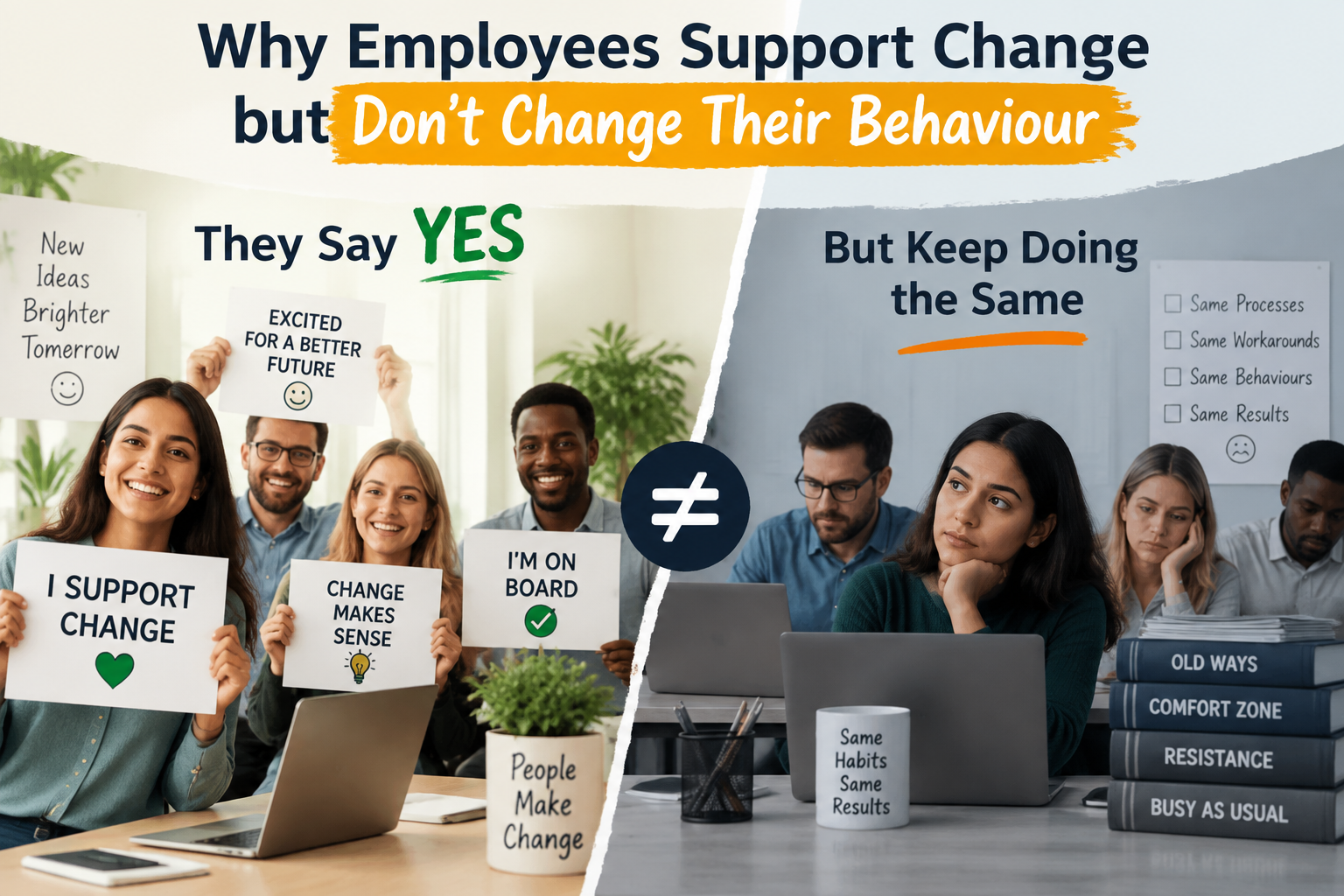
Every change manager has seen it: the survey results come back positive, the town hall gets nods and applause, and three weeks later the team is quietly back to doing things the old way. Employees support change but don’t change behaviour far more often than leadership expects, and it’s rarely because people are being difficult. It’s because agreement and behaviour change are two completely different psychological events, and most change initiatives only ever properly manage the first one.
This article explains why the support-behaviour gap happens, what’s actually going on underneath it, and the specific, practical steps that close it.
The Support-Behaviour Gap, Explained
Supporting a change means someone agrees, intellectually, that the change makes sense. Changing behaviour means someone reliably does the new process, tool, or approach under real pressure, deadlines, fatigue, and the pull of old habits, without being reminded. The gap between the two is where most change initiatives quietly fail, even when every survey and engagement score looks strong.
This isn’t a motivation problem in most cases. It’s a structural one: employees support change but don’t change behaviour because the conditions required for lasting behaviour change were never actually put in place, even though awareness and buy-in were handled well.
Why Employees Support Change but Don’t Change Their Behaviour
1. Old Habits Are Automatic, New Behaviours Aren’t
Established workflows run on autopilot, they take almost no cognitive effort. A new process requires conscious thought every single time, which is exhausting under normal workload pressure. Under stress or a deadline, people default back to the automatic behaviour, not because they disagree with the change, but because the old habit is simply easier to execute.
2. They Have Awareness and Desire, But Not Ability
In ADKAR terms, this is the single most common failure point: organisations do a good job building Awareness and Desire, people understand why the change matters and want it to succeed, but never properly build Ability, the actual skill and confidence to perform the new behaviour under real working conditions.
3. There’s No Reinforcement Once the Rollout Ends
Most change communication is front-loaded around go-live, then quietly disappears. Without ongoing reinforcement, coaching, recognition, visible leadership modelling, the new behaviour has no structural support once the initial momentum fades, and people drift back to what’s familiar.
4. “What Does This Mean for Me” Was Never Fully Answered
Employees can support a change at the organisational level while still being unclear on exactly what it means for their specific daily tasks. General enthusiasm doesn’t translate into behaviour change until someone can answer, precisely, “what do I do differently on Monday morning?”
5. Incentives and KPIs Still Reward the Old Way
If performance metrics, informal praise, or promotion criteria still implicitly reward speed and output under the old process, employees receive a mixed signal: leadership says the new way matters, but the reward system says the old way still wins.
6. There Was No Safe Space to Practise and Fail
Behaviour change requires practice, and practice involves early mistakes. If employees only ever encounter the new process live, with real consequences for errors, they default to the safer, familiar behaviour rather than risk visible failure in front of colleagues or managers.
7. Managers Aren’t Modelling the New Behaviour Themselves
Employees watch what their direct manager actually does, not just what the organisation announces. If managers quietly keep using the old spreadsheet, the old approval process, or the old reporting method, that behaviour spreads faster than any communication plan.
Support for Change vs Actual Behaviour Change
| What Drives Support for Change | What Drives Actual Behaviour Change |
| Clear rationale and vision for the change | Concrete, role-specific instructions for daily tasks |
| Leadership communication and town halls | Hands-on practice with real scenarios before go-live |
| Understanding why the change matters | Ability and confidence to execute it under pressure |
| Positive survey and engagement scores | Manager coaching and reinforcement after go-live |
| Agreement in principle | Aligned KPIs and incentives that reward the new way |
| One-off announcement or training session | Visible manager modelling of the new behaviour |
How to Close the Support-Behaviour Gap
- Translate the change into role-specific actions. Replace general messaging with a clear answer to “what does this mean for my exact daily tasks,” for every affected role.
- Build in real practice time before go-live. Give employees a safe environment to attempt the new process, make mistakes, and build genuine confidence before it’s live and consequential.
- Plan reinforcement as seriously as go-live. Schedule coaching check-ins, recognition, and visible reminders for weeks after launch, not just a single announcement.
- Audit KPIs and incentives for conflicts. Check whether existing metrics or informal recognition still quietly reward the old behaviour, and correct them before rollout.
- Equip managers to model and coach, not just announce. Managers need to visibly use the new process themselves and actively coach their teams, not simply relay a memo from leadership.
A Practical Example: ERP and Copilot Rollouts
This gap shows up constantly in large system rollouts. In our guide on ERP change management, we cover how SAP, Oracle, and Dynamics rollouts frequently see strong initial support followed by quiet reversion to old spreadsheets and workarounds once reinforcement drops off. The same pattern appears in AI tool adoption, our Copilot rollout guides walk through exactly how to build the practice time and reinforcement structure this article describes, specifically for driving real day-to-day usage rather than one-off enthusiasm.
Certifications That Build This Capability
- Prosci Change Management Certification the ADKAR model directly addresses the Ability and Reinforcement stages most rollouts skip.
- APMG Change Management Foundation and Practitioner builds structured planning for sustained behaviour change, not just initial communication.
For a full comparison of the two leading frameworks, see our guide on Prosci vs APMG Change Management Certification: Which Is Better in Australia?. For rollout-specific guidance, read Change Management for ERP Implementations: SAP, Oracle and Microsoft Dynamics and Microsoft Copilot Rollout Strategy for Change Managers: How to Drive Employee Adoption.
Structured change management training is available online and in-person through changemanagementcourses.au, delivered by Logitrain, Australia’s IT and business skills training provider.
Where This Gap Shows Up Across Australia
The support-behaviour gap plays out across every major Australian market, particularly in large system and process rollouts:
- Sydney — financial services rollouts where compliance pressure makes reversion to old, familiar processes especially common.
- Melbourne — government and enterprise change programs needing structured reinforcement beyond go-live.
- Brisbane — infrastructure and public sector projects with distributed teams needing consistent manager modelling.
- Perth — resources sector rollouts where safety-critical processes make practice-before-live especially important.
- Adelaide — defence and government change programs with strict process adherence requirements.
- Canberra — federal rollouts where policy and process changes require clear, role-specific translation.
Frequently Asked Questions
Why do employees support a change but not actually change their behaviour?
Because agreement and behaviour change are different events. Most organisations build awareness and desire well but skip the ability-building and reinforcement needed for the new behaviour to stick under real working pressure.
What is the ADKAR model’s explanation for this gap?
ADKAR frames it as reaching Awareness and Desire but failing to build Ability, and then failing to Reinforce the new behaviour once the initial rollout momentum fades.
How long does reinforcement need to continue after a change rollout?
Most successful change programs plan active reinforcement, coaching, recognition, and manager modelling, for at least 8 to 12 weeks after go-live, not just the launch period itself.
Can positive survey results mask a support-behaviour gap?
Yes. Engagement and sentiment surveys measure support, not behaviour. It’s common for survey scores to look strong while actual day-to-day process usage quietly reverts to the old way.
What’s the fastest way to check if this gap exists in my organisation?
Compare stated support (survey results, sentiment) against actual system or process usage data. A large gap between the two is a clear signal that ability and reinforcement, not communication, is the missing piece.
Final Thoughts
Employees support change but don’t change behaviour when the change program stops at agreement instead of building the ability and reinforcement required to sustain it. Positive sentiment is a necessary first step, not proof the change has actually happened. Close the gap by translating change into role-specific actions, building real practice opportunities, reinforcing well past go-live, and making sure managers model the behaviour they’re asking for.