

Employee adoption metrics are what actually tell you whether a change stuck not the go-live date, and not the project closure report. A new system, process or way of working can launch perfectly on paper and still fail in practice if people quietly revert to their old habits three weeks later. This guide covers the employee adoption metrics that matter, when to measure them, and how to act on what you find so change sticks well beyond go-live.
This is written for change managers, project leads and HR professionals across Melbourne, Sydney, Brisbane, Perth, Adelaide and Canberra who need a practical, structured way to prove and improve adoption after a rollout, not just a vague sense that “things seem to be going okay.”
Why Employee Adoption Metrics Matter More Than Go-Live Dates
A go-live date measures whether the technical work was delivered on time. It says nothing about whether people are actually using what was delivered, or using it correctly. Employee adoption metrics close that gap they tell you whether the change is landing with real users, not just whether IT flipped the switch.
Without adoption metrics, most organisations only discover a change failed months later, when the old process quietly resurfaces, help desk tickets pile up, or the promised business benefit never materialises. Measuring adoption early gives you the chance to intervene while it’s still cheap to fix.
The Core Employee Adoption Metrics to Track
These are the employee adoption metrics most change practitioners track after go-live, what each one actually tells you, and a general target range to work toward.
| Metric | What It Tells You | Typical Target |
| System / process usage rate | Whether people are actually using the new system or process, not just logging in | 80%+ active usage by day 60 |
| Proficiency / competency score | Whether users can complete tasks correctly, not just log in | Rising trend week over week |
| Help desk ticket volume | Where confusion or resistance is concentrated | Steady decline after week 2–3 |
| ADKAR barrier point | Which stage (Awareness, Desire, Knowledge, Ability, Reinforcement) is stalling adoption | No group stuck below 3/5 by 30 days |
| Employee sentiment / pulse survey | How people feel about the change, not just whether they comply | Improving trend post go-live |
| Business outcome metric | Whether the change is delivering the result it was meant to (revenue, cycle time, error rate) | Tracks toward original business case |
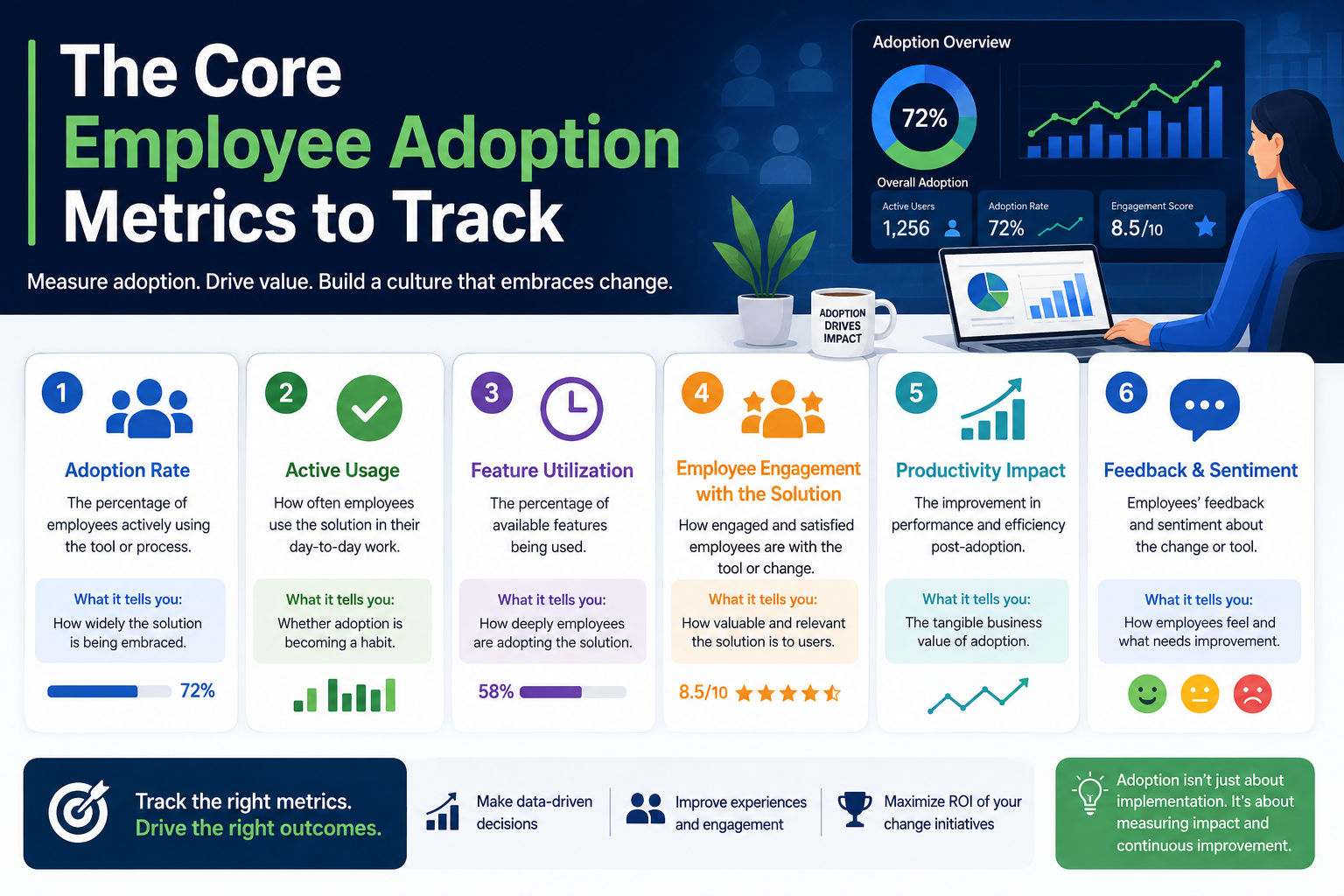
Note: targets vary significantly by organisation size, industry and the scale of the change. Treat these as a general starting benchmark, not a fixed rule a highly regulated finance environment and a fast-moving retail team will reasonably land on different numbers.
When to Measure Employee Adoption Metrics After Go-Live
Day 1–14: Immediate Reaction
Track login and initial usage rates, help desk ticket volume, and early sentiment. This window tells you whether people can even get started, and flags urgent training or communication gaps.
Day 15–30: Early Adoption
Usage should be moving from “trying it out” to “using it regularly.” This is when ADKAR-style barrier points become clearer are people stuck on Awareness, Desire, Knowledge, Ability or Reinforcement?
Day 30–60: Proficiency Check
This is where proficiency and competency metrics matter more than raw usage. People can be “using” a system daily while still doing it incorrectly, which is why task-completion accuracy needs its own measurement.
Day 60–90+: Sustained Adoption and Business Outcomes
By this point, employee adoption metrics should be trending toward the business case the change was approved on cost savings, cycle time reduction, error rate improvement. If they’re not, reinforcement activity, not more training, is usually the right response.
How to Collect Employee Adoption Metrics
- System usage data login frequency, feature adoption, task completion, pulled directly from the platform where possible.
- Help desk and support ticket trends categorised by theme to spot recurring confusion points.
- Manager and champion network feedback informal but often the earliest warning sign of resistance.
- Short pulse surveys three to five questions, run at 30, 60 and 90 days, tracking sentiment and confidence.
- Direct observation or spot checks especially for process changes that aren’t captured in system logs.
Turning Employee Adoption Metrics into Action
Metrics without a response plan are just a dashboard nobody acts on. Build a simple decision rule before go-live: if usage falls below a set threshold by day 30, trigger targeted refresher training; if sentiment scores drop, escalate to manager-led conversations rather than another all-staff email if a specific team lags well behind others, investigate whether their workflow genuinely differs before assuming it’s resistance.
This is exactly where the ADKAR model earns its keep it gives you a structured way to diagnose which specific barrier (Awareness, Desire, Knowledge, Ability or Reinforcement) is holding a group back, rather than applying a generic “more communication” fix to every adoption gap.
Build the Skills Behind Strong Employee Adoption Metrics
Measuring employee adoption metrics well is a structured discipline, not guesswork and it’s exactly what’s covered in properly designed change management training.
Our Change Management Foundation course covers the fundamentals of stakeholder engagement, communication planning and measuring change outcomes. For a deeper, more strategic approach including building measurement frameworks for complex, multi-team rollouts our Change Management Practitioner course is the natural next step.
Courses run in person in Melbourne, Sydney, Brisbane and Adelaide, with live online delivery for professionals in Perth and Canberra.
Related Reading
To go deeper on the model behind this diagnostic approach, see our guide to the ADKAR Model Explained for Australian Change Managers, our Change Readiness Assessment: How to Know If Your Organisation Is Ready for Change, and our sector-specific guide to Change Management for ERP Implementations: SAP, Oracle and Microsoft Dynamics for how these metrics apply to large system rollouts specifically.
Frequently Asked Questions
What’s a good employee adoption rate after go-live?
There’s no universal number, but many practitioners look for 70–80% active usage by around day 60, trending upward, alongside improving proficiency and sentiment scores not just login counts.
How often should employee adoption metrics be reported?
Weekly in the first month, then fortnightly to monthly through to the 90-day mark, with a final formal review once the change is considered stabilised.
What’s the difference between usage and adoption?
Usage means people are logging in or touching the new system. Adoption means they’re using it correctly, consistently, and in place of the old way of working which is why proficiency and behaviour metrics matter as much as raw usage numbers.
Conclusion
Employee adoption metrics turn “the project went live” into a measurable, defensible answer to “did the change actually work.” Track usage, proficiency, sentiment and business outcomes on a clear 30/60/90-day rhythm, and use what you find to trigger real interventions not just another status report.
Want a structured framework for measuring and sustaining adoption on your next rollout? Explore our change management courses across Australia or get in touch.