

A Microsoft Copilot rollout strategy that only covers licensing and IT deployment is missing the part that actually determines whether the tool succeeds: whether employees change how they work day to day. Organisations across Australia are learning this the hard way Copilot gets switched on for thousands of users, usage stats stay flat after three months, and the project quietly gets labelled a disappointment. The gap almost never sits with the technology. It sits with change management.
This guide walks through a practical Microsoft Copilot rollout strategy built for change managers the ADKAR framework applied specifically to Copilot, a realistic 90-day plan, the resistance patterns you’ll actually see, and how change management courses prepare practitioners to lead exactly this kind of rollout.
Why Copilot Rollouts Need Change Management, Not Just IT Training
IT teams are excellent at licensing, tenant configuration and security settings. What they’re not resourced to do is manage the human side of adoption the anxiety about job security, the scepticism about “yet another AI tool,” and the habit-forming work of getting people to actually open Copilot instead of doing the task the old way.
A Microsoft Copilot rollout strategy without a change management layer typically shows the same pattern: a strong launch week, a spike in curiosity-driven logins, then a steep drop-off once the novelty wears off and no one has built new habits or removed the friction of switching workflows.
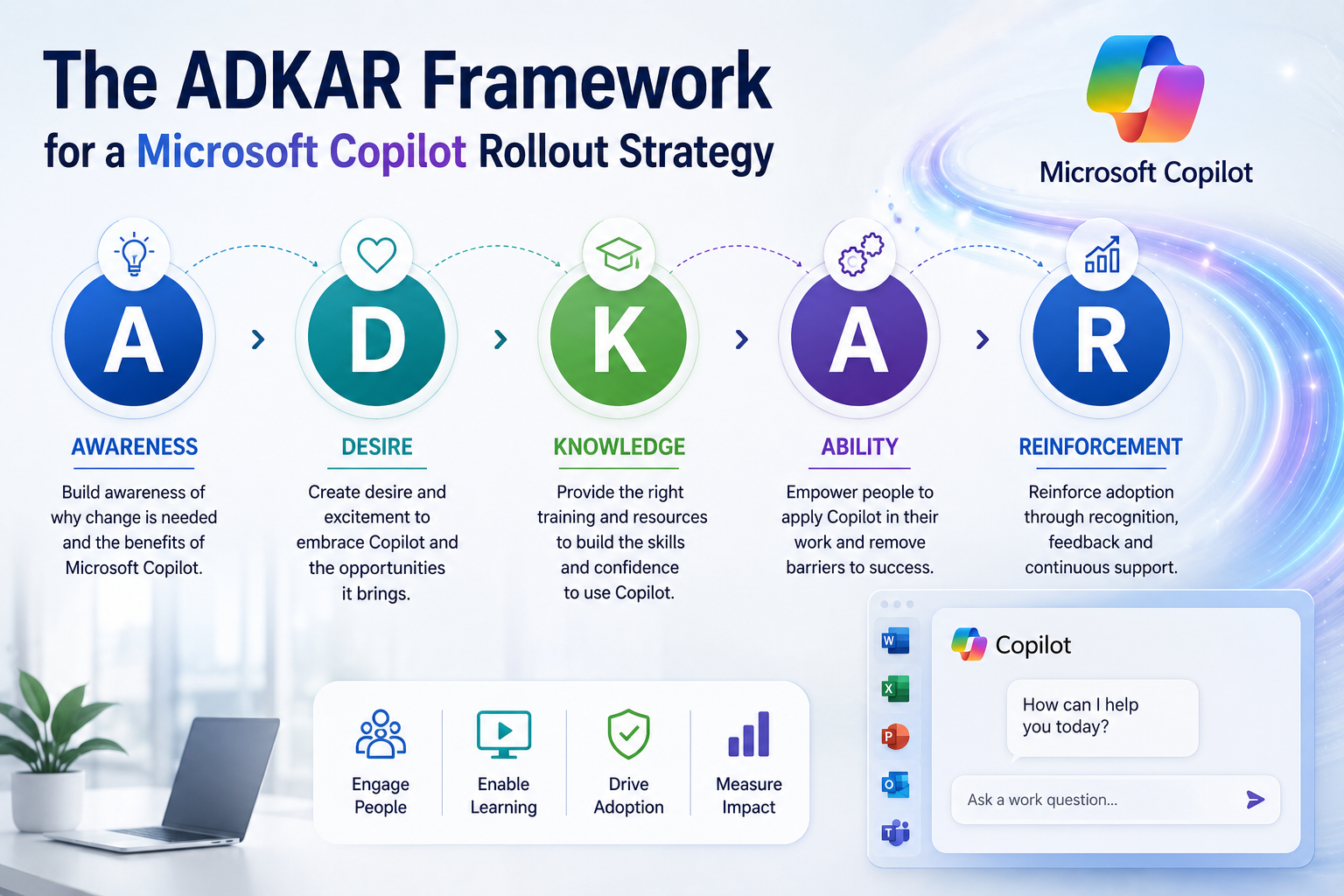
The ADKAR Framework for a Microsoft Copilot Rollout Strategy
ADKAR (Awareness, Desire, Knowledge, Ability, Reinforcement) is the most widely used change model for technology rollouts, and it maps cleanly onto a Copilot deployment because each stage answers a different employee objection.
| ADKAR Stage | Goal | Change Manager Tactics |
| Awareness | Employees understand why Copilot is being rolled out and what problem it solves | Town halls, leadership emails explaining the business case, FAQ page |
| Desire | Employees want to use Copilot rather than seeing it as extra work | Champion network, early-adopter success stories, WIIFM messaging |
| Knowledge | Employees know how to use Copilot in their specific role | Role-based training, prompt libraries, lunch-and-learn sessions |
| Ability | Employees can actually apply Copilot to real daily tasks | Sandbox practice time, embedded floor-walkers, quick-reference guides |
| Reinforcement | New Copilot habits stick instead of reverting to old workflows | Usage dashboards, manager check-ins, recognition for adoption |
Why Skipping a Stage Backfires
Most failed Copilot rollouts skip straight to Knowledge running training sessions before employees have any Desire to change how they work. The training gets attended, sometimes even rated positively, and then nobody uses what they learned because nobody addressed “what’s in it for me” first.
Building Your Microsoft Copilot Rollout Strategy: A 90-Day Plan
Copilot adoption rarely sticks on a rushed timeline. A 90-day structure gives change managers enough runway to move through all five ADKAR stages without losing momentum.
| Phase | Key Activities |
| Weeks 1-2: Foundation | Stakeholder alignment, define success metrics, identify champions, build the communication plan |
| Weeks 3-6: Awareness & Desire | Leadership town halls, WIIFM messaging, champion network launch, early-adopter pilot group |
| Weeks 7-10: Knowledge & Ability | Role-based training rollout, prompt libraries, sandbox practice, floor-walker support |
| Weeks 11-12: Reinforcement | Usage dashboards live, manager check-ins, recognition programme, gather feedback for iteration |
| Ongoing (post week-12) | Quarterly refresher sessions, new-feature briefings, adoption reporting to leadership |
Common Employee Resistance Points (and How Change Managers Handle Them)
- “Is this going to replace my job?” Address directly and early in leadership communications; vague reassurance increases anxiety rather than reducing it.
- “I don’t have time to learn another tool.” Frame training around time saved on tasks employees already find tedious, not as an extra burden.
- “I tried it once and it didn’t give me anything useful.” Usually a prompting problem, not a tool problem; role-based prompt libraries fix this quickly.
- “My manager isn’t using it, so why should I?” Visible leadership usage is one of the strongest adoption predictors; build it into the champion network.
Measuring Adoption: KPIs Change Managers Should Track
- Weekly active users vs. licensed users (the real adoption gap)
- Feature usage by role (e.g. Copilot in Outlook vs. Excel vs. Teams)
- Champion network engagement and peer-support requests logged
- Employee sentiment via short pulse surveys at 30/60/90 days
- Time-saved estimates self-reported in manager check-ins
Microsoft Copilot Rollout Demand Across Australia
Copilot adoption programs and demand for change managers who can lead them — vary by city and sector:
| City | Copilot Rollout / Change Manager Demand |
| Sydney | High demand — financial services and government agencies leading early Copilot rollouts |
| Melbourne | Strong demand across professional services and healthcare |
| Brisbane | Growing demand tied to government and infrastructure sector digital programs |
| Perth | Steady demand from mining and resources back-office transformation |
| Adelaide | Emerging demand from defence and public sector digital initiatives |
| Canberra | High demand — Commonwealth agencies rolling out Copilot under whole-of-government IT programs |
How a Change Management Certification Prepares You for Copilot Rollouts
Leading a Microsoft Copilot rollout strategy well requires the same core skills covered in structured, APMG-accredited change management training: stakeholder analysis, communication planning, resistance management, and benefits realisation. Practitioners who’ve completed Foundation and Practitioner-level training are consistently the ones organisations turn to when a Copilot, AI or other major technology rollout needs a dedicated change lead rather than an IT project manager wearing two hats.
You can see the full range of certifications, formats and course dates on logitrain.com.au, Logitrain’s main training site.
For Microsoft’s own adoption guidance and rollout resources, see the Microsoft Copilot adoption hub, which change managers can use alongside a structured ADKAR plan.
Frequently Asked Questions About Microsoft Copilot Rollout Strategy
Who should own a Microsoft Copilot rollout — IT or change management?
Both, but they own different parts. IT owns licensing, security and technical deployment. Change management owns adoption communication, training design, resistance management and measuring whether employees actually use it.
How long does a Copilot rollout take to show real adoption?
Most organisations see meaningful, sustained adoption within 90 to 120 days when a structured change plan runs alongside the technical deployment. Rollouts without a change layer often plateau within the first month.
What’s the biggest reason Copilot rollouts fail?
Skipping straight to training without first building employee desire to change their workflow. Awareness and Desire have to come before Knowledge, or the training doesn’t translate into behaviour change.
Do I need a change management certification to lead a Copilot rollout?
It’s not mandatory, but certified practitioners bring a tested framework (like ADKAR) rather than improvising, which noticeably improves adoption outcomes and gives leadership a credible plan to back.
How do you measure whether a Copilot rollout actually worked?
Track weekly active users against licensed seats, feature usage by role, and pulse-survey sentiment at 30/60/90 days login counts alone don’t tell you whether Copilot changed anyone’s actual workflow.
Final Verdict: Getting Your Microsoft Copilot Rollout Strategy Right
A Microsoft Copilot rollout strategy succeeds or fails on the human side, not the technical one. ADKAR gives change managers a proven structure to move employees from awareness through to reinforced daily habit, and a realistic 90-day plan keeps that structure from collapsing under a rushed go-live date.
Want to lead technology rollouts like this with a recognised change management qualification? Explore Logitrain change management courses and get started with live online classes available across Australia.