
The manager translation gap is the space between a change being announced and employees understanding what it means for their own Monday morning. The email went out. The town hall happened. The slides were polished. And yet, a week later, people are still asking the same question in the corridor: “Okay, but what am I actually supposed to do differently?” That unanswered question is where most change quietly stalls.
This guide explains why the manager translation gap appears, how to spot it in your own organisation and what practical steps close it. It is written for change managers, HR and project professionals and leaders wondering why a well-communicated change still isn’t sticking.
What Is the Manager Translation Gap?
Every change starts life as a big-picture message: a new system, a new structure, a new way of serving customers. Leaders talk in strategy, benefits and timelines. Employees, on the other hand, live in tasks, tools, deadlines and habits. Somebody has to convert the first language into the second. In most organisations, that somebody is the line manager.
The manager translation gap opens when that conversion does not happen, or happens badly. Managers receive the same announcement as everyone else, sometimes at the same moment, and are then expected to turn it into clear, local direction for their team. Without time, context or support, many simply forward the message and hope.
It is worth separating this from the wider change translation gap, which looks at how strategy gets lost between leadership and the frontline. The manager translation gap zooms in on one specific layer, the manager conversation, because that is where a general announcement is supposed to become a personal instruction.
Why an Announcement Is Not the Same as an Instruction
An announcement tells people that something is happening. An instruction tells people what to do about it. Most change communication stops at the first and assumes the second will take care of itself. It rarely does.
When employees hear a change announcement, they quietly run through a short list of personal questions:
- What exactly is changing in my job, and what is staying the same?
- What do I need to start, stop or do differently, and by when?
- Will I get training or help, and where do I find it?
- Who do I ask when something goes wrong?
- How will my work be judged now?
A company-wide message cannot answer these, because the answers differ for every team. Only someone who understands both the change and the team can respond. That is exactly why the manager translation gap matters so much: it sits right on the line between “informed” and “able to act.”
Prosci’s research on the role of people managers in change reports that most employees prefer to hear about changes that affect them personally from their direct manager, and describes five manager roles during change: communicator, liaison, advocate, coach and resistance manager. If managers are not equipped for those roles, the message has nobody to carry it the last step.
Where the Manager Translation Gap Comes From
Nobody designs a manager translation gap on purpose. It builds up from a handful of very ordinary habits.
- Managers are briefed too late. If they hear the news alongside their team, they have no time to digest it, ask questions or prepare a sensible answer.
- They get talking points, not context. A script covers the happy path. It does not help when an employee asks something unexpected, and employees always do.
- Managers are change recipients too. They are absorbing the same disruption as their team while being asked to lead it. That is a tough double role.
- Role-level impact was never worked out. The project team knows the system is changing. Nobody mapped what that means for a customer service team compared with a finance team.
- There is no time. Managers already carry full workloads. Translation work is invisible, unscheduled and usually squeezed in at the end of the day.
Research and practitioner commentary on frontline change communication, including Gartner’s article on empowering managers to drive change, points to the same issue behind the manager translation gap: managers are often expected to lead change without the context, preparation or support they need, and they work best when given conversation guides, peer forums and chances to practise dialogue.
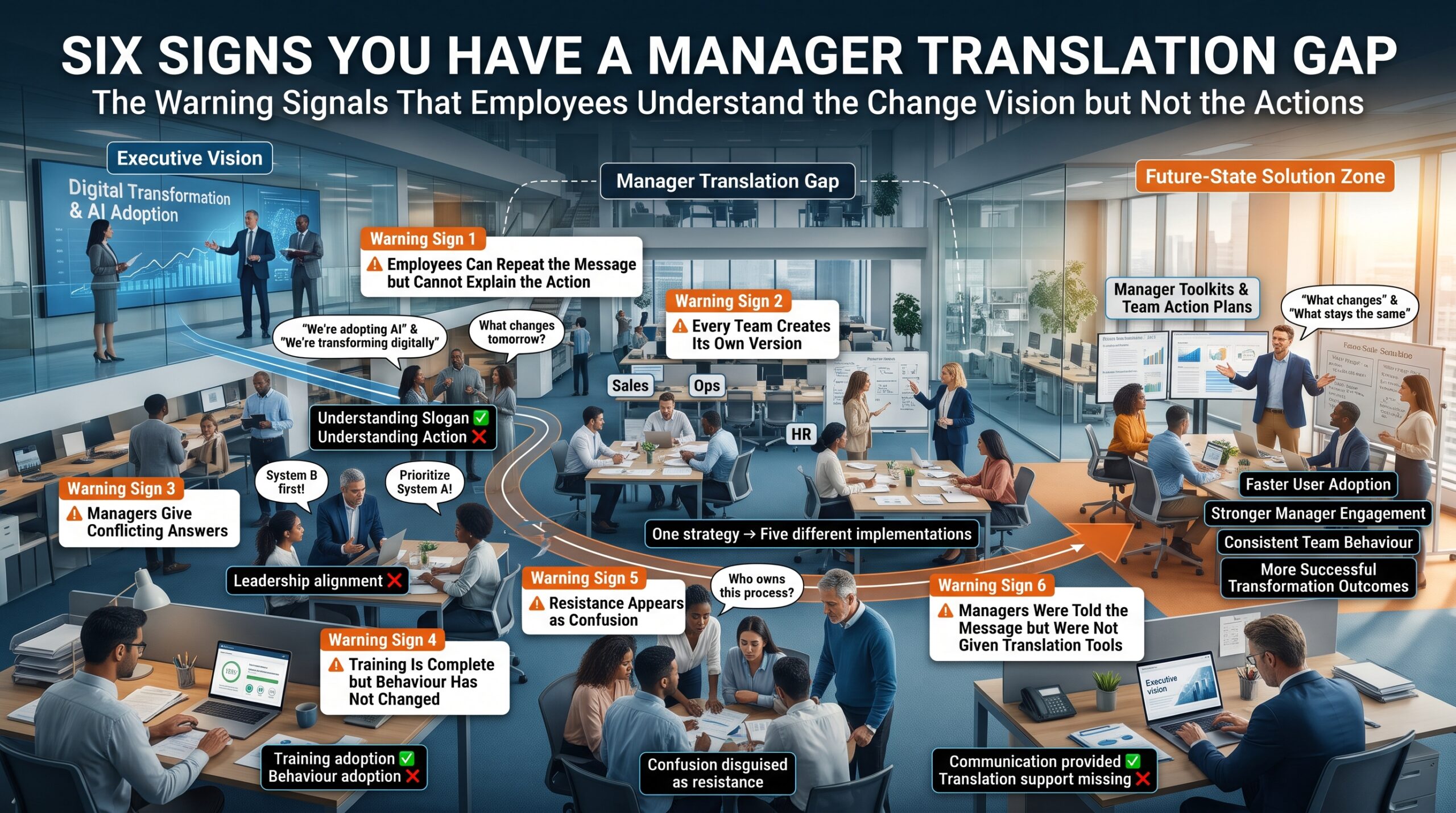
Six Signs You Have a Manager Translation Gap
You do not need a survey to spot the manager translation gap. Listen for these signals instead.
1. The same questions keep coming back
If employees keep asking basic questions weeks after the announcement, the message was heard but not translated. Repetition is a symptom, not a nuisance.
2. Different teams give different answers
Ask three managers what the change means for their team and compare the replies. Wildly different answers mean everyone is improvising.
3. People are “waiting to see what happens”
When employees carry on exactly as before, they are not necessarily resisting. They often just don’t know what is expected. This is a clarity problem before it is a motivation problem.
4. Workarounds appear quickly
Spreadsheets, side channels and old tools that should have been retired are the quiet evidence that nobody explained the new way of working in practical terms.
5. Managers say “I don’t know either”
Honesty is good, but a manager with no route to find the answer has a translation problem. The fix is an escalation path, not blame.
6. Adoption lags behind awareness
Awareness measures such as email opens and attendance look healthy, while usage and behaviour stay flat. The distance between those two lines is the manager translation gap, drawn on a chart.
What Employees Need a Manager to Translate
Translation is not about repeating the announcement in a friendlier voice. It is about answering the personal questions the announcement leaves open. This table shows what that looks like.
| What the announcement says | What the manager must translate |
| “We are moving to a new system.” | Which tasks change, which screens or steps replace the old ones, and what happens to work already in progress |
| “Teams will be restructured.” | Who reports to whom, who makes which decisions, and what happens to current responsibilities |
| “We are improving our process.” | What the new steps are, what to stop doing and how quality will be checked |
| “Training will be provided.” | When it is, how long it takes, whether it is covered in working hours and what to do while waiting |
| “This will improve customer experience.” | What a good outcome looks like for this team and how individual performance will be seen |
How to Close the Manager Translation Gap
Closing the manager translation gap does not require a giant programme. It needs a repeatable routine that treats managers as the main channel for change, not an afterthought. Here is a practical approach.
- Brief managers before everyone else. Give managers a head start so they can ask questions, digest the reasoning and prepare. Even a day’s notice changes the quality of the conversation.
- Give context, not only scripts. Explain why the change is happening, what leadership intends and what is still undecided. Managers who understand the thinking can answer questions no script predicted.
- Work out impact by role. Spend an hour mapping what changes for each team. This one step removes a huge amount of confusion.
- Run a short team conversation. Ask managers to hold a 20-minute “what does this mean for us?” session within a few days of the announcement, using a simple template.
- Create a question loop. Give managers a place to send questions they cannot answer, and a promise of a quick reply. Share the answers with every manager so teams stay consistent.
- Set the first small actions. Do not leave people with a vague future state. Name the first one or two things each person should do this week.
- Check understanding. Use teach-back: ask a few team members to explain, in their own words, what they will do differently. Gaps become visible immediately.
- Reinforce afterwards. Translation is not a one-off. Follow up, recognise the new behaviour and connect it to how work is judged. Our article on the manager reinforcement gap covers what happens when managers keep rewarding the old way.
A Simple Template to Reduce the Manager Translation Gap
Give managers a one-page frame they can fill in for their own team. Keeping it short matters more than making it perfect.
| Prompt | What the manager writes |
| What is changing for us? | One or two plain sentences about the change in this team’s work |
| What stays the same? | The parts of the job that are not affected, to reduce unnecessary worry |
| What do we do differently? | The specific new steps or behaviours, with a start date |
| What support is available? | Training, coaching, documents, and who to contact |
| What do we still not know? | Open questions and when answers are expected |
| How will we know it is working? | One or two signs the team will recognise |
Notice the fifth prompt. Admitting what is unknown builds more trust than pretending to know everything, and it keeps the manager translation gap from filling up with rumours.
How to Measure Whether the Manager Translation Gap Is Closing
Because translation is invisible, teams rarely measure it. A few simple checks make the manager translation gap visible and trackable.
| Measure | How to collect it | Healthy sign |
| Teach-back accuracy | Ask a sample of employees what they will do differently | Answers are consistent and specific |
| Repeat questions | Count recurring questions in team channels and help desks | Volume falls week on week |
| Manager confidence | Short pulse survey of managers after the briefing | Most managers feel able to answer questions |
| Time to first action | Track when teams start the new behaviour | Starts within the agreed window |
| Adoption vs awareness | Compare usage data with communication reach | The two lines move together |
The Manager Translation Gap in Melbourne, Sydney, Brisbane, Perth, Adelaide and Canberra
Whether your people sit in a head office, a regional branch or a hybrid mix of home and office, the manager translation gap looks much the same. Distance and hybrid work make it harder, because informal corridor conversations, which quietly fixed a lot of confusion in the past, happen less often. Practical, local training helps managers and change leads practise this skill with peers who face the same pressures.
- Melbourne: professional services, health and government teams juggle frequent restructures and system rollouts. Explore our change management course in Melbourne.
- Sydney: large corporates and financial firms often run several initiatives at once. See the change management course in Sydney.
- Brisbane: growing organisations and public sector teams need consistent manager messaging. Visit the change management course in Brisbane.
- Perth: resources and engineering businesses with dispersed sites rely on managers to carry the message. Read about the change management course in Perth.
- Adelaide: defence, education and manufacturing teams benefit from clear, repeatable communication routines. Check the change management course in Adelaide.
- Canberra: government agencies handle machinery-of-government shifts where managers must translate fast. Learn about the change management course in Canberra.
Skills That Help You Close the Manager Translation Gap
Translation is a learnable skill. The right training gives managers and change practitioners shared language, practical tools and the confidence to run those team conversations well. These courses are a good place to start:
- Change Management Foundation for managers, project staff and HR teams who need a solid grounding in people, stakeholders and communication in change.
- Change Management Practitioner for those who plan, run and support change and want to apply the methods in realistic situations. It follows the APMG International scheme, and you can read about the APMG International change management certification on the awarding body’s site.
- Leading Change for leaders and team managers who want hands-on strategies for guiding teams through transition.
Browse the full courses page, read more on our change management blog or check the FAQs. If you are dealing with several problems at once, these related articles may help: the change capacity problem, the change accountability gap and the informal influence gap.
Manager Translation Gap: Frequently Asked Questions
What is the manager translation gap?
It is the gap between a change being announced and employees knowing what to do differently in their own role. Managers are the people expected to bridge it, but they are often not given the time, context or support to do so.
Why do employees still not know what to do after a change announcement?
Because announcements explain what is happening, not what each person should do about it. Without a local conversation that answers role-specific questions, employees stay unsure and often carry on as before.
Who is responsible for translating change for employees?
Line managers carry most of the day-to-day translation, but they need support. Executives provide the reasoning, change teams map the impact and managers turn that into team-level direction.
How can managers explain change when they do not have all the answers?
They can say what is known, what is still open and when more information is due, then use an escalation route for unanswered questions. Honest uncertainty with a clear next step builds more trust than vague reassurance.
How do you measure whether change has been translated well?
Use teach-back conversations, track repeat questions, check manager confidence and compare adoption data with communication reach. When awareness and behaviour move together, translation is working.
Which change management course helps with this?
The Foundation course builds core knowledge of people, stakeholders and communication in change, while the Practitioner course focuses on applying those methods. Leaders and managers can also look at the Leading Change course.
Final Thoughts: Turn Announcements Into Action
The manager translation gap is not a sign that leaders communicate badly or that employees are not paying attention. It is a structural problem: a general message is being asked to do the job of a personal conversation. The cure is to treat managers as translators, brief them early, give them context and tools and check that the message really landed.
Close the manager translation gap and something shifts. Questions get answered closer to where they are asked, rumours lose their oxygen and the new way of working starts to feel like a plan instead of a headline.
Want your managers ready for the next change? Speak with Change Management Courses Australia on 1300 649 299 or send an enquiry to find the right course for your team.