
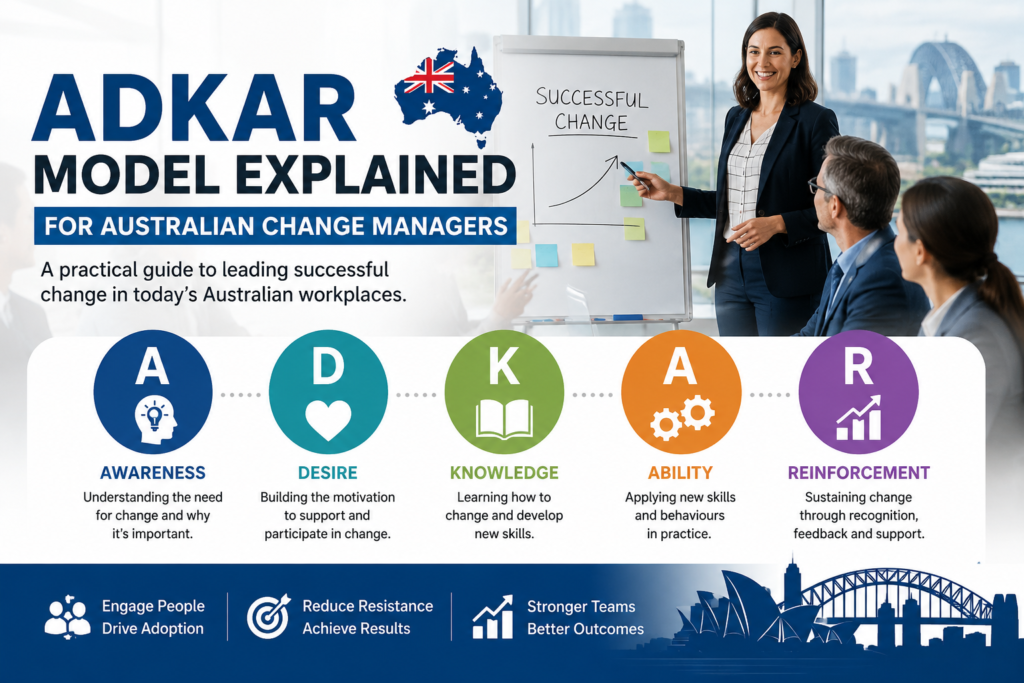
The ADKAR model Australian change managers reach for when a project’s technical plan is solid but people simply aren’t adopting the change. Unlike broader organizational models, ADKAR zooms in on the individual because a system go-live, restructure, or new policy only succeeds once enough people actually change how they work, day to day.
This guide walks through what the ADKAR model actually is, breaks down each of its five stages with workplace-relevant examples, and shows how Australian change managers are applying it in 2026 including where it fits alongside other change frameworks and how to get certified in it locally.
What Is the ADKAR Model Australian Change Managers?
ADKAR was developed by Jeff Hiatt, founder of the change management research firm Prosci, after studying change patterns across more than 700 organisations. The model’s core insight is simple: organisations don’t change individuals do. A project can have a flawless technical rollout plan and still fail if the people affected by it never move through the personal stages required to adopt it.
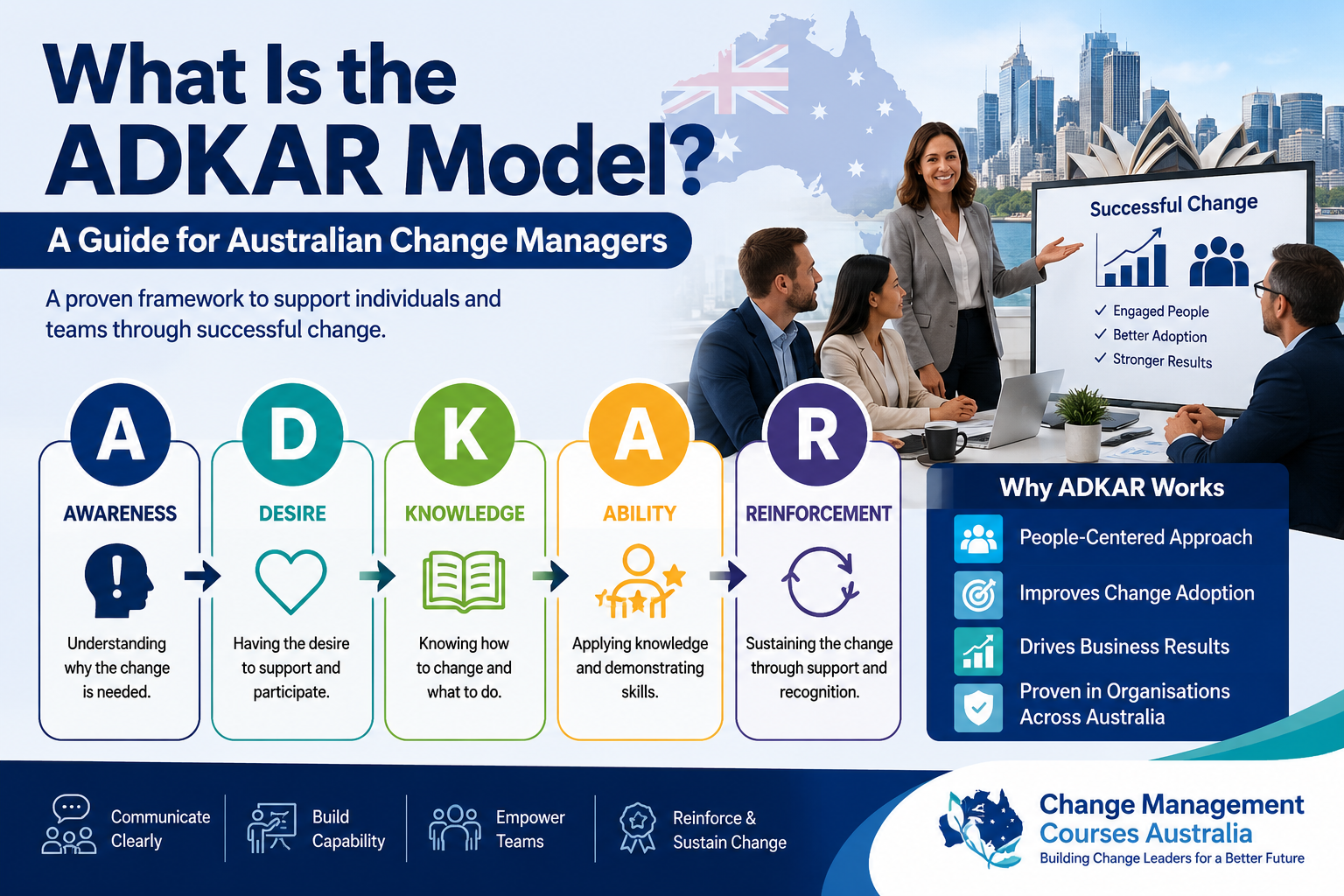
ADKAR is an acronym for the five sequential milestones an individual must pass through for change to stick:
- Awareness of the need for change
- Desire to participate and support the change
- Knowledge of how to change
- Ability to implement new skills and behaviours
- Reinforcement to make the change stick
Because the stages are sequential, you can’t skip ahead. Training someone before they understand why the change matters (Knowledge before Desire) is one of the most common reasons change initiatives stall — and it’s a mistake ADKAR is specifically designed to catch.
The 5 Stages of the ADKAR Model Australian Change Managers Explained
1. Awareness — Why is this change happening?
Awareness is the starting point: does the person understand the business reason for the change and the risk of not changing. In an Australian workplace context, this might mean explaining why a new CRM is replacing a legacy system, or why a restructure is happening ahead of a merger.
Common Awareness-building tactics include town halls, leadership briefings, FAQs, and direct manager conversations. If Awareness is low, no amount of training later on will fix adoption — people need the “why” before the “how.”
2. Desire — Do they want to be part of it?
Desire is the most personal and hardest-to-influence stage, because it depends on individual motivation, past experience with change, and what’s in it for them (or what they’re worried about losing). This is where resistance typically surfaces first.
Change managers build Desire through addressing “what’s in it for me,” involving employees early, and having visible sponsorship from leaders employees trust — not just a memo from head office.
3. Knowledge — Do they know how to change?
Once someone is aware of the change and wants to support it, they need to know how. This is the training and information stage — new processes, new systems, new reporting lines, new expectations.
Knowledge-building typically includes formal training sessions, user guides, one-on-one coaching, and access to subject matter experts. Skipping straight to this stage without building Awareness and Desire first is the single most common ADKAR mistake in Australian workplaces.
4. Ability — Can they actually do it?
Knowing how to do something in theory is different from being able to do it under real workplace conditions, with real deadlines and real customers. Ability is demonstrated performance not just completed training.
This stage often reveals gaps that Knowledge-stage training missed: system access issues, workload conflicts, or a skill gap that needs hands-on coaching rather than another slide deck. Change managers track Ability through practical observation, not attendance records.
5. Reinforcement — Will it stick?
The final stage prevents people from reverting to old habits once the initial rollout excitement fades. Reinforcement includes recognition, feedback loops, performance metrics tied to the new way of working, and addressing backsliding quickly rather than letting it become the new normal.
Reinforcement is where many Australian change initiatives quietly fail the project team disbands, the go-live is declared a success, and six months later staff have drifted back to their old workarounds.
Why Australian Change Managers Use ADKAR in 2026
ADKAR remains one of the most widely used change frameworks in Australian workplaces for a few practical reasons:
- It’s diagnostic, not just descriptive — a change manager can assess exactly which stage an individual or team is stuck at, rather than applying a generic communication plan to everyone.
- It scales from individuals to teams — the same five stages apply whether you’re managing one resistant stakeholder or an entire department through a system migration.
- It pairs well with AI-driven adoption tracking — in 2026, more Australian organisations are using digital adoption platforms and sentiment tools to measure Awareness and Desire in near real time, rather than relying on end-of-project surveys.
- It’s Prosci-certified and widely recognised — ADKAR training and certification are recognised by employers across government, banking, healthcare, and mining — three sectors where structured change management is now close to mandatory for major projects.
ADKAR vs Kotter vs Lewin: Which Model Should You Use?
Australian change managers rarely rely on a single framework in isolation. Here’s how ADKAR compares to the two other models most commonly taught alongside it:
| Model | Focus | Best Used For |
| ADKAR | Individual-level adoption | Diagnosing why specific people or teams are resisting change |
| Kotter’s 8-Step Model | Organisation-wide, leadership-driven | Large-scale cultural transformation with strong executive sponsorship |
| Lewin’s 3-Stage Model (Unfreeze–Change–Refreeze) | High-level conceptual structure | Simple, smaller-scale changes needing a clear before/after narrative |
Many Australian change practitioners use Kotter or Lewin to structure the overall program, then apply ADKAR at the individual and team level to manage adoption — the two layers complement rather than compete with each other.
How to Apply the ADKAR Model in an Australian Workplace
- Assess the current state — run an ADKAR readiness assessment to identify where key stakeholders and teams currently sit across the five stages.
- Identify the lowest-scoring stage — because the stages are sequential, fix the earliest barrier first rather than jumping to training or go-live activities.
- Design targeted interventions — build specific Awareness, Desire, Knowledge, Ability, or Reinforcement activities matched to the gap, rather than a one-size-fits-all communication plan.
- Involve line managers directly — in most Australian organisations, employees trust their direct manager’s view of a change far more than an email from a project team.
- Reassess and reinforce — repeat ADKAR assessments at key milestones, and don’t declare success until Reinforcement is genuinely embedded, not just scheduled.
ADKAR Certification Pathways in Australia
ADKAR is taught as part of Prosci’s certification program, but most Australian change professionals build their broader change management credentials through structured Foundation and Practitioner-level courses that cover ADKAR alongside Kotter, Lewin, stakeholder management, and resistance handling.
If you’re building a change management career in Australia, Change Management Courses Australia runs both a Change Management Foundation course and an APMG-aligned Change Management Practitioner course across Melbourne, Sydney, Brisbane, Adelaide, Perth, and Canberra, with live online options for the rest of Australia both covering ADKAR as part of a broader, job-ready toolkit rather than in isolation.
Common Mistakes When Using the ADKAR Model
- Starting with training instead of Awareness — rolling out Knowledge-stage activities before people understand or want the change is the most frequent cause of failed adoption.
- Treating ADKAR as a one-off assessment — readiness shifts throughout a project; a single early-stage survey doesn’t capture where people actually are by go-live.
- Skipping Reinforcement — declaring victory at go-live and disbanding the change team before new behaviours are actually locked in.
- Applying it only at the individual level — ADKAR works best when aggregated across teams to spot patterns, not just used stakeholder-by-stakeholder with no broader view.
Frequently Asked Questions
What does ADKAR stand for in change management?
ADKAR stands for Awareness, Desire, Knowledge, Ability, and Reinforcement the five sequential stages an individual moves through to successfully adopt change.
Who created the ADKAR model?
The ADKAR model was created by Jeff Hiatt, founder of Prosci, after researching change patterns across more than 700 organisations.
Is the ADKAR model still relevant in 2026?
Yes. It remains one of the most widely taught and applied individual-change frameworks in Australia, and is increasingly paired with digital adoption tracking and AI-driven sentiment tools.
How is ADKAR different from Kotter’s model?
ADKAR focuses on individual-level adoption and is diagnostic in nature, while Kotter’s 8-Step Model is organisation-wide and leadership-driven, better suited to large cultural transformations.
Do Australian employers value ADKAR certification?
Yes, particularly in government, banking, healthcare, and mining, where structured change management is increasingly expected for major transformation projects.
Final Thoughts
The ADKAR model gives Australian change managers something most other frameworks don’t, a way to diagnose exactly why an individual or team isn’t adopting change, rather than guessing. Used properly assessed regularly, applied sequentially, and reinforced well past go-live it remains one of the most practical tools available for turning a technically sound project into one that people actually adopt.