

Microsoft Copilot adoption change management is quickly becoming one of the most searched challenges for Australian IT and business leaders in 2026. Rolling out Microsoft 365 Copilot is a technology deployment, but the real success factor is how well an organisation manages the human side of change. Licensing Copilot for every desk is the easy part getting staff to trust it, use it correctly, and change how they work is the hard part.
This guide breaks down a practical, step-by-step change management strategy for Microsoft Copilot rollouts, drawing on the ADKAR model and Prosci methodology that Australian change managers already use for ERP, cloud, and platform migrations.
Why Most Microsoft Copilot Rollouts Struggle
Industry adoption data consistently shows that organisations rolling out generative AI tools without a structured change plan see low daily usage rates within the first 90 days. The most common failure points are:
- No clear business case communicated to end users staff don’t know why Copilot was purchased
- Training focused on features, not on real workflows (emails, meetings, reports, spreadsheets)
- No nominated champions or super-users within teams
- Leadership uses Copilot inconsistently, sending mixed signals
- Data governance and prompt-security concerns left unaddressed, creating hesitancy
- No adoption metrics tracked, so problems are invisible until license renewal
These are the same root causes seen in any technology rollout the difference is that Copilot changes daily habits (how people write, summarise, and analyse), which requires deeper behavioural change than a typical software upgrade. This is precisely why a formal change management course or Prosci-aligned framework is now considered essential IT project governance, not an optional extra.
Copilot Adoption Change Management Framework: ADKAR Applied
The ADKAR model (Awareness, Desire, Knowledge, Ability, Reinforcement) maps cleanly onto a Copilot rollout. Here is how each stage applies:
| ADKAR Stage | Copilot Rollout Activity |
| Awareness | Town halls and email comms explaining why Copilot is being introduced and what problem it solves |
| Desire | Department-specific demos showing time saved on real tasks (meeting notes, email drafting, Excel analysis) |
| Knowledge | Role-based training: Copilot in Word/Excel for finance, Copilot in Teams for project managers, Copilot in Outlook for client-facing staff |
| Ability | Hands-on practice sessions, sandbox environments, and peer coaching from super-users |
| Reinforcement | Usage dashboards, recognition of power users, monthly tips, and manager check-ins on adoption |
Copilot Change Management Timeline (12-Week Rollout)
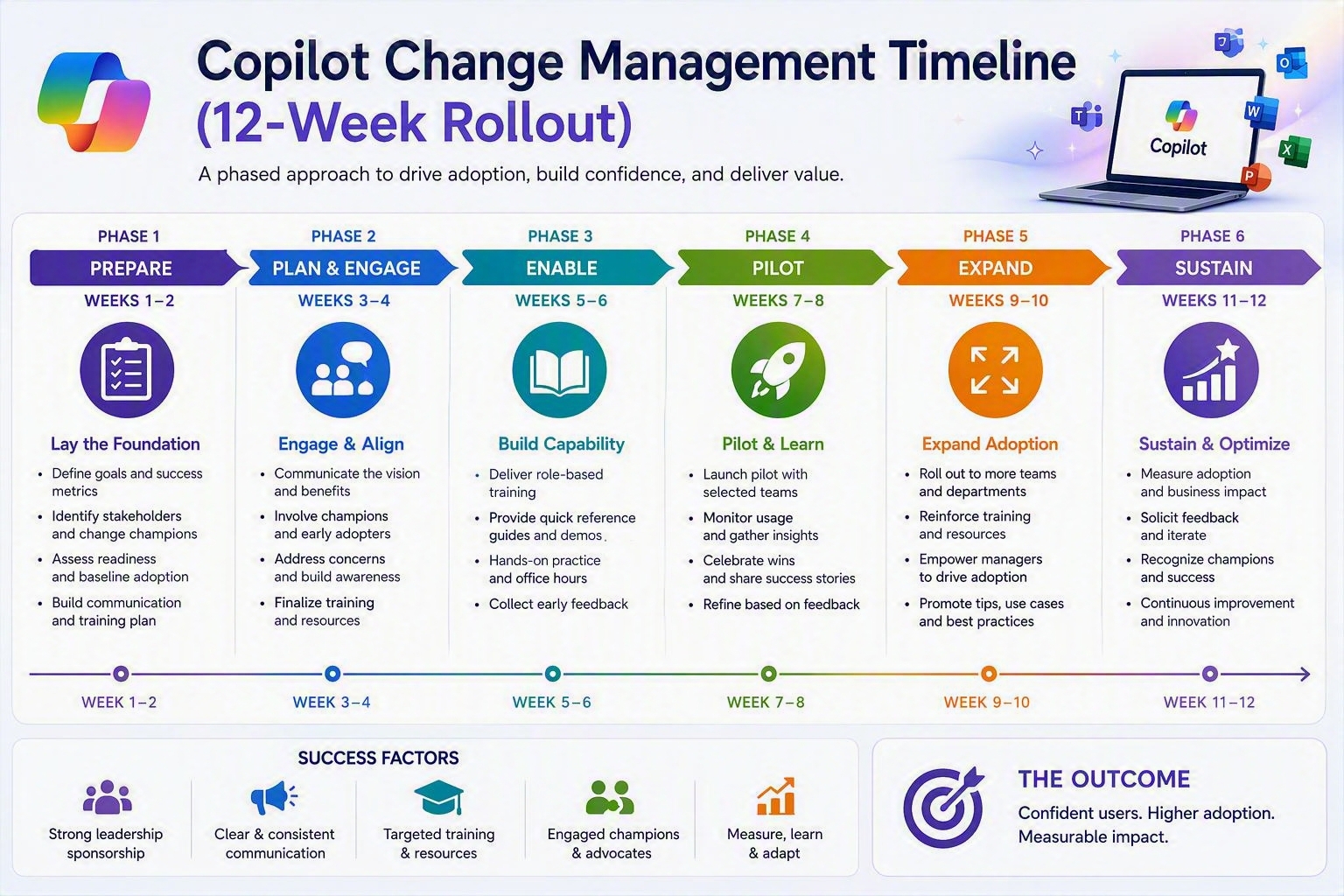
| Phase | Weeks | Key Activities |
| Prepare | 1–2 | Stakeholder mapping, readiness assessment, licensing plan, governance and data security review |
| Pilot | 3–5 | Small pilot group (20–50 users) across 2–3 departments, feedback loops, early champion identification |
| Rollout | 6–9 | Phased deployment by department, role-based training, communications cadence, help-desk support |
| Reinforce | 10–12 | Usage reporting, targeted coaching for low-adoption teams, success stories shared org-wide |
Building a Copilot Change Management Plan: Key Stakeholders
A successful Microsoft Copilot adoption change management plan needs sponsorship and structure across four groups:
- Executive Sponsor: sets the vision and models Copilot use publicly
- Change Manager / Project Lead: owns the ADKAR plan, comms calendar, and training schedule
- Department Champions: trusted peers who demonstrate Copilot in real team workflows
- IT & Security Team: manages licensing, data permissions, and Copilot governance policy
Organisations without an internal change resource are increasingly upskilling a project manager or HR business partner through a PROSCI-aligned change management certification specifically to lead AI tooling rollouts like Copilot, Power BI Copilot, and Dynamics 365 Copilot together.
Measuring Microsoft Copilot Adoption Success
Adoption should be tracked with the same rigour as any change initiative. Recommended metrics include:
- Weekly/monthly active Copilot users vs total licensed seats
- Feature usage split (Copilot in Word, Excel, Teams, Outlook, PowerPoint)
- Time-saved estimates gathered via pulse surveys
- Help-desk tickets related to Copilot (should trend down after week 8)
- Manager-reported confidence scores by department
Microsoft’s own Copilot usage reporting in the Microsoft 365 admin center provides the raw usage data; the change management layer is what turns that data into targeted coaching interventions.
Microsoft Copilot Rollouts Across Australian Cities
Demand for structured Copilot adoption support is rising across every major Australian business hub, with change management skills increasingly requested alongside Microsoft 365 admin roles:
| City | Copilot Adoption Demand Driver |
| Sydney | Financial services and professional services firms leading enterprise Copilot licensing |
| Melbourne | Large government and higher-education Microsoft 365 tenants piloting Copilot |
| Brisbane | Resources and construction sector back-office teams adopting Copilot for reporting |
| Perth | Mining and energy corporate teams rolling out Copilot in Excel and Teams |
| Adelaide | Defence and public sector agencies trialling Copilot under strict governance reviews |
| Canberra | Federal government departments running structured, compliance-led Copilot pilots |
Where Change Managers Fit Into a Copilot Rollout
Microsoft Copilot adoption change management is now a standing agenda item in enterprise PMOs, and it draws directly on the same skill set taught in Foundation and Practitioner-level change management courses. If your team has already compared Change Management Foundation vs Practitioner training, a Copilot rollout is a strong first live project to apply that certification to.
For organisations running Copilot alongside a broader ERP or platform change such as SAP, Oracle, or Dynamics 365 the same governance model applies. See our related guide on change management for ERP implementations for how AI copilots now sit inside those bigger transformation programs.
Logitrain delivers Prosci-aligned and APMG change management training across Australia, giving project managers, business analysts, and HR leads the structured framework to run Copilot and other AI rollouts with measurable adoption outcomes. Explore full IT and change management course catalogue for upcoming Australian dates.
Frequently Asked Questions
How long does a Microsoft Copilot rollout take with proper change management?
Most mid-sized Australian organisations run a 12-week phased rollout: 2 weeks preparation, 3 weeks pilot, 4 weeks phased deployment, and 3 weeks reinforcement. Larger enterprises with multiple business units often extend this to 6 months.
What is the biggest risk in Microsoft Copilot adoption?
Low sustained usage after the initial launch. Without reinforcement activities (coaching, recognition, refresher training), usage typically drops within 60 days of go-live, which is why the ADKAR reinforcement stage is critical.
Do you need a certified change manager to roll out Copilot?
It is not mandatory, but organisations using a Prosci or APMG-certified change manager report materially higher adoption rates, since these frameworks were built for exactly this kind of behavioural, tool-driven change.
Conclusion
Microsoft Copilot adoption change management is the difference between a tool that sits unused and one that measurably improves productivity across an organisation. A structured ADKAR-based rollout with clear sponsorship, role-based training, champions, and reinforcement gives Australian businesses the best chance of turning Copilot licences into real, sustained usage.
Ready to build this capability in-house? Explore Logitrain Change Management courses or view current dates on logitrain.com.au.