
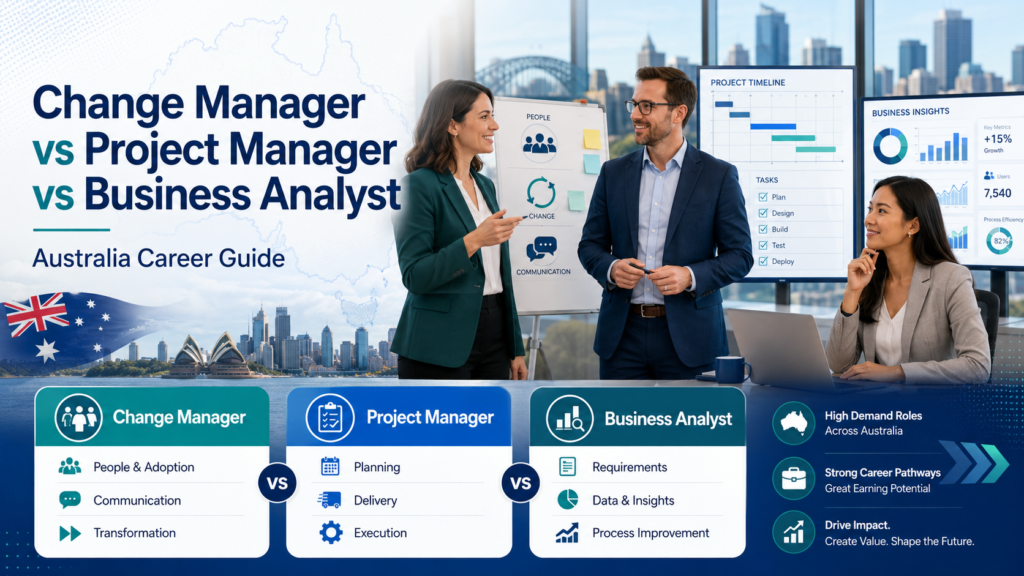
Change Manager vs Project Manager vs Business Analyst Australia, because these three roles constantly work side by side on the same projects especially in digital transformation, system implementation, process improvement, government, finance, technology and organisational change programs. All three are consistently identified as in-demand roles in Australia’s projects, strategy and change market, yet the job titles get confused more often than you’d expect.
In short:
- A Project Manager delivers the project.
- A Business Analyst defines what needs to change.
- A Change Manager helps people adopt the change.
Quick Comparison: Change Manager vs Project Manager vs Business Analyst
- Project Manager = manages delivery, timeline, budget, scope and risks.
- Business Analyst = gathers requirements, analyses processes and defines business needs.
- Change Manager = prepares people, teams and stakeholders to adopt the change.
| Role | Main Focus | Key Question | Main Outcome |
|---|---|---|---|
| Change Manager | People, adoption and behavioural change | Will people adopt the change successfully? | Adoption, readiness and sustained change |
| Project Manager | Delivery, scope, schedule and budget | Will the project be delivered on time and within budget? | Completed project deliverables |
| Business Analyst | Requirements, processes and business needs | What does the business need and why? | Clear requirements and improved processes |
What Does a Change Manager Do?
A Change Manager focuses on the people side of change. Their job is to help individuals, teams and organisations move from the current way of working to the future state.
The Change Management Institute originated and was incorporated in Australia in 2005 and supports change professionals through capability development, accreditation, professional development and thought leadership.
Typical responsibilities:
- Conducting change impact assessments
- Creating change management strategies
- Developing communication plans
- Planning training and support
- Managing stakeholder engagement
- Assessing change readiness
- Identifying resistance to change
- Supporting adoption after implementation
- Measuring benefits and adoption
Best fit for:
- People who enjoy communication
- People who understand human behaviour
- People who like stakeholder engagement
- People who enjoy training and adoption work
- People who want to support business transformation
What Does a Project Manager Do?
A Project Manager is responsible for planning, coordinating and delivering a project. The role focuses on scope, schedule, budget, risks, resources, governance and delivery outcomes.
AIPM describes itself as Australia’s national peak body for the project profession, supporting project leadership, performance, certification and professional growth. AIPM’s Certified Practising Project Manager certification is aimed at project managers who plan projects, manage teams and implement projects, including initiation, planning, execution, monitoring, controlling and finalisation.
Typical responsibilities:
- Creating project plans
- Managing project scope
- Building schedules and timelines
- Managing budgets and resources
- Tracking risks and issues
- Reporting to sponsors and steering committees
- Coordinating delivery teams
- Managing vendors and dependencies
- Ensuring project deliverables are completed
Best fit for:
- People who enjoy planning
- People who are organised and outcome-focused
- People who can manage competing priorities
- People who are comfortable with budgets and deadlines
- People who like leading delivery teams
What Does a Business Analyst Do?
A Business Analyst identifies business needs, analyses problems, gathers requirements and helps define solutions. They often act as the bridge between business stakeholders and technical or delivery teams.
IIBA describes the BABOK Guide as the globally recognised standard for business analysis, covering the skills, deliverables and techniques business analysis professionals use to achieve better business outcomes. IIBA also highlights stakeholder engagement, elicitation and collaboration as important areas for Business Analysts.
Typical responsibilities:
- Gathering requirements
- Facilitating workshops
- Documenting business needs
- Mapping current-state and future-state processes
- Writing user stories and acceptance criteria
- Conducting gap analysis
- Supporting solution design
- Helping with testing and UAT
- Communicating requirements to delivery teams
Best fit for:
- People who enjoy problem-solving
- People who like asking questions
- People who can translate business needs into clear requirements
- People who enjoy process improvement
- People who like working between business and technology teams
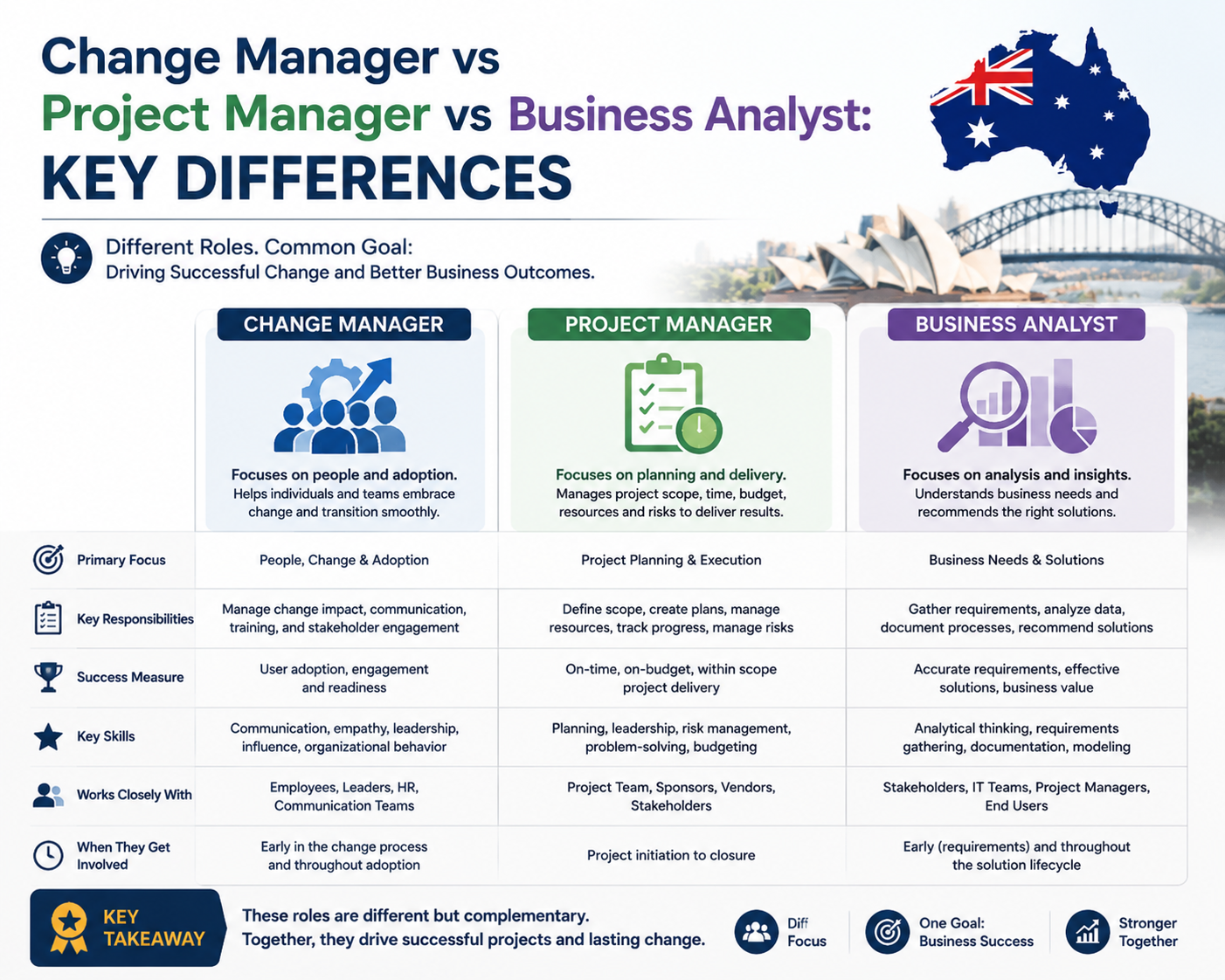
Change Manager vs Project Manager vs Business Analyst: Key Differences
Difference in Main Focus
- Change Manager: focuses on people and adoption.
- Project Manager: focuses on delivery and control.
- Business Analyst: focuses on requirements and business needs.
Difference in Daily Work
- Change Manager: stakeholder engagement, communications, training and readiness.
- Project Manager: planning, reporting, risk management and delivery coordination.
- Business Analyst: requirements workshops, documentation, process mapping and analysis.
Difference in Success Measures
- Change Manager: adoption, engagement, readiness and benefits realisation.
- Project Manager: time, cost, scope, quality and delivery.
- Business Analyst: clear requirements, improved processes and solution fit.
Difference in Stakeholder Interaction
All three roles work with stakeholders, but in different ways:
- Change Manager: manages stakeholder buy-in and adoption.
- Project Manager: manages stakeholder expectations around delivery.
- Business Analyst: elicits stakeholder needs and requirements.
How These Three Roles Work Together on a Project
On a system implementation or transformation project:
- The Business Analyst discovers what the business needs.
- The Project Manager plans and manages how the work will be delivered.
- The Change Manager prepares people to use the new process, system or way of working.
Example New CRM Implementation:
- Business Analyst: gathers CRM requirements from sales, service and operations teams.
- Project Manager: manages timeline, vendor delivery, budget, testing and go-live.
- Change Manager: prepares communication, training, readiness checks and adoption support.
Skills Needed for Each Role
Change Manager Skills
- Stakeholder engagement
- Communication planning
- Change impact assessment
- Training needs analysis
- Resistance management
- Change readiness assessment
- Benefits realisation
- Facilitation
- Emotional intelligence
Project Manager Skills
- Project planning
- Scheduling
- Budget management
- Risk and issue management
- Resource management
- Governance
- Vendor management
- Reporting
- Leadership
Business Analyst Skills
- Requirements gathering
- Process mapping
- Gap analysis
- User stories
- Acceptance criteria
- Workshop facilitation
- Data analysis
- Stakeholder management
- Documentation
Tools Used by Change Managers, Project Managers and Business Analysts
Change Manager Tools
- Change impact assessment templates
- Stakeholder maps
- Communication plans
- Training plans
- Readiness surveys
- ADKAR assessments
- PowerPoint
- Excel
- Miro
- SharePoint
Project Manager Tools
- Microsoft Project
- Jira
- Asana
- Monday.com
- Smartsheet
- Excel
- Power BI
- Risk registers
- Project dashboards
- Status reports
Business Analyst Tools
- Jira
- Confluence
- Microsoft Visio
- Lucidchart
- Miro
- Excel
- PowerPoint
- Process maps
- User story templates
- Requirements traceability matrix
Salary Comparison in Australia
Salaries vary depending on experience, location, industry, contract type, project complexity and whether the role is permanent or contract.
Hudson’s 2026 Projects & Transformation Salary Guide lists Australian salary ranges including Business Analyst roles from $115,000 to $140,000, Project Manager roles from $130,000 to $160,000, and Change Manager roles from $140,000 to $170,000, excluding superannuation, bonuses and additional benefits. The same guide lists senior roles at higher ranges across all three professions.
Business Analyst Salary Australia
- Business Analyst: approximately $115,000 – $140,000
- Senior Business Analyst: approximately $140,000 – $180,000
Source: Hudson 2026 Projects & Transformation Salary Guide.
Project Manager Salary Australia
- Project Manager: approximately $130,000 – $160,000
- Senior Project Manager: approximately $160,000 – $190,000
Source: Hudson 2026 Projects & Transformation Salary Guide.
Change Manager Salary Australia
- Change Manager: approximately $140,000 – $170,000
- Senior Change Manager: approximately $165,000 – $190,000
Source: Hudson 2026 Projects & Transformation Salary Guide.
Which Role Is Best for Career Changers in Australia?
Choose Business Analyst If…
- You enjoy solving business problems.
- You like working with requirements and processes.
- You are comfortable asking questions.
- You want to work between business and technology.
Choose Project Manager If…
- You enjoy planning and organising work.
- You can manage deadlines, budgets and risks.
- You like leading teams and coordinating delivery.
- You are comfortable with accountability.
Choose Change Manager If…
- You enjoy helping people through change.
- You are strong at communication and stakeholder engagement.
- You understand resistance and adoption challenges.
- You like training, readiness and business transformation.
Which Role Is More Technical?
Suggested ranking: most people-focused Change Manager. Most delivery-focused — Project Manager. Most analysis-focused Business Analyst.
Business Analyst: can become technical if working on systems, data or software projects. Project Manager: needs technical awareness but not always hands-on technical skills. Change Manager: usually less technical but needs strong business, people and communication skills.
Best Certifications for Each Career Path
Change Manager Certifications
- Change Management Institute Accreditation
- Prosci Change Management Certification
- APMG Change Management Foundation and Practitioner
- Graduate Certificate in Change Management
The Change Management Institute offers accreditation and professional development pathways for change management professionals.
Project Manager Certifications
- AIPM RegPM
- CPPM
- PMP
- PRINCE2 Foundation and Practitioner
- AgilePM
- Scrum Master
AIPM offers certification pathways for Australian project professionals, including CPPM for project managers directly accountable for managing projects.
Business Analyst Certifications
- ECBA
- CCBA
- CBAP
- Agile Business Analyst
- IIBA Certifications
IIBA’s BABOK Guide is globally recognised as a standard for business analysis practice and supports the skills, deliverables and techniques used by business analysis professionals.
Career Path Options in Australia
Change Manager Career Path
- Change Analyst
- Change Coordinator
- Change Manager
- Senior Change Manager
- Change Lead
- Head of Change
- Transformation Lead
Project Manager Career Path
- Project Coordinator
- Junior Project Manager
- Project Manager
- Senior Project Manager
- Program Manager
- Portfolio Manager
- Project Director
Business Analyst Career Path
- Junior Business Analyst
- Business Analyst
- Senior Business Analyst
- Lead Business Analyst
- Product Owner
- Business Architect
- Enterprise Business Analyst
Common Mistakes When Comparing These Roles
- Thinking a Project Manager and Business Analyst do the same job
- Assuming Change Management is only communications
- Thinking Business Analysts only write documents
- Assuming Project Managers do all stakeholder engagement
- Ignoring the people side of transformation
- Choosing a role based only on salary
- Not considering your strengths and personality
- Not learning Agile, stakeholder management and communication skills
Final Verdict: Which Career Should You Choose?
Choose Business Analyst if you enjoy understanding business problems, gathering requirements and improving processes.
Choose Project Manager if you enjoy planning, coordination, delivery, budgets, timelines and accountability.
Choose Change Manager if you enjoy helping people adopt new systems, processes and ways of working.
In Australia, all three roles are valuable across transformation, technology, government, banking, healthcare, consulting and operations, whether you’re based in Sydney, Melbourne, Brisbane, Perth or Canberra. The best choice in the Change Manager vs Project Manager vs Business Analyst comparison depends on whether you prefer analysis, delivery or people-focused change.
FAQs About Change Manager vs Project Manager vs Business Analyst in Australia
Is a Change Manager the same as a Project Manager?
No. A Project Manager focuses on delivering the project, while a Change Manager focuses on helping people adopt the change.
Is a Business Analyst the same as a Project Manager?
No. A Business Analyst defines business needs and requirements, while a Project Manager manages delivery, scope, budget and timelines.
Can a Business Analyst become a Project Manager?
Yes. Many Business Analysts move into Project Manager roles after gaining delivery, stakeholder and project coordination experience.
Can a Project Manager become a Change Manager?
Yes. Project Managers with strong stakeholder engagement, communications and transformation experience can move into change management.
Which role pays more in Australia?
Salary depends on experience and industry, but Hudson’s 2026 salary guide shows Change Manager and Project Manager roles often sitting slightly higher than standard Business Analyst roles, with senior roles across all three paying strongly.
Which role is best for beginners?
Business Analyst or Change Analyst roles can be good entry points for career changers. Project Coordinator roles can also lead into Project Manager positions.
Call to Action
Not sure which career path is right for you?
If you enjoy people and adoption, explore Change Management. If you enjoy delivery and planning, choose Project Management. If you enjoy requirements and problem-solving, start with Business Analysis.