
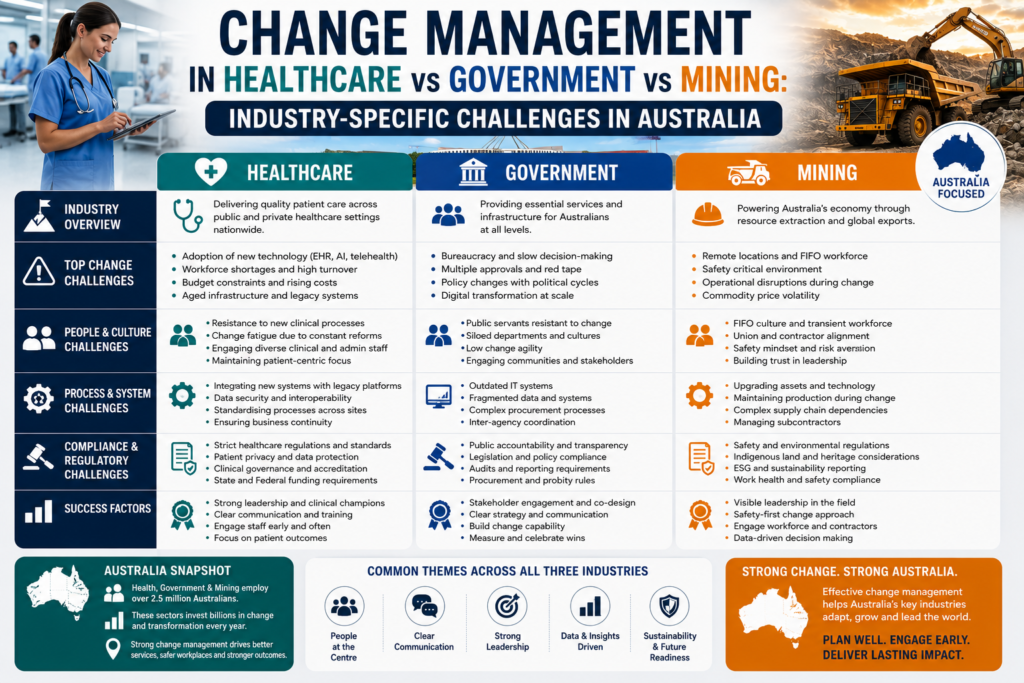
Change Management in Healthcare vs Government vs Mining looks like one skill set on a resume, but anyone who has actually run a change project in all three sectors will tell you they’re barely the same job. A change manager who thrives rolling out a new rostering system in a Melbourne hospital can genuinely struggle leading a policy change through a federal department, and vice versa. The frameworks are similar; the politics, pace and risk tolerance are not.
We broke down how change management actually plays out across Australia’s three toughest sectors for it healthcare, government and mining so you know what you’re walking into before you take the role.
Why the Industry Context Changes Everything
Prosci and PMI-style change frameworks (ADKAR, Kotter’s 8-Step) are taught as universal, and technically they are but how they’re applied shifts dramatically once patient safety, ministerial accountability or FIFO rosters enter the picture. Understanding the sector you’re walking into matters as much as knowing the framework itself.
Healthcare: Change Management Under Clinical Risk
- Every change touches patient safety, so risk-aversion is structurally higher than in most industries.
- Clinical staff (nurses, doctors) often have more organisational influence than management hierarchy suggests buy-in from clinical leads is non-negotiable.
- Change windows are tight: hospitals in Sydney and Brisbane can’t pause operations, so rollouts happen in phased, after-hours or ward-by-ward cycles.
- Regulatory bodies add layers most other sectors don’t have to navigate.
Government: Change Management Under Political and Process Constraints
- Change in Canberra and state departments moves through layers of governance, approval chains and ministerial sign-off that private sector change managers rarely encounter.
- Public accountability means documentation and audit trails matter as much as the change outcome itself.
- Machinery-of-government changes (restructures, portfolio shifts) can reset a change project’s sponsor and priorities overnight.
- Union engagement and enterprise bargaining agreements shape what change is even possible.
Mining: Change Management Under Operational and Safety Pressure
- FIFO rosters in Perth and Adelaide-based operations mean change communication has to reach dispersed, rotating shifts not a static office team.
- Safety-critical culture means any process change gets tested against zero-harm standards before rollout.
- Remote site connectivity limits digital change-management tools that work fine in metro offices.
- Strong operational unions and site-based leadership mean change has to be negotiated at the site level, not just head office.
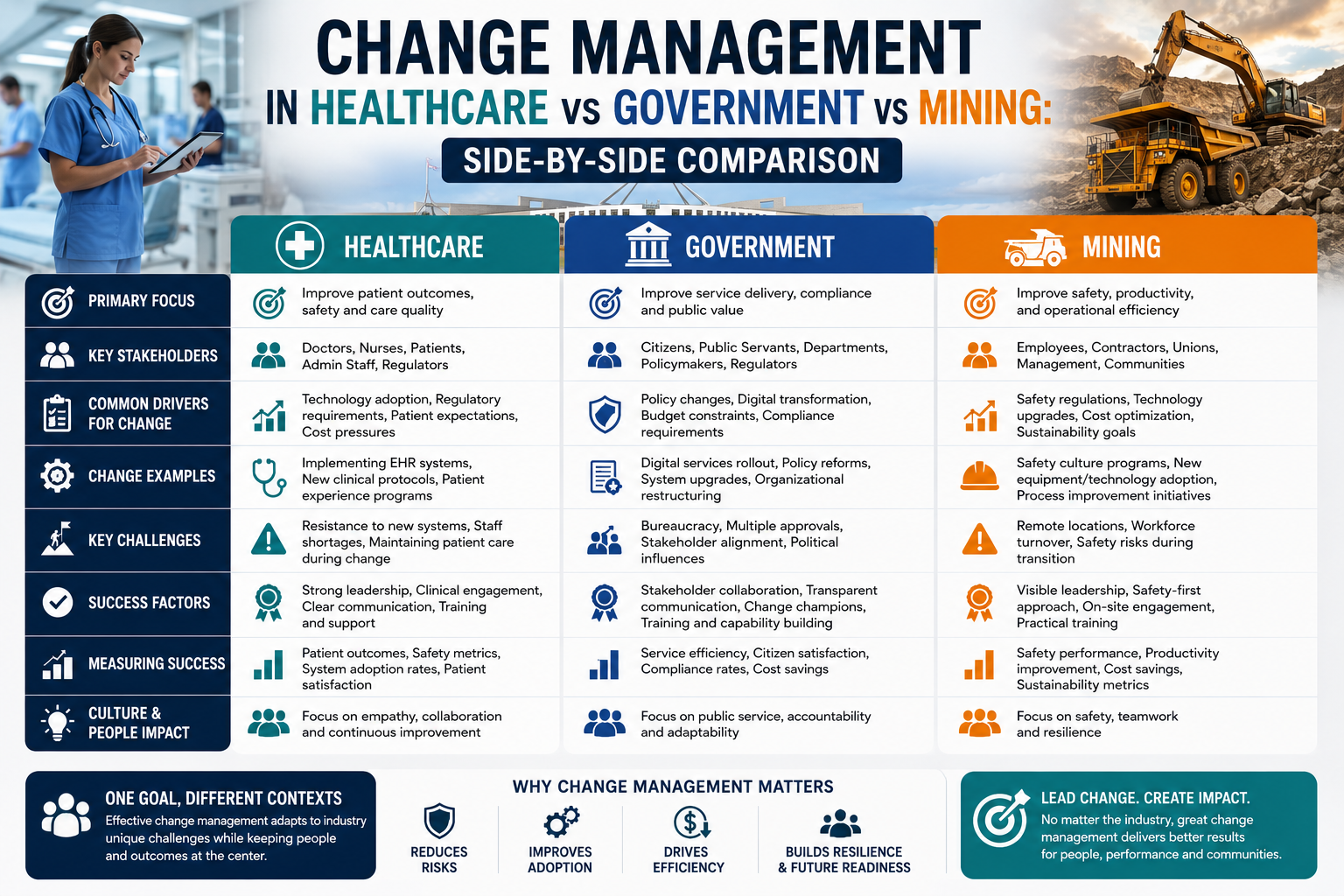
Change Management in Healthcare vs Government vs Mining: Side-by-Side
| Factor | Healthcare | Government | Mining |
| Primary risk | Patient safety | Political/reputational | Site safety/operational |
| Decision speed | Slow — clinical sign-off | Slow — governance layers | Moderate — site-by-site |
| Key stakeholders | Clinicians, patients, regulators | Ministers, unions, public | Site leaders, FIFO crews, unions |
| Communication challenge | Ward-by-ward, after-hours | Formal, audited, tiered | Remote, rostered, dispersed |
| Typical AU salary range | $95k–$130k (Change Lead) | $100k–$140k (APS 6/EL1 equiv.) | $110k–$150k (Site Change Manager) |
What the Data Says About Each Sector
The Change Management in Healthcare vs Government vs Mining comparison holds up against sector data too. AHPRA’s regulatory guidance outlines the compliance obligations that shape how clinical change gets approved and monitored in Australian healthcare settings, which explains the slower, safety-first pace change managers describe in hospitals.
On the government side, the Australian Public Service Commission’s guidance sets out the governance and capability frameworks public sector change work has to operate within, including the layered sign-off processes that slow down even well-supported initiatives.
For mining, Austrade’s resources and energy sector overview highlights how dispersed, remote operations shape the entire industry which is exactly why change rollouts have to be planned around FIFO rosters rather than a single head-office timeline. Broader methodology-level detail on standard change frameworks is available via PMI’s change management resources and Prosci’s ADKAR model overview, both of which underpin most Australian change management training regardless of sector.
Which Sector Should You Target for Your Change Management Career?
- Prefer structure, documentation and long-term stability? Government offers career progression with strong governance exposure.
- Want to make a visible difference and don’t mind slower, safety-first pacing? Healthcare change roles are deeply rewarding and in high demand.
- Comfortable with remote work, FIFO rosters and higher pay? Mining consistently pays at the top end of the three.
- New to change management? Government and healthcare tend to offer more structured entry points than mining, which often expects prior site experience.
Building Change Management Skills Employers in Any Sector Trust
Regardless of which sector you’re aiming for, a recognised change management qualification (Prosci ADKAR, APMG Change Management, or similar) signals you understand the framework the sector-specific nuance is then built through experience.
Frequently Asked Questions About Change Management Across Industries in Australia
Is change management harder in healthcare than in other industries?
It’s not necessarily harder, but it’s slower and higher-stakes, since every change has to be assessed against patient safety and clinical sign-off before it can roll out.
Why does government change management move so slowly?
Public sector change has to move through governance layers, ministerial accountability and audit requirements that don’t exist in the same form in the private sector, which naturally slows down implementation timelines.
Does mining pay more for change management roles than healthcare or government?
Generally yes. Site-based mining change roles in Australia tend to sit at the higher end of the salary range, largely reflecting remote work conditions and the operational risk involved.
Can change management skills transfer between healthcare, government and mining?
The core frameworks transfer well, but stakeholder management style, communication cadence and risk tolerance need to be relearned for each sector this is usually the biggest adjustment for change managers moving industries.
What qualification should I get to work in change management across sectors?
A recognised framework-based certification such as Prosci ADKAR or APMG Change Management is respected across healthcare, government and mining alike, since it demonstrates the underlying methodology rather than sector-specific knowledge.
Bottom line: Change Management in Healthcare vs Government vs Mining comes down to risk tolerance, pace and stakeholder complexity more than the underlying framework. Healthcare demands patience and clinical trust, government rewards governance discipline, and mining pays well for change managers comfortable with remote, safety-critical environments. The right sector depends on which trade-off suits your working style.