

AI in change management Australia has quietly become one of the hardest leadership problems of 2026 not because the technology is complicated, but because people are. Most Australian organisations have already rolled out some form of AI tool, yet a large share of employees still feel uncertain about what’s expected of them, whether their role is at risk, and whether leadership actually has a plan. That gap between AI adoption and AI readiness is exactly where change management earns its keep.
This guide walks through why AI adoption resistance happens, which change management models actually apply, and a practical roadmap Australian leaders can use to drive adoption without dragging their teams through it. If you’re looking for expert advice on managing organisational change and AI adoption, contact us on 1800 159 151 to discuss the right training and change management solutions for your team.
Why AI Adoption Is a Change Management Problem, Not Just a Technology Rollout
Recent Gartner research into the Australian workforce found that only around half of employees report having clear guidance, training or support for using AI at work, and even fewer say their organisation has explained how roles will actually change. Separate 2026 research from Microsoft found a similar pattern: most Australian AI users feel pressure to keep up with the technology, yet only a minority say their leadership is clearly and consistently aligned on AI strategy.
In other words, the technology is arriving faster than the leadership plan around it which is precisely the gap AI change management strategy is meant to close. You can read the full Gartner HR survey findings on Australian AI adoption for the underlying data.
Why Employees Resist AI in Australian Workplaces
Employee resistance to AI rarely comes from laziness or stubbornness it usually comes from unanswered questions. Will this replace my role? Will I look incompetent if I need extra training? Is the organisation actually going to support me through this, or just hand me a tool and move on? Research from the World Economic Forum on AI workplace readiness describes a spectrum of responses, from enthusiastic early adopters through to employees whose resistance is rooted in genuine fear of job loss or surveillance and notes that this resistance often shows up quietly, in informal pushback and workarounds, rather than open refusal.
This is why an AI readiness assessment matters before any rollout: understanding where your team actually sits on that spectrum enthusiastic, cautious, or genuinely opposed shapes everything else in your AI adoption strategy for leaders.
Change Management Models for AI Adoption: ADKAR vs Kotter
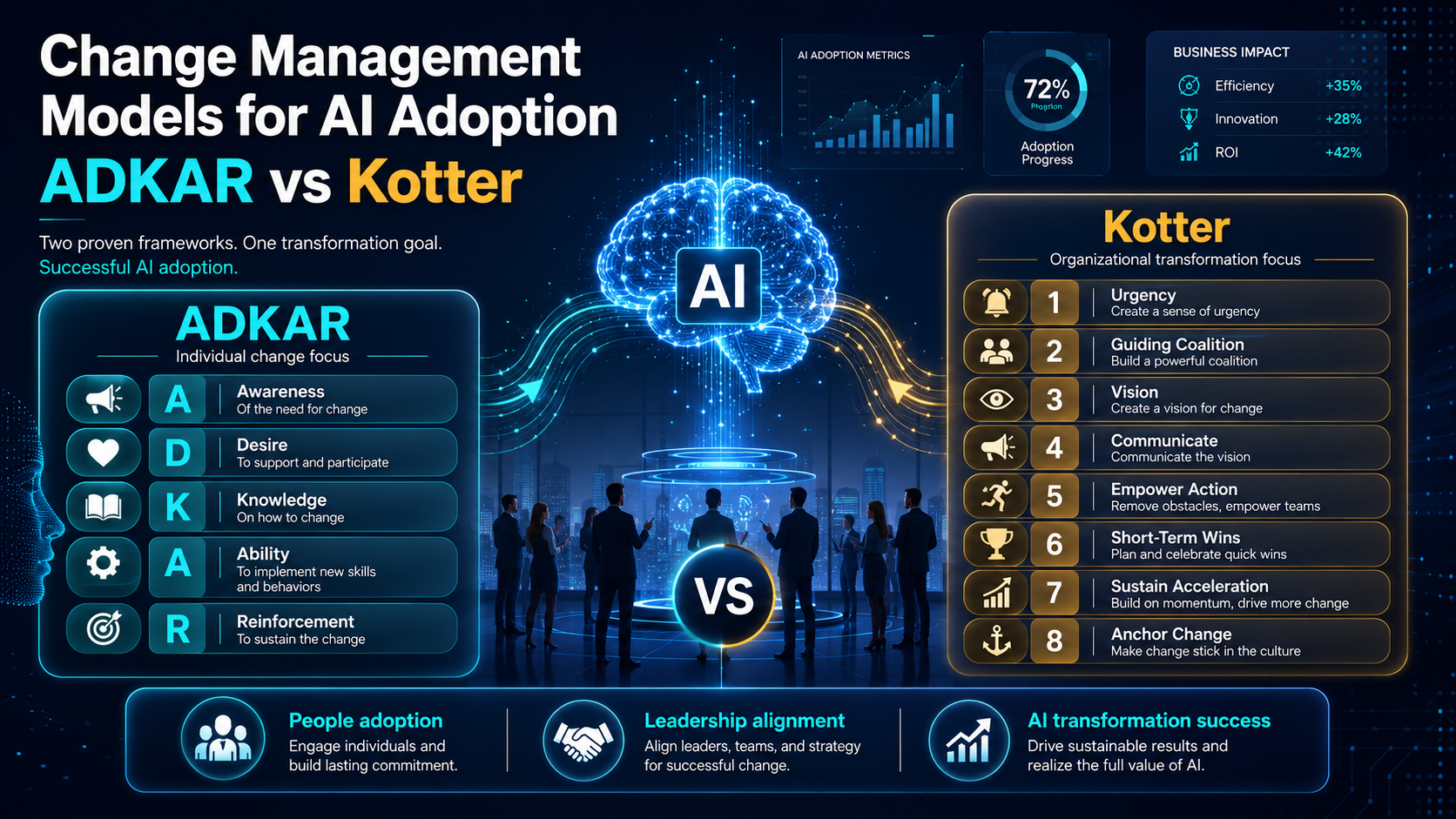
The ADKAR Model for AI Adoption
Prosci ADKAR AI adoption applies the same five building blocks Prosci has always used for individual change Awareness, Desire, Knowledge, Ability, Reinforcement to an AI rollout specifically. Awareness means employees understand why AI is being introduced; Desire means they want to engage with it rather than avoid it; Knowledge and Ability cover the actual training; and Reinforcement is what stops old habits creeping back in once the initial rollout excitement fades. You can review Prosci’s own explanation of the model on the official Prosci ADKAR page.
Kotter’s 8-Step Model for AI Transformation
Kotter model AI transformation works at the organisational level rather than the individual level building a sense of urgency, forming a coalition of sponsors, communicating the vision, and anchoring the change into culture so it doesn’t quietly reverse six months later. It’s a useful complement to ADKAR when AI adoption spans multiple teams or an entire organisation rather than a single department. Kotter’s own institute outlines the steps in detail on the Kotter Inc. 8-step process page.
ADKAR vs Kotter AI Change: Which Should Australian Leaders Use?
In practice, the two aren’t competitors. ADKAR vs Kotter AI change comes down to scale and focus: Kotter is strong for setting organisation-wide direction and sponsorship, while ADKAR is stronger for managing how each individual employee actually moves through the change. Many Australian change management courses now teach both together Kotter for the top-down strategy, ADKAR for the person-by-person execution.
A Practical AI Adoption Roadmap for Australian Leaders
- Step 1 — Run an AI readiness assessment. Understand where teams sit between enthusiasm and resistance before deciding on your rollout pace.
- Step 2 — Build visible sponsorship. Leaders need to be seen using and supporting the AI tools themselves, not just mandating them from a distance.
- Step 3 — Create an AI change communication plan. Address job security, expectations and support directly silence is what fuels AI job loss fear in the workplace.
- Step 4 — Train for confidence, not just competence. Employees need enough hands-on practice to feel safe experimenting, not just a single onboarding session.
- Step 5 — Pilot with willing teams first. Let early adopters become internal champions rather than forcing full-scale rollout on day one.
- Step 6 — Build feedback loops. Regularly ask what’s working and what isn’t, and visibly act on that feedback.
- Step 7 — Reinforce the change. Recognise and reward good AI use so it becomes the new normal rather than reverting once attention moves elsewhere.
Building an AI Change Communication Plan That Actually Reduces Resistance
The single biggest driver of successful AI adoption, according to the same Gartner research cited above, is employee confidence not training volume. A strong AI change communication plan explains, in plain language, what’s changing, what isn’t, and what support is available, repeated consistently rather than announced once and left to fade. Leaders who explain how roles will evolve instead of leaving that question open consistently see less of the quiet, backstage resistance that undermines AI rollouts.
AI Leadership Skills Australian Managers Need in 2026
AI transformation leadership skills go beyond understanding the tools themselves. The managers succeeding with AI adoption in Australian business right now tend to share a few traits: they can explain AI’s impact on a specific role without vague corporate language, they involve employees in shaping how AI gets used in their own team rather than dictating it top-down, and they treat resistance as information to respond to rather than a problem to push through. Change leadership for AI is, in the end, mostly still change leadership the AI is simply the trigger.
Where to Build These Skills: Change Management Training in Australia
At Change Management Courses Australia, training runs from foundational organisational change management Australia content through to a full change management certification Australia pathway, with dedicated modules on applying ADKAR and Kotter specifically to AI adoption.
- Change management course Australia — covering ADKAR, Kotter and practical AI adoption case studies for leaders at any level.
- Change management practitioner course Australia a deeper, certification-track option for people leading change management professionally.
- AI leadership training Australia — shorter, focused sessions specifically on leading AI transformation and reducing employee resistance.
- Change management training for managers Australia practical sessions for line managers who need to run day-to-day AI adoption conversations with their own teams.
Training is available for leaders based in Melbourne, Sydney, Brisbane and beyond, delivered both in person and as change management training Australia-wide online, so location doesn’t need to be a barrier to building these skills properly.
AI in Change Management Australia: Frequently Asked Questions
What is the biggest cause of employee resistance to AI adoption?
Uncertainty, more than opposition. Most employees aren’t against AI outright they’re unclear on how their role will change, whether their current skills will still be valued, and whether leadership has a real plan. Addressing that uncertainty directly, early and often, resolves far more resistance than mandating tool usage.
Should we use ADKAR or Kotter for our AI rollout?
Most Australian organisations get the best results combining both: Kotter’s model for setting direction and building organisational sponsorship, and ADKAR for managing how individual employees move through awareness, desire, knowledge, ability and reinforcement. Neither model alone covers both the organisational and individual layers of an AI change.
How long does an AI adoption change management plan typically take?
For a single team or department, a structured AI adoption roadmap readiness assessment through to reinforcement usually runs three to six months. Organisation-wide AI transformation, particularly where Kotter’s model is layered on top, more commonly takes twelve months or more to genuinely embed rather than just launch.
Can small businesses use the same AI change management approach as large organisations?
Yes, scaled down. National AI Centre research shows a meaningful share of Australian SMEs are still hesitant about AI adoption, often due to unclear guidance rather than opposition to the technology itself the same readiness assessment, communication and training principles apply, just with a lighter, faster-moving process suited to a smaller team.
Is a formal change management certification necessary to lead AI adoption?
Not strictly necessary, but genuinely useful. A change management certification Australia pathway gives leaders a structured framework (like ADKAR or Kotter) rather than improvising a rollout from instinct alone particularly valuable if AI adoption is one of several major changes happening at once.
What should an AI change communication plan actually include?
At minimum: why the change is happening, what specifically will change day-to-day, what won’t change, what training and support is available, and a clear channel for employees to ask questions or raise concerns. Repetition matters more than most leaders expect a single announcement rarely lands.
Does AI adoption really threaten jobs, or is that fear overstated?
The picture is mixed rather than one-directional. Some recent Australian research suggests organisations with more advanced AI adoption are increasing entry-level hiring rather than cutting it, while other surveys show real, ongoing employee anxiety about role security. Leaders who acknowledge that nuance honestly rather than dismissing the fear outright tend to build more trust than those who simply insist AI is purely additive.
Final Thoughts
AI in change management Australia isn’t a side conversation to the technology rollout it’s the difference between AI adoption that sticks and AI adoption that quietly stalls in the background while employees work around it. Start with an honest readiness assessment, borrow the right parts of ADKAR and Kotter, communicate consistently rather than once, and reinforce the change once it’s live. Leaders who treat this as a genuine change management discipline, not just an IT project, are the ones actually seeing AI adoption without resistance.